
AMPG and the AI Infrastructure Valuation Gap


AI investors have spent the last two years obsessing over GPUs. But Nvidia's acquisition of Mellanox demonstrated that some of the most valuable assets in the AI stack are the less visible infrastructure layers that move, route, and optimize data rather than just the processors that compute it. AmpliTech Group, Inc. (AMPG) is building one of those layers on the wireless side — through RF, microwave, MMIC, packaging, and AI-ready ORAN radio platforms — yet the market continues to value the company more like a micro-cap component vendor than a strategic AI infrastructure asset.
Why Mellanox Matters
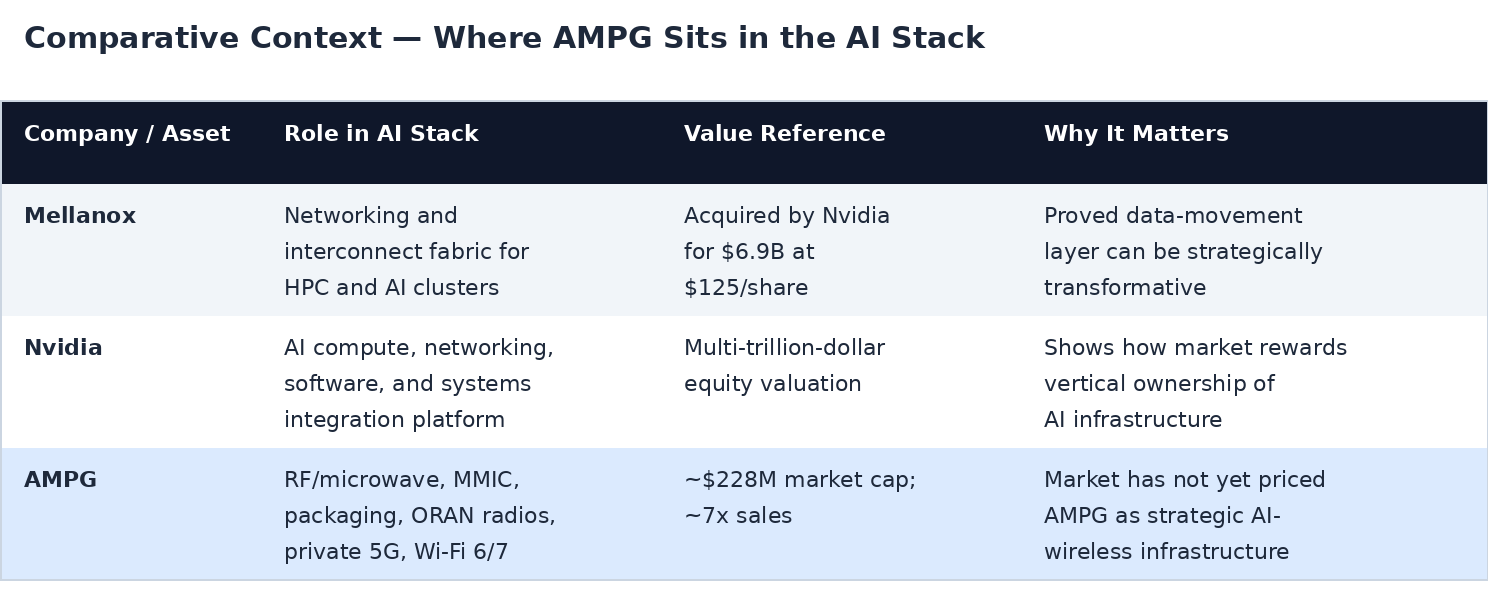
Nvidia agreed to acquire Mellanox Technologies for $6.9 billion in cash, or $125 per share, in 2019, and the transaction closed in April 2020. At the time, many observers saw the deal as a complementary networking acquisition, but Mellanox has since become a foundational part of Nvidia's data-center and AI networking franchise. That outcome changed how investors think about the AI stack: networking, interconnects, and data movement are not secondary to compute — they are core determinants of system performance.
The lesson from Mellanox is straightforward. As AI systems scale from individual accelerators to vast clusters and distributed edge environments, the companies that control bottlenecks in connectivity, latency, throughput, and system integration can command strategic premiums far above conventional hardware multiples.
Where AMPG Fits in the Stack
AMPG is positioned in a part of the market that is still underappreciated by many equity investors: the RF and radio layer that connects AI systems to the physical world. The company has described capabilities across advanced RF and microwave components, MMICs, U.S.-based packaging, private 5G, Wi-Fi 6/7, and AI-ready ORAN radio platforms including 4T4R, 4T8R, and 64T64R massive MIMO systems.
That matters because the next phase of AI is increasingly physical and distributed. Factories, campuses, smart cities, industrial automation systems, defense applications, vehicles, and edge devices all require low-latency wireless infrastructure that can carry data efficiently and adapt dynamically to spectrum, interference, and traffic conditions. In that context, RF performance and intelligent radios become part of the AI infrastructure stack, not just a generic communications expense.
Vertical Integration as a Strategic Asset
One reason Mellanox became so valuable inside Nvidia is that it was not just selling parts — it controlled a key infrastructure layer and allowed system-level optimization across the stack. AMPG is building a similar, though much earlier-stage, form of vertical integration within wireless infrastructure by combining RF components, MMIC development, packaging capabilities, and complete ORAN radio systems under one corporate umbrella.
That integrated model creates several strategic advantages:
- Better control over RF performance, thermal behavior, and packaging efficiency in high-frequency applications.
- Greater flexibility to support AI-enabled ORAN architectures, including radios that work with RAN Intelligent Controllers and xApps for real-time optimization.
- A more resilient supply-chain and domestic-manufacturing narrative, which can matter in telecommunications and defense-sensitive environments.
This combination makes AMPG more than a niche RF supplier. It positions the company as a platform builder for AI-native wireless infrastructure.
AI Inside the Radio Access Network
One of the strongest parts of the AMPG thesis is that the company is not merely adjacent to AI traffic. It is explicitly working on wireless products designed to incorporate AI and machine learning into network control and optimization. AI/ML integration is being applied across ORAN 5G, private networks, and Wi-Fi 6/7 solutions to improve spectrum use, automate operations, manage interference, and support edge-intelligent environments.
This distinction is important for valuation. The market often gives premium multiples to companies whose products become more valuable as AI adoption rises. Radios and RF platforms that can participate in AI-driven network orchestration, rather than simply transport bits, fit that pattern more closely than legacy hardware vendors do.
The NVIDIA AI-RAN Signal
AMPG's relevance to the AI ecosystem is not theoretical. The company's O-RAN Category B 64T64R massive MIMO radio platform served as the hardware foundation for an open-source prototype of a Massive MIMO AI-RAN system demonstrated at Northeastern University's Open6G OTIC, alongside NVIDIA's AI Aerial software stack. That demonstration is significant because it shows that AMPG hardware can operate within a cutting-edge AI-native RAN environment rather than simply meeting baseline telecommunications specifications.
For investors, this serves as an early strategic proof point. The value lies not only in the academic demonstration itself, but in what it implies: AMPG can become part of the emerging reference architecture for AI-enhanced wireless networks, much as Mellanox became embedded within the architecture of modern AI data centers.
Commercial Traction and Backlog
The AMPG thesis is also supported by early signs of commercial traction. In May 2026, the company announced follow-on orders exceeding $2 million from a North American mobile network operator under a previously announced letter of intent. The same disclosure stated that bookings had surpassed $8 million and backlog exceeded $20 million across business segments through April 2026.
Those figures are important because they suggest the company is moving beyond concept-stage positioning into real commercial adoption. For a micro-cap infrastructure business, backlog and repeat orders are often early indicators that product-market fit is strengthening before the income statement fully reflects the strategic opportunity.
The Valuation Gap
The most compelling part of the argument is the disconnect between AMPG's strategic position and its market valuation. AMPG's market capitalization sits at roughly $227.8 million, with 25.34 million shares outstanding and trailing twelve-month revenue of about $25.2 million. With the stock trading around $9, that translates into a current price-to-sales ratio of roughly 7x.
By contrast, AI companies and infrastructure assets have often been priced at meaningfully higher revenue multiples. In private-market and advisory comparisons, 25x to 30x EV/revenue has appeared in premium AI contexts, while public AI infrastructure names often command high-single-digit to mid-teen sales multiples depending on growth, profitability, and strategic positioning.
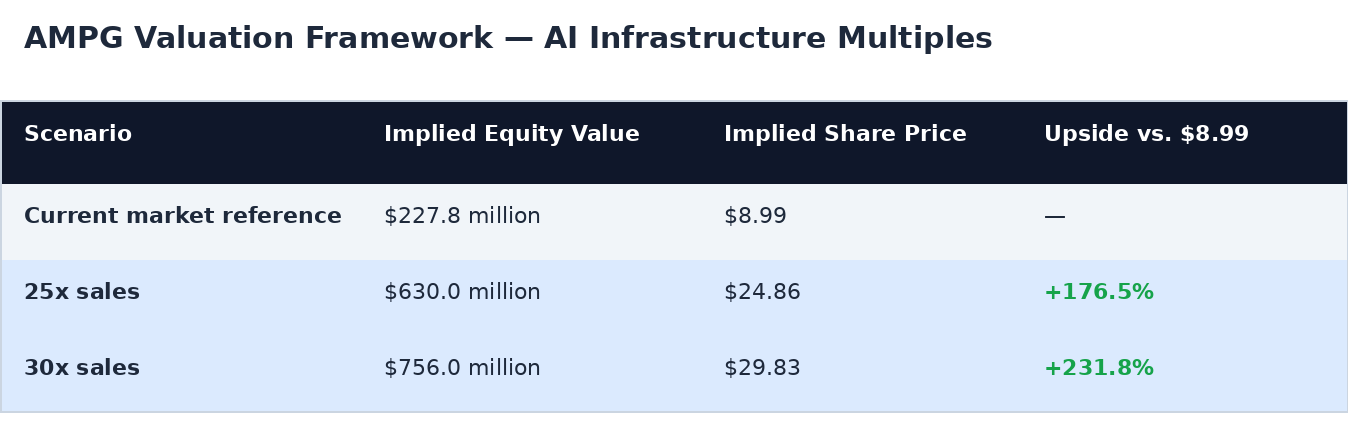
At 25x sales, AMPG would be worth approximately $630 million, or about $24.86 per share. At 30x, the valuation would rise to roughly $756 million, or about $29.83 per share. A premium AI-infrastructure multiple implies that AMPG could be worth roughly 2.8x to 3.3x its current share price if the market starts to value the company as a strategic AI-wireless platform rather than a conventional micro-cap RF supplier.
Comparative Context
Investment Interpretation
The strongest bullish argument for AMPG is not that it will become the next Nvidia. It is that the company may be one of the few public micro-cap vehicles offering exposure to the wireless and RF layer of the AI infrastructure buildout at a valuation that still reflects legacy market framing. If AI expands deeper into private networks, industrial automation, smart infrastructure, and edge compute, then RF performance, ORAN intelligence, and domestic system integration should become more valuable over time.
In that scenario, AMPG's current valuation can be seen as a mispricing rather than a fair reflection of long-term strategic optionality. Mellanox was once viewed as a supporting technology. History suggests that supporting layers can become central when the architecture around them changes.
Closing View
The core investment case is that AMPG occupies a strategically important but underfollowed position in the evolving AI infrastructure stack. Nvidia's $6.9 billion purchase of Mellanox established that control over networking and interconnect layers can deserve extraordinary valuation premiums when those layers become indispensable to AI performance. AMPG's combination of RF and microwave technology, AI-ready ORAN radios, U.S.-based packaging, and growing commercial backlog suggests that it may be building a similarly important position on the wireless side of the market — while still trading at a valuation more consistent with a conventional micro-cap hardware company.
Disclosure: The authors hold positions in securities mentioned and reserve the right to buy or sell shares at any time without notice. This report is for informational purposes only and does not constitute investment advice. Forward-looking statements involve risk and uncertainty; actual outcomes may differ materially.