
What the US Bond Market Has Wrong, and Why the 10-Year and 30-Year Bonds Will Rally


The solvency question: federal debt measured against what Americans own, 1926 to 2026, and the balance-sheet asset that can retire it without a tax. A wealth fee would work. It should never be needed. The Postal Service, carried at nothing on the federal balance sheet, is worth more than the debt.
This analysis is written for policymakers, fixed-income investors and the general reader. It uses Federal Reserve, Treasury, Congressional Budget Office and Postal Service data as of June 30, 2026, unless otherwise noted. The Postal Service program economics are drawn from the companion BCII proposal cited in the sources. They are projections, not commitments.
1. The Argument in One Page
The federal government owed $39.46 trillion on June 30, 2026. Take out the $4.49 trillion the Federal Reserve holds and the $2.52 trillion in the Social Security trust funds, both of which are the government owing itself, and the debt owed to everyone else is $32.45 trillion. That is a very large number. Measured against the $195.9 trillion net worth of American households, nonprofits and the trusts and corporations they own, it is 16.6 percent. In 1945 the same ratio was 29.9 percent, and the country went on to the strongest quarter-century of growth in its history.
The bond market is nonetheless pricing solvency risk. The 30-year Treasury closed at 5.27 percent on July 31, 2026, its highest yield since 2007, with investors explicitly demanding more compensation to lend to the government for long periods. Moody's removed the last Aaa rating in May 2025, citing debt and interest costs it described as significantly higher than those of similarly rated sovereigns. The Congressional Budget Office projects the deficit at $1.9 trillion in 2026 and debt held by the public rising from 101 percent of GDP to 120 percent by 2036.
This paper makes three points in order.
The debt is small relative to the balance sheet that stands behind it. Over a full century, gross federal debt has never exceeded one-third of household net worth, and today it sits at one-fifth. Solvency is a balance-sheet question, and the balance sheet is sound.
If it ever came to it, a fee on wealth would retire the debt in five to seven years. A 4 percent annual charge on the $217.8 trillion of household assets raises $8.7 trillion a year. This is the proof that the debt is payable. It is also the worst way to pay it, and it should be understood as the last resort, not the plan.
The government does not need to reach for that lever, because it owns assets it carries at zero. The Financial Report of the United States lists $6.1 trillion of assets against $47.8 trillion of liabilities, but federal accounting standards exclude the minerals, timber, spectrum and going-concern businesses the government controls. The most glaring and the easiest to monetize is the Postal Service. Its 78.7 million Informed Delivery users, its Master Coupon on $80 billion of postal fees, and its statutory position as a federal commerce rail can be turned into a Super Coupon Token whose trading tax, token sales and program remittances retire the entire federal debt in four to seven years on the assumptions modeled here, without a dollar of new tax.
The conclusion is that the bond market is wrong to worry about the solvency of the United States. The debt can be paid down seamlessly, to the taxpayer's benefit, using legal authority that already exists under the GENIUS Act and the 2025 SEC and CFTC actions on digital assets. The parties with a genuine reason to worry are the online advertising giants, because the mechanism that pays the debt is a redirection of the advertiser dollars they now collect.
2. A Century of Debt Against Wealth
Debt is usually measured against GDP, the country's annual income. That is a flow measure and it says nothing about solvency. A household earning $100,000 with a $300,000 mortgage is not insolvent if it owns a $900,000 house. The right denominator for a solvency question is the stock of wealth that stands behind the borrower. For the United States that is the net worth of its people.
What the net worth of the US populace includes is worth being precise about. The Federal Reserve's Financial Accounts, the Z.1 release, measure the household and nonprofit sector at market value. That sector includes charitable and educational nonprofits, personal and family trusts, and the corporate sector as well, because corporate equity is carried at market price in household portfolios, pension funds and mutual funds. Adding corporate net worth separately would count the same value twice. On June 30, 2026 the sector held $217.8 trillion of assets, owed $21.9 trillion of mortgages and consumer credit, and had a net worth of $195.9 trillion. Figures before 1952 are spliced from the Kopczuk-Saez estate-tax wealth series scaled to the Z.1 basis. The debt series is Treasury's historical debt outstanding with Federal Reserve holdings from the Fed's annual reports.
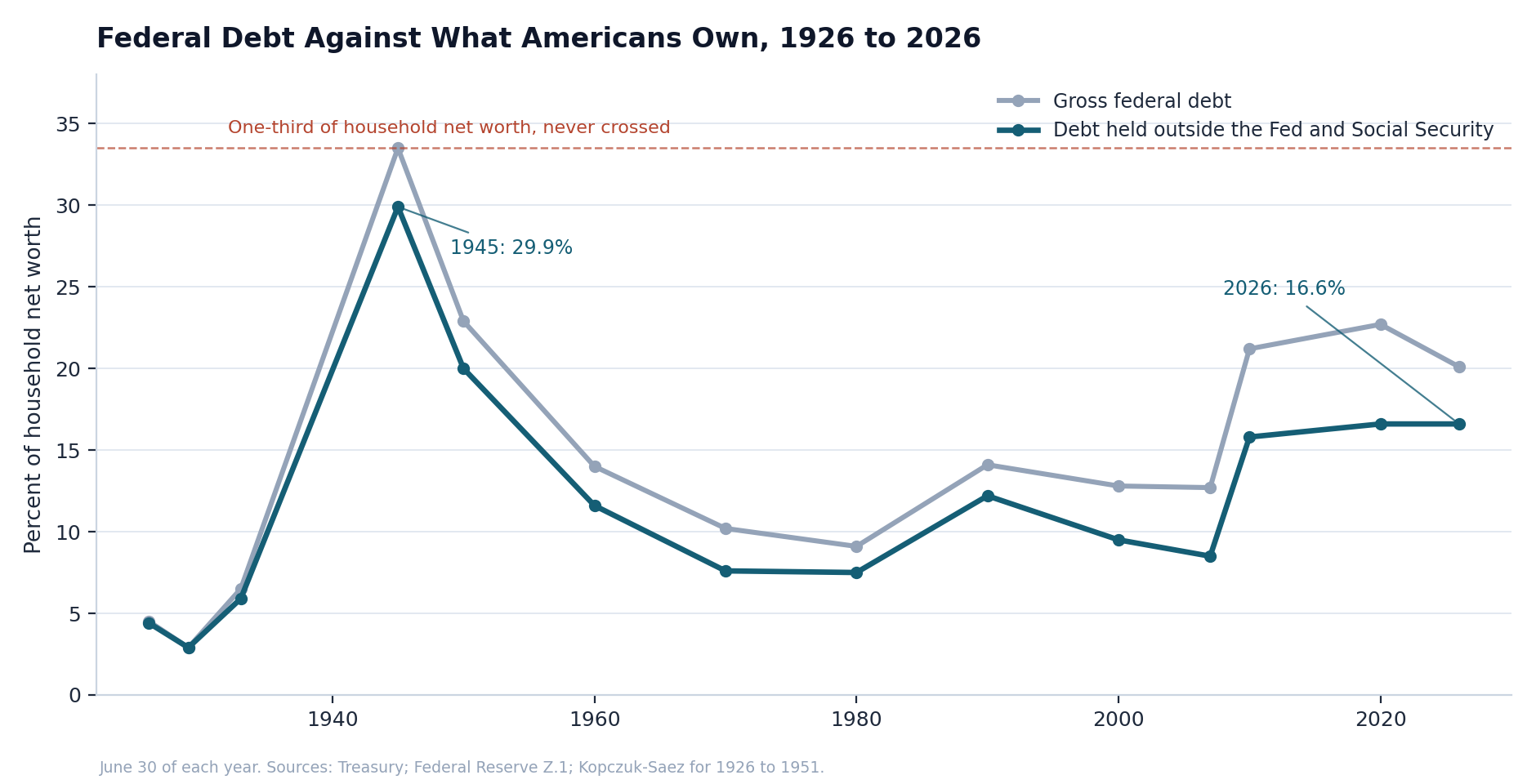
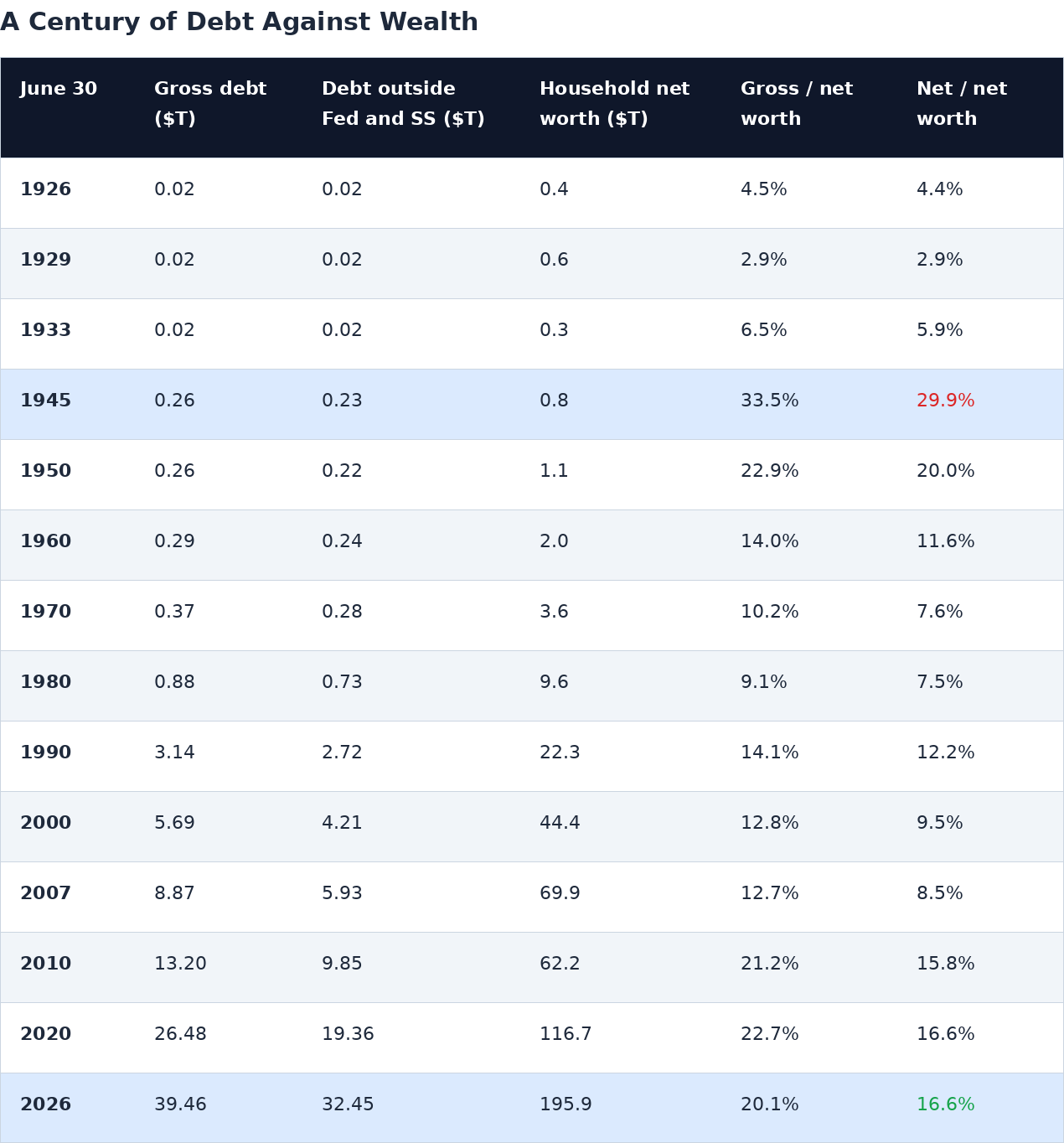
Three things stand out. First, the ratio has never crossed one-third, even at the end of the Second World War when the government had borrowed the equivalent of an entire year's output. Second, the post-1945 decline to a low of about 7 percent net, or 9 percent gross, in the early 1970s happened without a wealth tax or a default. Growth and inflation did it. Third, the current level of 20.1 percent gross and 16.6 percent net is high by peacetime standards but well inside the range the country has already lived through. Nothing in this history supports the view that the United States is approaching a balance-sheet limit.
3. What the Bond Market Is Pricing
The market's concern is real and it is measurable. Global yields have risen through 2026 on a combination of energy prices, sticky core inflation, hawkish central banks and, as Vanguard puts it, growing concerns about the fiscal sustainability of governments. The 10-year Treasury reached 4.95 percent in September while short rates did not follow, steepening the curve. Stifel attributes the gap to a rising term premium, the extra compensation investors demand for lending to the government for 30 years. Reuters described a global bond market in turmoil ahead of the September FOMC meeting.
The fiscal arithmetic behind that worry is the CBO baseline: a $1.9 trillion deficit in fiscal 2026, equal to 5.8 percent of GDP, growing to $3.1 trillion by 2036, with debt held by the public passing the post-war record of 106 percent of GDP and reaching 120 percent. Moody's downgrade cited the same trajectory.
Why the worry is misplaced comes down to one thing. Every one of these measures is a flow measure or a ratio to a flow. None of them asks the question a lender should ask about any borrower: what does this borrower own, and can it be reached? The answers are, respectively, more than enough and yes. Section 4 shows that the debt is payable from the private balance sheet by brute force if it ever had to be. Section 5 shows that it does not have to be, because the public balance sheet contains a self-funding asset large enough to do the job on its own.
4. The Last Resort: A Fee on Wealth
Suppose Congress concluded that the debt had to be retired quickly and chose the bluntest instrument available: an annual charge on the assets of households, trusts and nonprofits. The arithmetic is straightforward. Household assets were $217.8 trillion on June 30, 2026. A 4 percent annual fee raises $8.71 trillion in the first year. Against a $1.5 trillion annual deficit, that retires $7.2 trillion of principal a year, reducing as the asset base is drawn down.
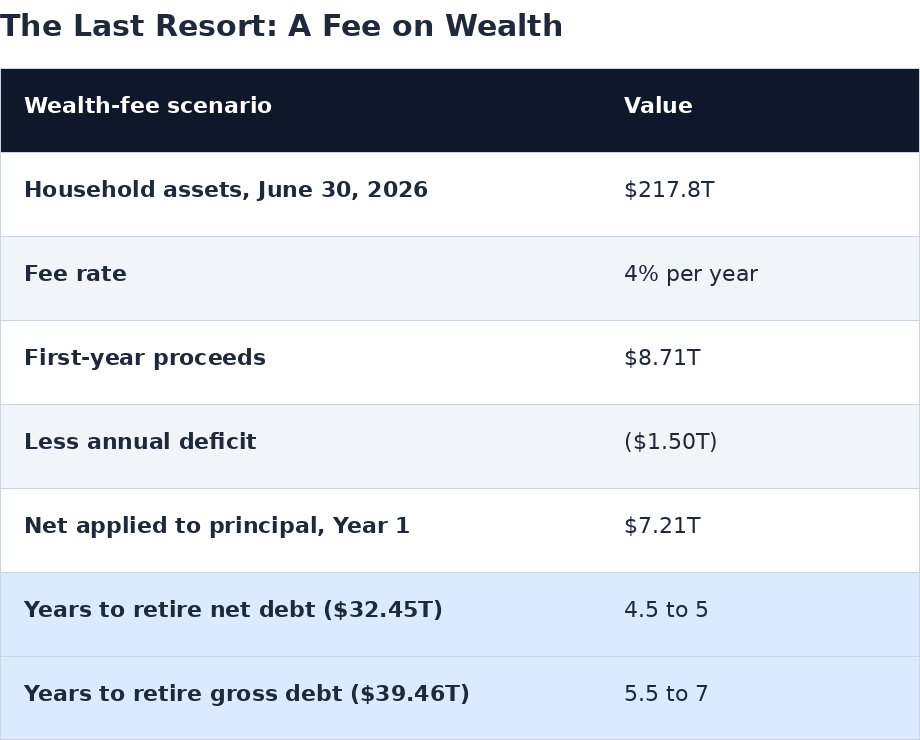
This settles the solvency question on its own terms. A borrower whose creditors could be repaid in full within seven years by a charge that leaves its people with 75 percent of their wealth is not a candidate for default. But it also shows why the fee is the wrong tool. It is involuntary and falls on every household. Most household wealth is in homes, retirement accounts and closely held businesses, so a 4 percent charge would have to be paid largely by selling illiquid assets into a market where everyone else is selling too. The proceeds equal roughly a third of all personal and corporate income, so the fee would be a severe recession by design. It is the proof that the debt is payable, and it should stay in the drawer.
There is a better answer on the other side of the government's own ledger.
5. The Balance Sheet Nobody Reads
The FY 2025 Financial Report of the United States Government reports total assets of $6.1 trillion, of which $2.0 trillion is loans receivable and $1.4 trillion is property, plant and equipment, against total liabilities of $47.8 trillion. Read literally, the government is insolvent by $41.7 trillion. Read carefully, the asset side is a fiction of accounting convention. Federal standards exclude natural resources in federal custody from balance-sheet recognition entirely, and they carry land, spectrum and the going-concern value of federal enterprises at cost or at nothing. The government's most valuable holdings do not appear because no standard requires them to.
Those holdings include the following.
Mineral rights under federal lands. Oil, gas, coal, hard-rock and critical minerals under roughly 640 million surface acres and the outer continental shelf. Carried at zero.
National forests and public-land businesses. Timber, grazing, recreation and concession rights. Carried at cost of acquisition, which for most of the estate is nothing.
Spectrum, facilities and surplus property. The electromagnetic spectrum, military and civilian facilities and disposal inventory. Spectrum has no balance-sheet value at all.
The Postal Service. A 250-year-old federal enterprise with a legal monopoly on the mailbox, a delivery point at every address in the country, $80 billion of annual fee revenue and a digital relationship with 78.7 million households. Carried as a deficit.
Any of these could be monetized. Most would take years of statute, leasing and litigation. The Postal Service is different. Its digital list already exists, its fee schedule already exists, and the legal tools to turn them into a tradeable, non-security digital asset were put in place in 2025. That is why it is the most glaring and the easiest to act on.
6. The Postal Service as a Federal Asset
The Postal Service reported revenue of $80.45 billion and a net loss of $8.98 billion in fiscal 2025. The Postmaster General told the Senate in June 2026 that unrestricted cash had fallen to $8.9 billion, that the Service had defaulted on roughly $31 billion of cumulative payments, and that it was effectively out of cash. By August it was seeking an appropriation from Congress after a further $2.5 billion quarterly loss. Every one of those numbers describes the mail business. None of them describes the asset.
The asset is the relationship. Informed Delivery, the free daily email preview of incoming mail, had 78.7 million active users across 53.9 million households at March 31, 2026, with a 62.1 percent email open rate. No retailer, bank or media company reaches that share of American households every day with a message they open. Google and Meta reach them with advertising the recipient did not ask for. The Postal Service reaches them with a message about their own mail. That audience, attached to the Service's $80 billion fee schedule and to a settlement rail that already reaches every address, is what the Super Coupon Token monetizes.
How the token works
The BCII Super Coupon Token is a fixed-supply digital carrier, hard-capped at 300 million units, that entitles the holder to a Coupon Book of purchase discounts. It is not a security and pays no yield. Its value is the value of the discounts it carries, which a holder either uses or sells. The Coupon Book has four sections.
Master Coupon. 20 percent off every Postal Service fee for 11 months, unlimited use. Face value about $87 per token at current volumes.
Company coupons. Cooperating retailers, brands and service companies attach purchase-triggered discounts to the token instead of buying online advertising. Each company line is valued at $220, and the roster grows from 100 companies in Year 1 to 25,000 in Year 5.
Stablecoin purchase coupons. The GENIUS Act forbids permitted stablecoin issuers from paying yield to holders, but it does not forbid a merchant or issuer from funding a 5 percent discount on purchases settled in a permitted stablecoin. Every permitted issuer may participate. At the average household's $78,535 of annual spending, the section is worth about $3,600 per token, and it gives a $304 billion stablecoin market its first legal reason for a consumer to hold one.
Gold coupon tokens. Tokenized-gold issuers, following the Aurica model, attach purchase discounts on their own gold tokens at roughly $2,250 per line, uncapped. Tokenized gold is a $5 billion market against $30 trillion of physical gold, and the coupon line is the on-ramp.
Every trade of the token pays a 6 percent transaction tax, of which 63 percent flows to token holders, 33 percent to the Postal Service, and the balance to the settlement operator, administrator and BCII. When a coupon is exercised the token is recycled to the Postal Service's reserve and sold again, so a fixed supply produces a recurring stream of sales. The Postal Service's share of tax, its token sales and the incremental postage its coupons generate are what fund the remittance to Treasury.
7. The Legal Basis Already Exists
The token relies on four pieces of law and regulatory practice, all in place by the end of 2025.
The GENIUS Act, July 18, 2025. Creates a federal license for payment stablecoin issuers and, in Section 4(a)(11), prohibits them from paying yield to holders. The prohibition is the token's opportunity: a purchase-triggered discount funded by merchants is not yield, and it is the only legal way for a stablecoin to reward its holders.
SEC token taxonomy and no-action relief. In November 2025 the SEC Chairman set out a taxonomy that distinguishes network tokens, digital collectibles and digital tools from tokenized securities, anchored in the Howey investment-contract test. Staff had already issued no-action letters to utility and rewards tokens whose value derives from use rather than from the efforts of a promoter, including the Fuse energy-rewards token in November 2025. A coupon carrier whose only value is the discount it delivers sits squarely in the tool category.
SEC and CFTC joint statement on spot trading, September 2, 2025. Staff of both agencies confirmed that current law does not prohibit CFTC-registered designated contract markets and SEC-registered national securities exchanges from listing certain spot crypto asset products, and invited applications. A non-security digital commodity like the Super Coupon Token can therefore trade on a regulated venue with surveillance and clearing, which matters to the Treasury as much as to the holder.
FASB ASU 2023-08. Requires crypto assets to be carried at fair value with changes through earnings, so the Postal Service's token reserve appears on its books at market and the remittance to Treasury is an audited, visible number.
Remittance itself needs one statutory step. Postal Service receipts are deposited in the Postal Service Fund under 39 U.S.C. 2003, and Treasury already maintains an account that accepts gifts to reduce debt held by the public. Congress would authorize the transfer of net token proceeds above operating needs from the one to the other. Nothing else in the architecture requires legislation.
8. What the Postal Service Is Worth
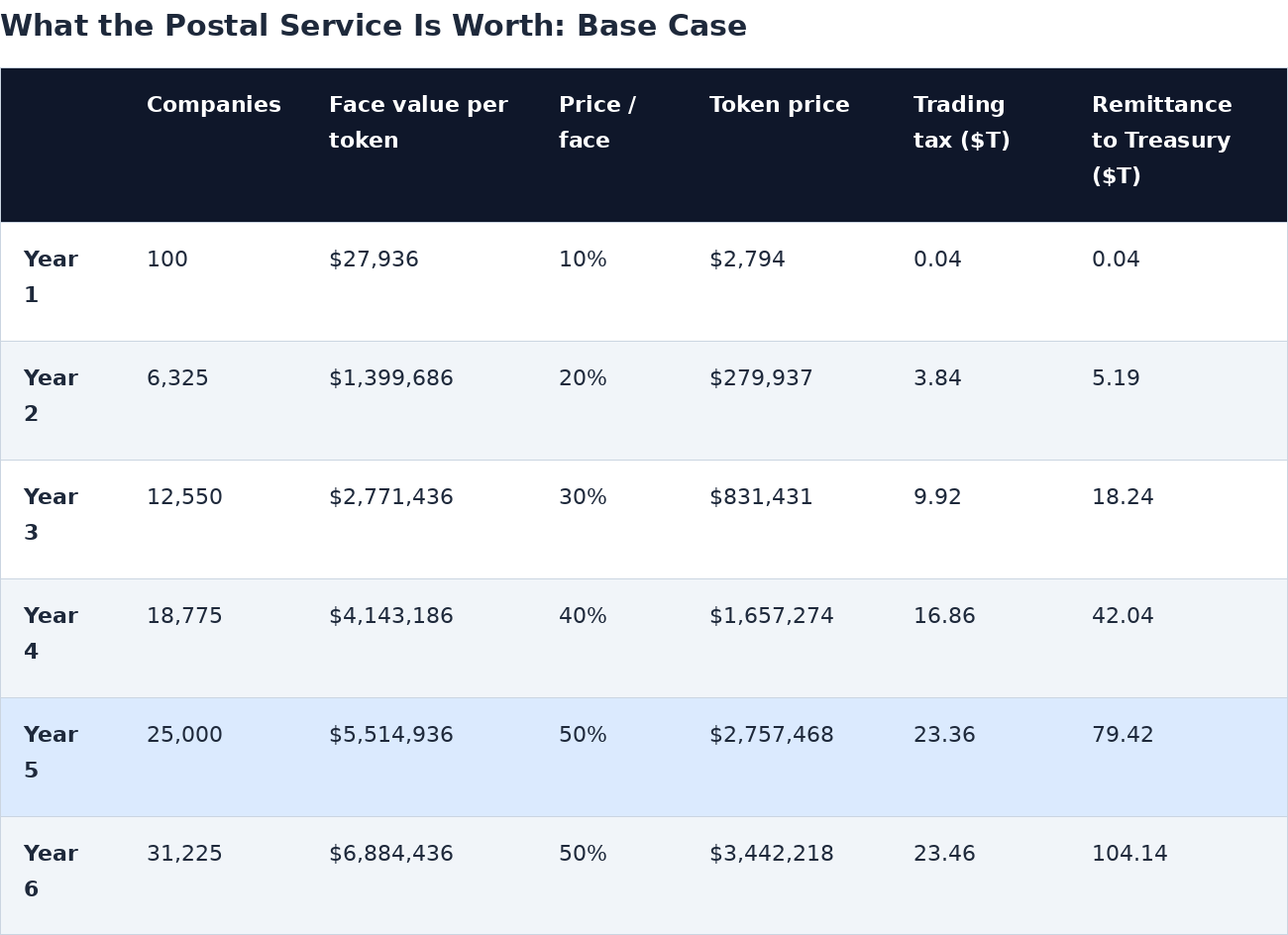
The face intrinsic value of one token is the sum of the four Coupon Book sections. Because the company roster grows from 100 to 25,000 lines and every line is worth $220, face value rises roughly 200-fold between Year 1 and Year 5. The token trades below face, and the price at which it trades is the single assumption that drives every other number in the model. The base case has the price converging linearly from 10 percent of face in Year 1 to 50 percent in Year 5.
How fast the debt is retired
The table and figure below apply each year's remittance to the June 30, 2026 debt balances, adding a $1.5 trillion deficit every year and taking no credit for the interest saved as principal is retired. Seven convergence cases are shown, from a price that reaches only 7.5 percent of face in Year 5 to the 50 percent base case.
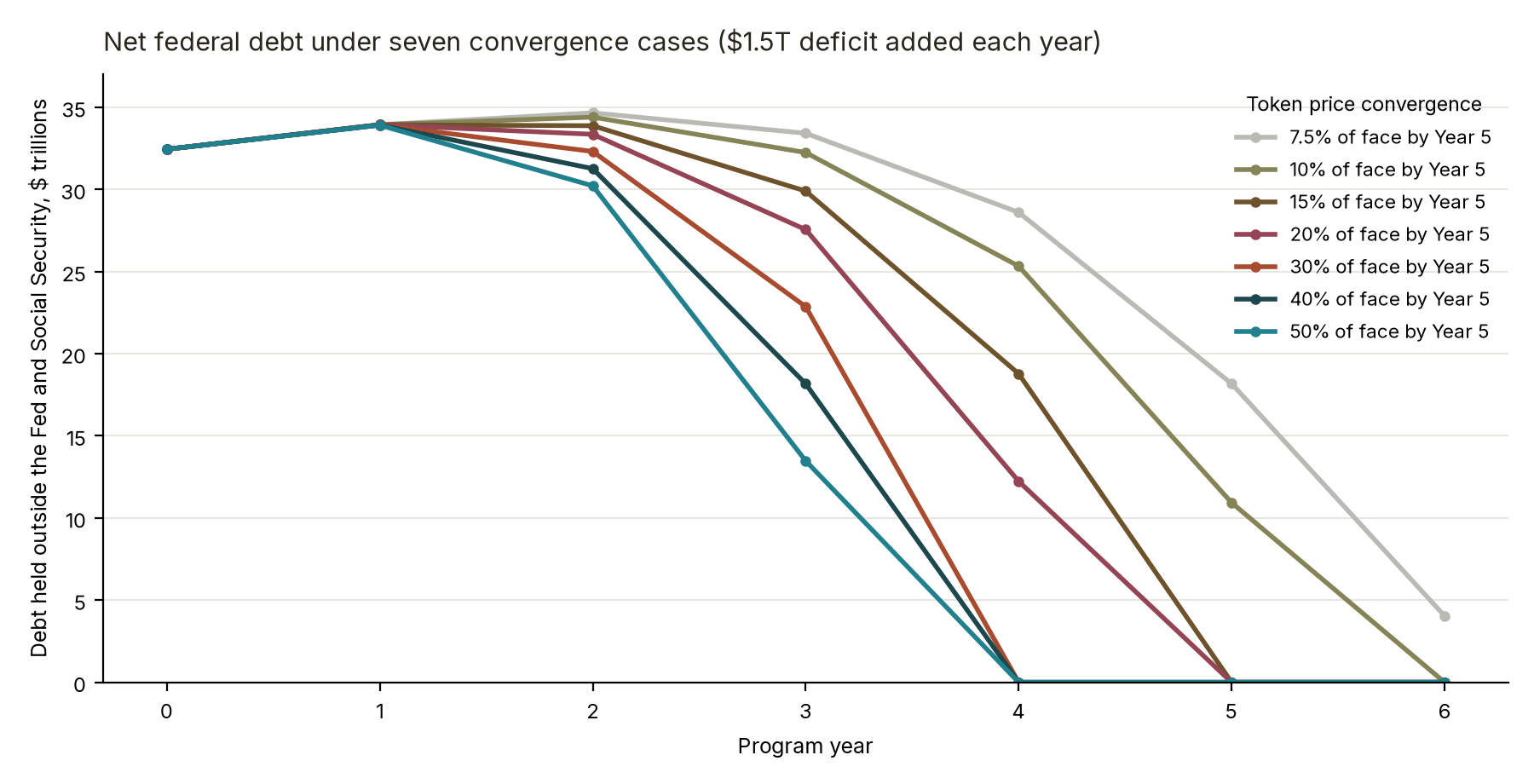
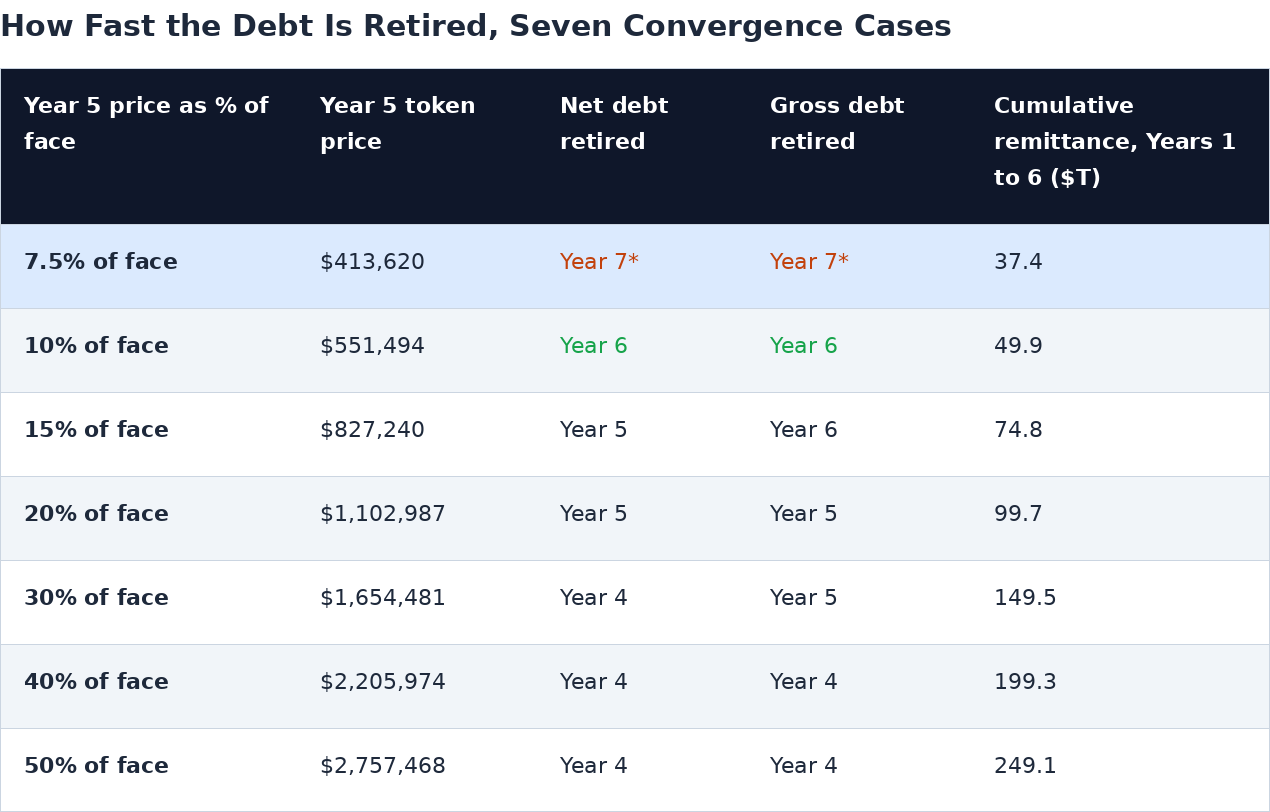
The result barely depends on the assumption. If the token never trades above 10 percent of the savings in its Coupon Book, both debt measures are gone in Year 6. At 20 percent they are gone in Year 5. At 40 percent and above, in Year 4. The reason is that the schedule is driven by roster growth, which multiplies face value 200 times, and the convergence ratio merely scales that growth. Even the weakest case delivers $37 trillion to Treasury in six years, more than the entire debt held outside the government's own accounts today.
One caution belongs here. At the 50 percent endpoint, Year 5 remittances of $79 trillion exceed the total wealth-fee proceeds of Section 4 by a factor of nine, and Postal Service token sales in that year would exceed the household asset base within about three years. A Treasury reader will test the convergence assumption first, which is precisely why the 7.5 and 10 percent cases are presented. The point does not require the token to trade anywhere near face value.
9. Who Pays: The Online Advertising Giants
Nothing in this program taxes a household. The money comes from four places: advertisers who fund company coupons instead of buying search and social advertising; stablecoin issuers and their merchant partners who fund purchase discounts; gold issuers who fund on-ramp discounts; and traders who pay the 6 percent transaction tax on a voluntary secondary market. The largest of these by far is the first.
US digital advertising spending reached $361.9 billion in 2025, and Google, Meta and Amazon together collect 58.8 percent of US advertising dollars. A company that spends $10 million on search advertising to reach customers it cannot identify can instead attach a $220 coupon line to a token held by 78.7 million households who open the Postal Service's email six days in ten. The token gives the advertiser what the platforms cannot: a purchase-triggered discount that costs nothing until a sale is made, delivered through a channel the household trusts because it is about their own mail.
Advertiser budgets are finite. Every dollar that moves into a Coupon Book line is a dollar that does not go to a search auction or a social feed. The 25,000-company roster in Year 5 represents a redirection of advertising spend measured in the hundreds of billions of dollars a year, most of it from the three platforms that dominate the market today. The program is neutral toward them in design. It simply offers advertisers a cheaper and more accountable path to the same customer. But the arithmetic is not neutral in effect, and investors in those companies should read the base case as a competitive threat, not as a public-finance curiosity.
10. Conclusion: The Bond Market Is Wrong
The United States owes $32.45 trillion to lenders outside its own accounts, against $195.9 trillion of net worth held by its people and their institutions. That ratio, 16.6 percent, is lower than it was in every year from 1943 through 1952. If the country ever had to, it could retire the entire debt in five to seven years with a fee on wealth. It will never have to, because it owns assets that its own accountants carry at zero, and the most obvious of them, the Postal Service, can be converted into a stream of remittances large enough to retire the debt in four to seven years using legal authority that Congress and the regulators finished putting in place in 2025.
The Treasury's term premium is compensation for a risk that does not exist. The federal government is not a borrower running out of income. It is a borrower that has never opened its own balance sheet. When it does, the debt is retired seamlessly, the taxpayer pays nothing, the Postal Service becomes the most profitable enterprise in the government, and stablecoin and tokenized-gold issuers acquire the consumer franchise that the GENIUS Act otherwise denies them. The only balance sheets that shrink are those of the online advertising giants whose revenue the program redirects.
Investors pricing a solvency premium into long Treasuries are pricing the wrong thing. The question was never whether the United States could pay. It was whether anyone would count what it owns.
This document is an analysis prepared by BCII Enterprises Inc. for discussion purposes. Historical figures are drawn from the public sources cited. Program projections are model outputs on stated assumptions, are not forecasts of Postal Service or Treasury results, and depend on regulatory and legislative actions that have not occurred. The Super Coupon Token is not a security and is not offered by this document. Nothing here is investment, legal or tax advice.
BCII Enterprises Inc. is the developer of the Super Coupon Token architecture described here and has a direct commercial interest in its adoption. The authors hold positions in securities mentioned and reserve the right to buy or sell shares at any time without notice.