
Welcome to the 1920s, Ms. Wood and Mr. Lee


An open response to Cathie Wood's CNBC interview and In The Know newsletter, and to Tom Lee's recent commentary, from the authors of Reliving the 1920s. JD Unfiltered: Reliving the 1920s, A Century-Long Market Analog (July 2026), and publishers of the JD Unfiltered and the 1921 = 2020 series on LinkedIn.
In one sentence
Two of the most followed voices in American markets have now arrived, in September 2026, at the conclusion we have published on LinkedIn for two years and in Reliving the 1920s under a clock that began in May 2020: artificial intelligence is this century's electrification, it will lift productivity, real growth and real interest rates together, and the higher yields that frighten conventional strategists are a sign of the boom, not its end. We are honored by the company. We also owe our readers a clear account of where we agree, what we said first, and where we still part ways.
1. A sincere thank-you, and a note on the calendar
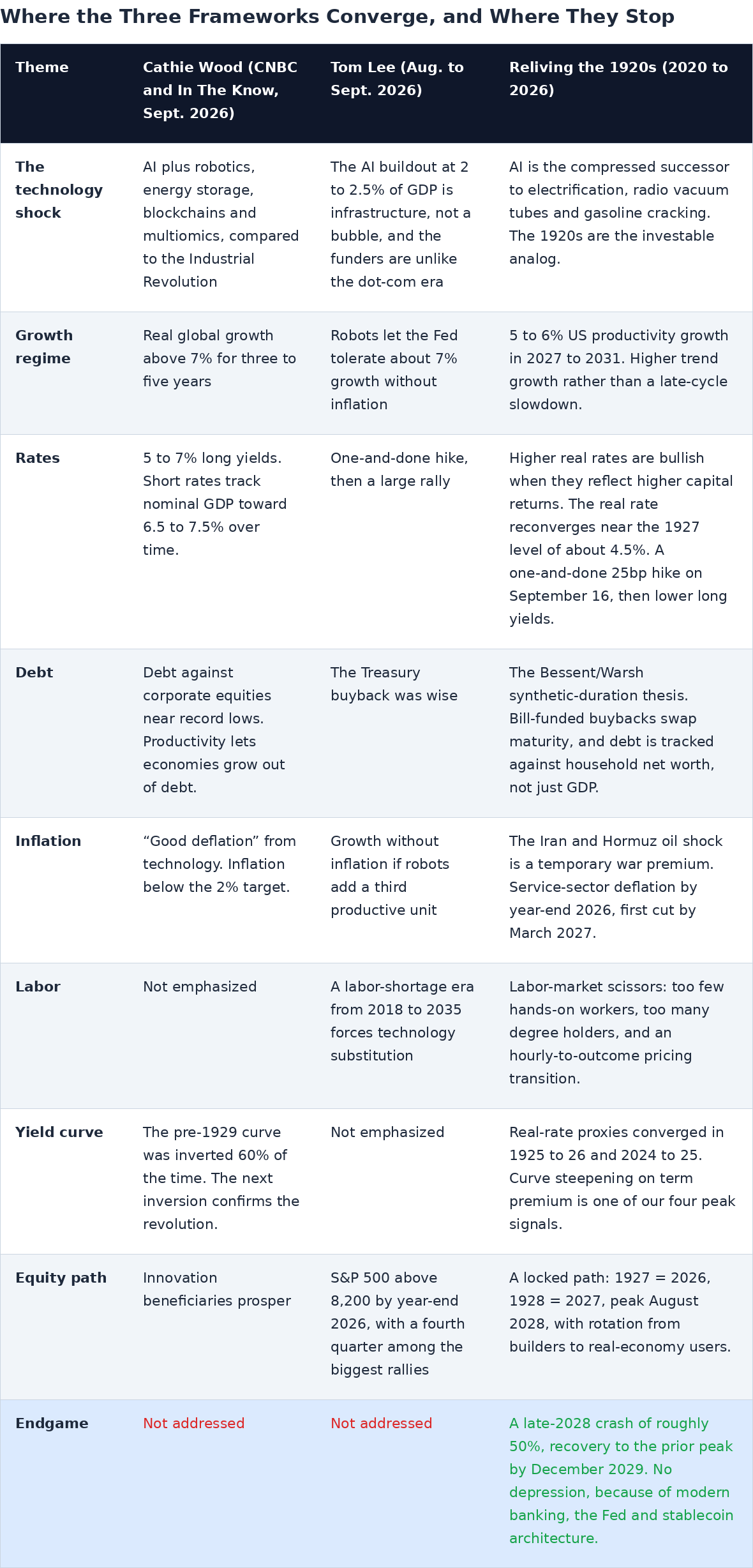
On Friday morning, September 25, 2026, Cathie Wood told CNBC's Squawk Box that real global GDP growth could average above 7 percent for the next three to five years, that the figure might "look conservative in hindsight," that nominal growth of 6 to 8 percent could put long yields in the 5 to 7 percent range without ending the expansion, and that productivity can let economies grow out of their debts. She reached for the Industrial Revolution as her historical anchor.
Three weeks earlier, her In The Know newsletter carried the title "This Hasn't Happened Since Before The Depression." In it, and in ARK's posts that followed, she argued that the pre-1929 yield curve was inverted more than 60 percent of the time and that an inverted curve during a technology boom confirms the revolution rather than warning of recession; that federal debt measured against corporate equities is near record lows; and that five converging platforms, meaning AI, robotics, energy storage, public blockchains and multiomics, could at least double global growth.
And over the past several weeks, Tom Lee of Fundstrat has told his audiences that the AI buildout is not the dot-com bubble, that the Treasury's long-bond buyback was a wise move, that a single Fed hike would clear the way for a large rally, that robots could allow the Fed to tolerate 7 percent growth without inflation, and that America is in a labor-shortage era that runs to 2035 and will force heavy technology substitution.
We are genuinely honored. When we titled our book Reliving the 1920s and locked its clock to May 1921 = May 2020, the consensus view treated the AI trade as a narrow semiconductor story and treated every uptick in yields as a threat. To see the founder of ARK Invest and the head of research at Fundstrat adopt the same causal spine, meaning technology-led productivity, higher real growth, higher real rates, and debt outgrown rather than defaulted, is the kind of validation an independent research shop rarely receives so quickly.
We would only add a gentle note about the calendar. What Ms. Wood and Mr. Lee said in September 2026 is what JD Unfiltered has been publishing on LinkedIn since 2024, what we set out in a 127-page book in July 2026, and what our month-by-month forecast has been tracking since the clock started in May 2020. We welcome their assent. We also think readers deserve to know that the framework has been in the public record for some time, that it has a calendar the newcomers do not yet have, and that it contains an ending they have not yet addressed.
2. The central thesis they have now joined
Here is the argument of Reliving the 1920s in a paragraph. Between 1921 and 1929 the United States electrified its factories, put radios in half its homes, cracked gasoline at industrial scale, and reorganized production around the new energy source. Productivity jumped, profits followed, and real interest rates rose because the return on capital rose. Observers who assumed a normal business cycle called the boom impossible at every stage. AI, arriving in force in November 2022, is the compressed successor to that electrification wave: general-purpose infrastructure that lowers the cost of analysis, design, administration, discovery and logistics across the entire service economy. Because services are a far larger share of modern employment than manufacturing was in the 1920s, a 1920s-scale productivity burst applied to services can deliver 5 to 6 percent annual US productivity growth in 2027 to 2031, a higher natural real rate of roughly 3 to 5 percent, and a broad, real-economy-led equity advance through 1928 = 2027.
Set against that, the convergence is striking.
3. The most important convergence: rates
The best match with Ms. Wood is her refusal to treat higher yields as automatically bearish. Our 99-year real-rate work makes the more precise version of her argument. During an electrification-style capital boom, a rise in real rates signals that the expected return on productive investment has increased. That is different from a rate spike caused solely by monetary restriction, fiscal panic or inflation expectations. In our framework, higher productivity produces higher expected capital returns, which produce a higher natural real rate, which produces strong equities, robust investment and expanding profits, until financing costs, leverage or capital oversupply become destabilizing.
Ms. Wood made the first half of that case on CNBC: 5 to 7 percent yields need not mean recession if the growth impulse is genuine. Mr. Lee made the tactical half: get the hike behind you and the market runs. Our September 12, 2026 whitepaper, The Real Rate on the 99-Year Clock, said both in advance and added the mechanism. A one-and-done 25 basis-point hike on September 16 under what we call the Bessent/Warsh Accord, followed by lower long yields, larger 30-year buybacks, stablecoin-driven bill demand, lower oil by November, service-sector deflation by year-end, and a first cut by March 2027.
The nuance still matters. Today's yield rise is not yet a clean productivity signal. CNBC attributed the 10-year's brief visit to 5.23 percent, its highest since 2007, to energy prices, hawkish Fed commentary and strong activity data, while the University of Michigan one-year inflation expectation rose to 4.6 percent. Our thesis handles that by separating the temporary Iran and Hormuz oil disturbance from the underlying AI-productivity regime. Ms. Wood's long-run logic and our near-term sequencing can both be true. The route to a higher-productivity equilibrium can be volatile and inflationary along the way.
4. Industrial Revolution versus the 1920s
Ms. Wood reaches back to the Industrial Revolution. We chose the more investable analog, the 1920s, and the distinction is not academic.
The Industrial Revolution establishes the principle that technology can lift the trend growth rate for a prolonged period. But it spans generations and cannot guide a present market cycle. The 1920s provide the tighter operational parallel. Electrification finally diffused through factories, households and cities. Automobiles, roads, radio, petroleum processing, appliances and mass production drove complementary investment. Productivity rose, corporate profitability expanded, and markets priced a new economic architecture. Rates, credit, investment and valuation interacted in ways that looked unsustainable to observers who assumed a normal business cycle. And the eventual failure came not because the technologies were fake, but because capital formation, leverage, valuation and global fragility overshot.
Our AI-as-electrification analogy is therefore more specific than her Industrial Revolution framing, and it answers questions television cannot: which year of the cycle we are in, what the market did in that year a century ago, which sectors led, and what the end looked like.
5. What we have that they do not: a calendar and a machine
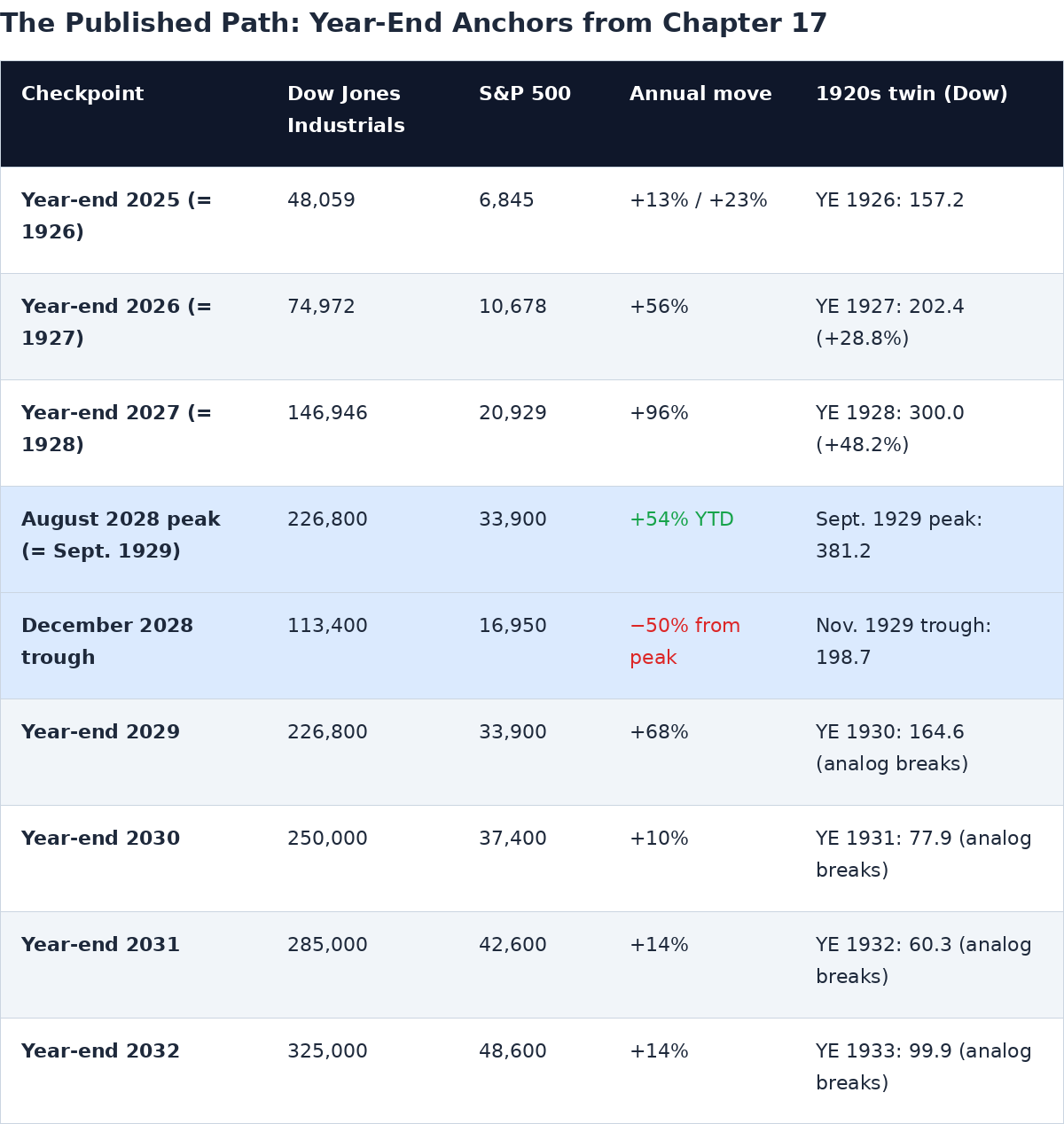
Ms. Wood offers a three-to-five-year horizon. Mr. Lee offers a year-end target. Reliving the 1920s assigns the boom to a historical sequence with a constant 99-year offset, so that 1921 = 2020, 1926 = 2025, 1927 = 2026, 1928 = 2027 and 1929 = 2028, and it does something no television interview does. It publishes the path month by month and states in advance what would prove it wrong.
The monthly path is not hand-drawn. We built it with a reservoir computer still in development at Quantum Computing Inc., a company we helped found. Reservoir computing is a form of machine learning designed for time series: a fixed, high-dimensional dynamical system absorbs the input history, and only a light readout layer is trained, which makes it well suited to the overlay problem at the heart of our book. That problem is mapping the 1921 to 1930 S&P 90 and Dow Jones Industrial Average against the 2020-onward S&P 500 and Dow, month by month, and projecting the aligned path forward. We used it to track and forecast S&P 500 and Dow movements month by month through the current cycle and to extend the forecast, month by month, into the early 2030s. The published year-end anchors from Chapter 17 of the book are below, and the monthly detail sits behind them in the JD Unfiltered series.
The five falsification tests, published with the forecast
The S&P 500 fails to reach 8,500 by year-end 2026. The acceleration is not operating.
Top-10 S&P concentration falls below 35 percent in 2026 to 2027. The concentration amplifier is broken.
Monthly realized volatility rises sustainably above 22 percent in 2026 to 2027. The peak must come forward.
The Fed raises rates by more than 200 basis points in 2026 to 2027. The productivity-cycle interpretation is wrong.
A single-bank failure comparable to December 1930 occurs in 2028 to 2029. The banking-holds thesis has failed.
A forecast that names the conditions under which it should be abandoned is a different kind of object from a forecast that names only its destination. We invite Ms. Wood and Mr. Lee to publish theirs.
6. Mr. Lee's recent commentary, side by side with ours
We admire Tom Lee's work and have for years. That is why the resemblance between his recent language and our JD Unfiltered Substack and LinkedIn posts is so gratifying, and, in places, so close that readers of both have written to ask which came first. The record answers that question. We set the parallels out plainly, not as a complaint but as a matter of attribution and as evidence that the framework is travelling.
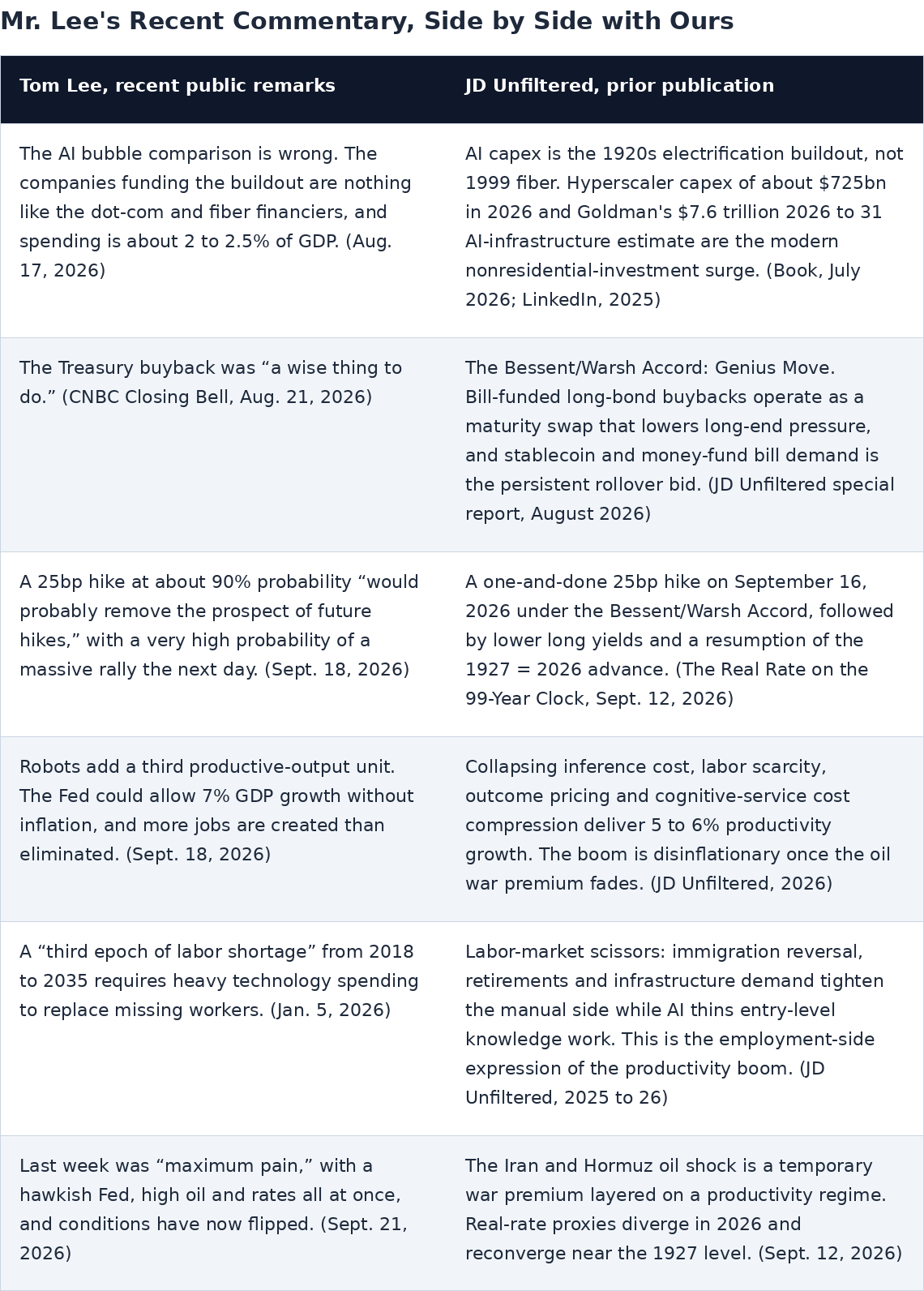
We welcome every one of these echoes. Ideas that are right should spread, and Mr. Lee reaches an audience we do not. We ask only what any author asks: that the framework be recognized as Reliving the 1920s when it is used, and that its authors be named.
7. Where we still part ways
Assent is welcome. Agreement is not the same as identity. Here are the differences that matter to a portfolio.
With Ms. Wood
The 7 percent global number is a very high bar. CNBC cited IMF global real growth of 3.3 percent in 2023, 3.4 percent in 2024 and 3.4 percent in 2025. Doubling that on a sustained global basis requires rapid deployment, complementary physical investment, energy availability, labor and regulatory adaptation, and broad international diffusion. Our 5 to 6 percent figure is a US productivity estimate, not a global GDP forecast, and we think that is the honest scope.
Short rates at 6.5 to 7.5 percent is not our path. Ms. Wood expects short rates to track nominal growth higher over time. Our clock expects a one-and-done hike, a first cut by March 2027, and a long end held down by buybacks and stablecoin-bill demand, with the real rate rather than the nominal policy rate doing the work at roughly 3 to 5 percent.
The yield curve is not a green light on our clock. Her newsletter argues that the next inversion would confirm the revolution. We agree that inversion is not a mechanical recession signal, but curve steepening on rising term premium is one of our four signals for the April to August 2028 de-risking window. The curve remains information, not decoration.
Oil is her weakest near-term claim. Electrified transport may push crude toward $30 to $35 over a long horizon, but with Brent near $104 and WTI near $92 on Iran and Hormuz risk, today's price is a geopolitical war premium. We expect it to fade by November. We do not build a portfolio on $30 oil.
Builders versus users. ARK's natural emphasis is the owners of disruptive technology. Our allocation map expects compute makers to match the market for roughly a year and then decline in absolute terms as inference costs collapse, while integrated hyperscalers outperform slightly and the durable gains shift to Dow Industrials, Dow Transports, the Russell 2000 and real-economy S&P 500 companies that use AI to improve output, margins and capital efficiency. Exactly as the permanent 1920s winners were the firms that reorganized around electricity, not only the firms that sold it.
The ending. Ms. Wood's framework does not have one. Ours does: an August 2028 peak, a roughly 50 percent break into December 2028 that likely begins abroad in China and Japan before it is unmistakable in the United States, and a twelve-month recovery to the prior peak, because full-reserve stablecoins, a Fed with Section 13(3) and deposit insurance convert what would have been 1930 to 1932 into a crash without a depression. Stablecoin float growth is our fuel gauge and our principal exit signal.
With Mr. Lee
Magnitude. An S&P 500 above 8,200 by year-end 2026 is a fine tactical call. It is also below the 8,500 floor of our first falsification test and well below the book's 1927 = 2026 path. We think he is right about direction and too modest about scale.
The drawdown-first sequencing. Mr. Lee has argued the market must survive a small bear market before the rally. Our reading of 1927 is a rising-volatility melt-up in which corrections are shallow and short, and in which the four-year crypto cycle he watches is less useful than the stablecoin float we track.
Chips on dips. His standing advice to buy semiconductors on weakness fits the first phase of our cycle and conflicts with the second. Our compute-commoditization work, which casts NVIDIA and AMD as Dow Chemical and Union Carbide, expects suppliers to keep growing while losing premium economics as open-weight diffusion and customer financing compress margins.
An exit. Mr. Lee's framework, like Ms. Wood's, describes the boom without dating its end. Ours ends in August 2028 and says so in writing.
8. Bottom line
Cathie Wood and Tom Lee are now validating the central causal spine of Reliving the 1920s: AI is not merely a stock-market theme. It is a general-purpose technological platform capable of changing productivity, growth, interest rates, debt arithmetic, energy demand, capital spending and market leadership. We are honored to have them alongside us, and we say so without reservation.
But the book remains the more useful investor framework because it adds four things their September 2026 commentary does not: a historical timing model locked to May 1921 = May 2020; a regime-sensitive interpretation of rates that distinguishes a return-on-capital adjustment from monetary restraint; a rotation map from infrastructure builders to broad productivity users; and an explicit recognition, with a date, that the same real technological boom can end in financial excess.
Cathie Wood and Tom Lee see the destination: an AI-led productivity boom large enough to lift growth, rates and profits together. Reliving the 1920s explains the route, meaning why the boom looks improbable to conventional economists, why higher real rates need not end it, how leadership should broaden as adoption spreads, and why the final risk is not technological failure but the familiar late-cycle combination of overbuilding, leverage and global financial strain.
Welcome to the 1920s. We have been here since May 2020, and we have saved you a seat. Bring your falsification tests.
Sources
Statements attributed to Ms. Wood and Mr. Lee are drawn from the following public sources. JD Unfiltered positions are drawn from Reliving the 1920s (July 2026), The Bessent/Warsh Accord: Genius Move (August 2026), The Real Rate on the 99-Year Clock (September 12, 2026), and the authors' LinkedIn and Substack posts.
- CNBC, "Ark Invest CEO Cathie Wood: Expect growth north of 7% over the next 3-5 years," Squawk Box, Sept. 25, 2026.
- CNBC, "Stock market today: Live updates," Sept. 24 to 25, 2026 (10-year at 5.23%, IMF growth figures, Brent and WTI, Michigan expectations).
- Stocktwits, "Cathie Wood Says AI Could Drive Global GDP Growth Above 7%, Calls It 'Conservative'," Sept. 25, 2026.
- ABC News (Australia), "$42b fund manager Cathie Wood sees interest rates topping 7pc on AI boom," Sept. 16, 2026.
- Hokanews, "Cathie Wood Says Technology Boom Could Lift Real GDP Growth to 7% or Higher," Sept. 23, 2026 (ARK investor letter of Sept. 22).
- ARK Invest on X, pre-1929 yield-curve inversion and In The Know, Sept. 21, 2026.
- ARK Invest on X, Industrial Revolution platforms and doubling of global growth, Sept. 16, 2026.
- "Cathie Wood: This Hasn't Happened Since Before The Depression, In The Know," Sept. 4, 2026, as summarized on X (debt versus corporate equities).
- Fortune, "Why Wall Street permabull Tom Lee thinks we're in the...," Jan. 5, 2026 (labor-shortage era 2018 to 2035).
- "Tom Lee and Dan Ives Explain Everything," TCAF 260, Sept. 18, 2026 (robots, 7% growth, one hike then rally).
- "Tom Lee: The AI Bubble Comparison Is Wrong," Aug. 17, 2026.
- CNBC Closing Bell, "The Treasury buyback was a 'wise thing to do', says Fundstrat's Tom Lee," Aug. 21, 2026.
- TradingView and Stocktwits, "Fundstrat's Tom Lee Sees S&P 500 Above 8,200 By Year-End," Sept. 2026.
- "Tom Lee's Case for S&P 8,000 This Month," CNBC clip, Sept. 21, 2026.
- CNBC, "FOMC could trigger a very big rally in equities, says Fundstrat's Tom Lee," Sept. 15, 2026.
This document is analog reasoning and public commentary. It is not investment advice. Statements attributed to Ms. Wood and Mr. Lee are drawn from the public sources listed above and are summarized in our own words except where quoted. Forecasts, price paths and dated projections are outputs of the JD Unfiltered framework, not predictions of certainty.
The authors hold positions in securities mentioned and reserve the right to buy or sell shares at any time without notice.