
Understanding Your Redox Reserve


A Patient Guide to the ReBalU Test–Treat–Retest Approach — and What Two Large Heart Trials Taught Us
SOD-PG-001 · Patient Guide · SOD Sciences Inc., "The Coupled Correction." This guide is written for patients and caregivers. It explains the science in plain language. It is educational only and is not a substitute for care from your own clinician.
1. What This Guide Covers
You may have read that chronic, low-grade inflammation is behind many long-term diseases — heart disease, diabetes, dementia, and more. A New York Times Magazine feature in July 2026 called it one of the biggest ideas in modern medicine.
That idea is largely right. But something surprising happened in the same month. A major drug designed to shut down inflammation was tested in thousands of heart patients, and it did not prevent a single extra heart attack or stroke.
This guide explains what that trial found and why it matters to you, why a second large trial using fish oil produced almost exactly the same disappointing result, what both trials skipped and why we think that omission is the whole story, what test, treat, and retest would look like for you, and what we can honestly say today alongside what we cannot.
We have written this the way we would want it written for a member of our own family: honest about what is known, honest about what is not.
2. The Two Trials, in Plain Language
A trial called ZEUS tested a medicine named ziltivekimab in 6,376 people who had heart disease, kidney disease, and a blood marker showing active inflammation. The medicine was a monthly injection designed to block a specific inflammatory signal called interleukin-6, or IL-6.
The medicine worked exactly as designed. Blood tests confirmed the inflammatory signal went down. But the number of heart attacks, strokes, and cardiovascular deaths was the same in the treated group and the placebo group. Researchers describe this using a number called a hazard ratio, where 1.00 means no difference at all. ZEUS came back at 0.99 — essentially no difference.
Six years earlier, a trial called STRENGTH gave 13,078 high-risk patients a daily omega-3 supplement containing EPA and DHA. It was stopped early because it was not helping. Its hazard ratio was 0.99, the same number.
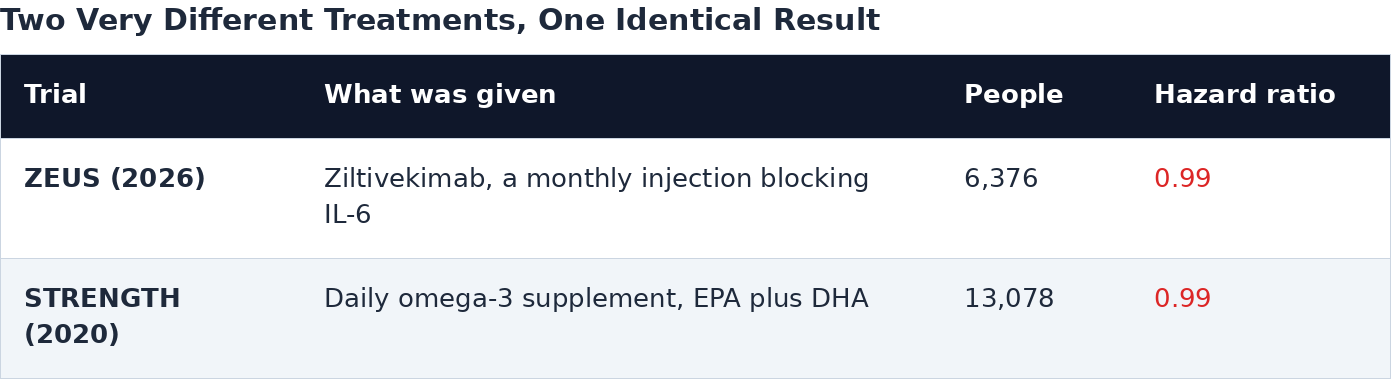
Two mechanistically opposite treatments, one identical result.
These two treatments could hardly be more different. One is a targeted antibody made in a laboratory. The other is an oil derived from fish. They act on different parts of the body through different pathways, and they produced the identical result. When two opposite approaches fail in the same way, that usually means they share a hidden flaw. We believe they do, and it is not the flaw most people assume.
3. The Simplest Way to Understand What Went Wrong
Think of your body's defense against cellular damage as a bucket and a drain.
The water pouring in is oxidative stress, the everyday cellular wear that comes from metabolism, poor sleep, infection, air pollution, excess weight, and time itself. The drain is your antioxidant enzyme capacity, a set of proteins your own body makes, with names like SOD2, GPX1, and GPX4, which neutralize damage before it accumulates. Inflammation is what happens when the bucket overflows.
Now consider what each trial did. The inflammation drug mopped the floor. It reduced the visible overflow without touching either the water coming in or the drain, and the moment you stop mopping, the floor is wet again.
The fish oil trial poured in more water and hoped the drain was open. This sounds unfair to fish oil, so let us explain it carefully, because it is the single most important idea in this guide.
DHA, the omega-3 in question, is a genuinely valuable molecule. It builds itself into the membranes of your cells and makes them more flexible and more functional. But DHA is also, chemically, the most easily oxidized fatty acid in human biology — it has six reactive bonds. And your body has exactly one enzyme that cleans up the specific kind of damage DHA can suffer inside a cell membrane. It is called GPX4.
So if you add a large amount of DHA to a person whose GPX4 capacity is low, you have increased the amount of material that can be damaged without increasing the ability to repair it. In a person with good capacity, DHA helps. In a person with low capacity, the benefit shrinks or disappears.
STRENGTH never measured anyone's capacity. It gave the same dose to everyone and averaged the result. Some people probably benefited. Others probably did not. Averaged together across 13,078 people, the answer was zero.
4. What Genetics Has to Do With It
Not everyone has the same drain. Small, common differences in your DNA, called SNPs and pronounced "snips," change how well these antioxidant enzymes work. These are not rare disease mutations. They are ordinary human variation, and most people carry at least one.
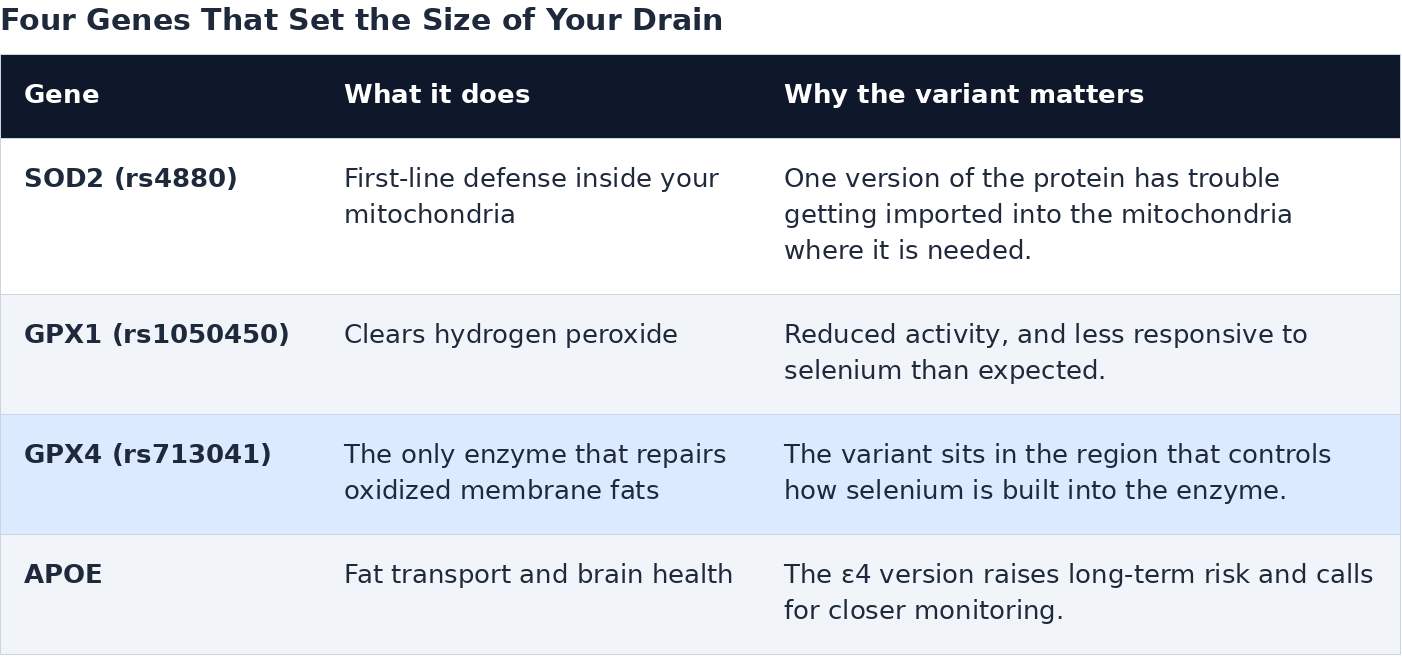
Four common variants, and what each one changes.
GPX4 is the one that connects directly to fish oil. If you carry the variant form, your ability to clean up oxidized membrane fat may be reduced, and that is exactly the job that DHA creates more of.
Neither ZEUS nor STRENGTH tested any of these genes. ZEUS did not even register a plan to look at them later.
5. The Selenium Connection
Here is a detail that turns out to matter a great deal. GPX4 is a selenoprotein, meaning it cannot function without selenium built into its structure. Your body can produce the GPX4 protein, but without enough selenium, the protein sits there without doing its job.
Average selenium levels in the United States are adequate, about 125 µg/L. But averages hide individuals. Selenium comes from soil, and soil selenium varies widely across the country, running lower in the Northwest, the Northeast, and parts of the Southeast.
If you carry the GPX4 variant and your selenium status is unknown or low, high-dose DHA should not be your starting point. Capacity first, then substrate.
This is the kind of decision that requires a measurement, not a guess. It is also the kind of decision no large trial has ever made.
6. The Two-Part Approach: Capacity and Substrate
Our approach uses two things at the same time, because we do not believe either one works properly alone.
Part one — building capacity with your own butyrate
This is the point we most want you to take away from this guide, so we are going to state it as plainly as we can.
The butyrate has to be made by your own gut bacteria, inside your own colon. It is not something you swallow.
That distinction is not a technicality. It is the entire design of the capacity stage. Butyrate is a short-chain fatty acid, and your gut microbes produce it when they ferment certain fibers. What we give you is not butyrate itself but the raw material your microbes need — a specific fermentable blend of tagatose, Fibersol-2, and high-methoxyl pectin. Your own microbiota does the manufacturing.
Why does that matter so much? Because butyrate produced by your microbes is made continuously, in the colon, right where the gut barrier that needs repairing actually sits. A swallowed dose is absorbed early, arrives as a pulse rather than a steady supply, and largely misses the tissue that needs it. The whole mechanism described below depends on butyrate being generated where and when the body can use it — which means it depends on your microbiome doing the work.
It also means the capacity stage can genuinely fail for some people. If your microbial community cannot ferment the substrate well, your butyrate will not rise, and we will see that on the retest. That is precisely why the retest exists.
Why butyrate specifically? Because in laboratory studies it does four things at once that are unusually well matched to this problem. It raises the exact enzymes DHA needs, increasing GPX3 and GPX4 and overall enzyme activity in blood vessel wall cells. It turns on NRF2, your body's master antioxidant switch — and when researchers deleted the NRF2 gene in animals, butyrate's protective effect disappeared entirely, which tells us NRF2 is the actual mechanism rather than a bystander. It calms inflammation upstream by suppressing NF-κB, a control switch that sits well above the IL-6 signal the ZEUS drug was blocking. And it repairs the gut barrier, restoring the tight seals between intestinal cells and sharply reducing the bacterial fragments that leak into the bloodstream and drive chronic inflammation.
That fourth point is worth pausing on. Neither ZEUS nor STRENGTH addressed the gut at all. If part of your chronic inflammation is being fed by a leaky intestinal barrier, no injection that blocks a downstream signal will change that — and neither will a capsule that never reaches the colon.
Part two — the right substrate, in the right order
Once capacity is measurable, we add refined marine microalgal DHA. Microalgal rather than fish-derived, because it is the original source of DHA in the marine food chain and it avoids the contaminant and oxidation concerns that come with fish oil.
And here is the counterintuitive finding that supports this arm. In human studies, DHA — the most oxidizable fat there is — reduced measured oxidative damage by 14 to 27 percent, using a marker called F2-isoprostanes. Adding the most peroxidizable fat in biology and measuring less peroxidation is a real result, and it is why we consider DHA worth including, provided the drain is open first.
Why the order matters
This is the part that makes this a protocol rather than a supplement stack. The DHA stage does not begin until the capacity stage has been confirmed by testing. No omega-3 trial has ever required this. STRENGTH did the opposite by design.
7. What Test–Treat–Retest Looks Like
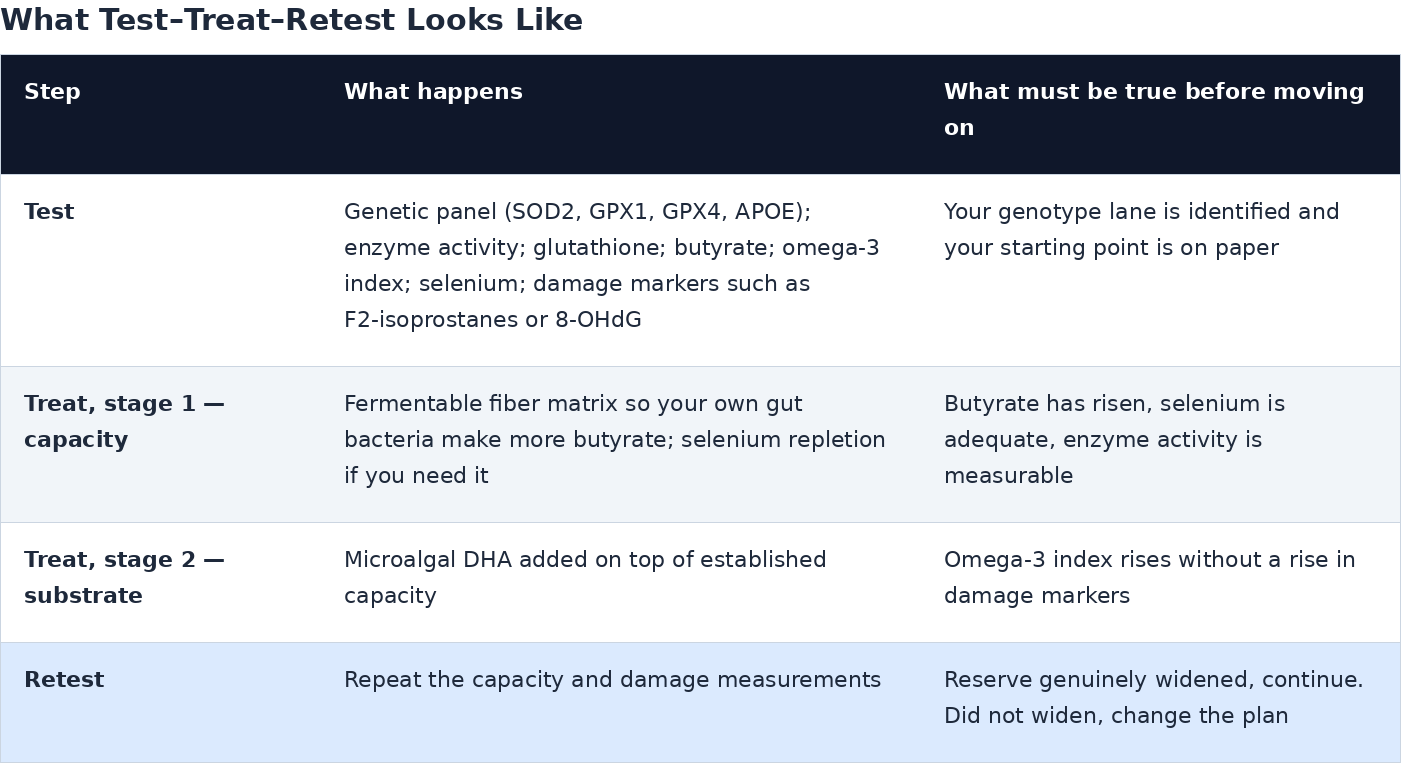
The four phases, and the gate that must be met before each advance.
That last box is the whole point. If the numbers do not move, we do not tell you to keep going and hope. We re-stratify. Both large trials confirmed their treatment reached its target and stopped there. Neither went back to ask whether the underlying process had actually changed.
8. Five Genotype Lanes
Your results place you in one of five general paths. Your clinician determines which.
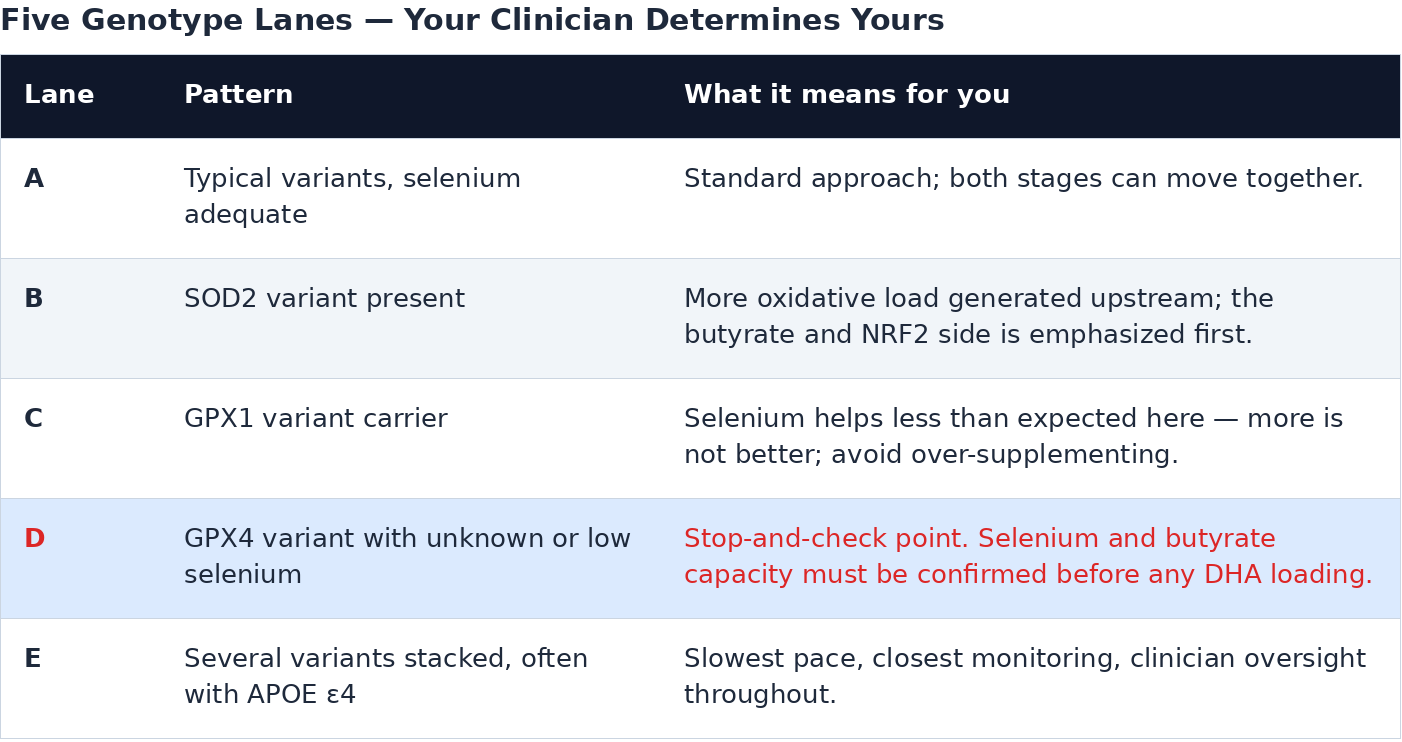
Lane D is the hard rule.
Lane D exists because the biology is specific, not because we are being cautious for its own sake.
9. Three Things We Want to Correct
We would rather tell you these ourselves than have you discover them elsewhere.
DHA does not lower your apoB
Apolipoprotein B, or apoB, is a measure of how many cholesterol-carrying particles are circulating in your blood, and it is one of the best predictors of heart risk available. DHA does not lower it. At some doses it raises it slightly, around 3 percent in one study.
What DHA does instead is change the character of those particles: larger, fluffier, and considerably harder to oxidize. Combined with butyrate raising your cleanup enzymes, the honest description is that this approach reduces how oxidizable and sticky your particles are, not how many of them there are.
What this means for you is straightforward. If lowering apoB is one of your goals, that is what statins, PCSK9 inhibitors, and related medications are for. Our approach is meant to sit alongside those, not replace them. If you are on one, keep taking it unless your own physician tells you otherwise.
We do not claim to reverse plaque
You may have seen claims that natural approaches reverse arterial plaque. We are not making that claim. The butyrate plaque data are genuinely impressive — a 50 percent reduction in arterial lesions, with more collagen and more stable plaque composition — but that work is in mice, at butyrate doses far above what a human diet produces. In humans, plaque regression has been shown only with aggressive cholesterol-lowering drug therapy. The word we are willing to stand behind from our evidence is stabilization, not reversal.
We have not run an outcomes trial
Nobody has tested whether this coupled approach prevents heart attacks and strokes. That study has not been done. What we have is mechanism — a chain of laboratory and human marker studies that fit together — plus two specific experiments we have designed to try to prove ourselves wrong.
Mechanism is a reason to test something carefully. It is not proof of benefit.
10. Why We Think Personalization Is the Missing Piece
The strongest evidence for this way of thinking comes from an unexpected place. Researchers gave a nutrient combination called GlyNAC to older adults who had a measured deficiency in glutathione, and it worked, improving oxidative stress, mitochondrial function, inflammation, and physical function. They then gave the same combination to 114 healthy older adults whose glutathione was already normal, and it did essentially nothing.
The benefit existed only where the deficit existed.
Now apply that to a trial with thousands of people who were never measured. The people with a real deficit may improve. The people without one will not. Average them together and the result trends toward zero, which is the arithmetic behind both hazard ratios of 0.99.
There is a second version of the same lesson. Plasma antioxidant vitamins such as vitamin E were tested across 188,209 people in 15 trials and showed no cardiovascular benefit, with vitamin E linked to increased bleeding-stroke risk in one analysis. Yet a version of an antioxidant engineered to reach the mitochondria specifically improved blood vessel function in older adults in six weeks. Same category of compound, opposite results. The variable that changed was where it went, and whether the person receiving it actually needed it.
11. Questions to Bring to Your Clinician
Ask what your SOD2, GPX1, GPX4, and APOE genotypes are, and what your selenium level is and whether your genotype changes what an ideal level would be for you. Ask what your baseline oxidative damage markers are and whether they can be rechecked in twelve weeks. If you are taking a fish oil supplement now, ask whether your cleanup capacity is adequate for that dose. Ask whether any of this should change the medications you already take — our answer is that it should not, without your physician's direction. And ask what the plan is if your retest numbers do not improve.
12. What We Can and Cannot Say
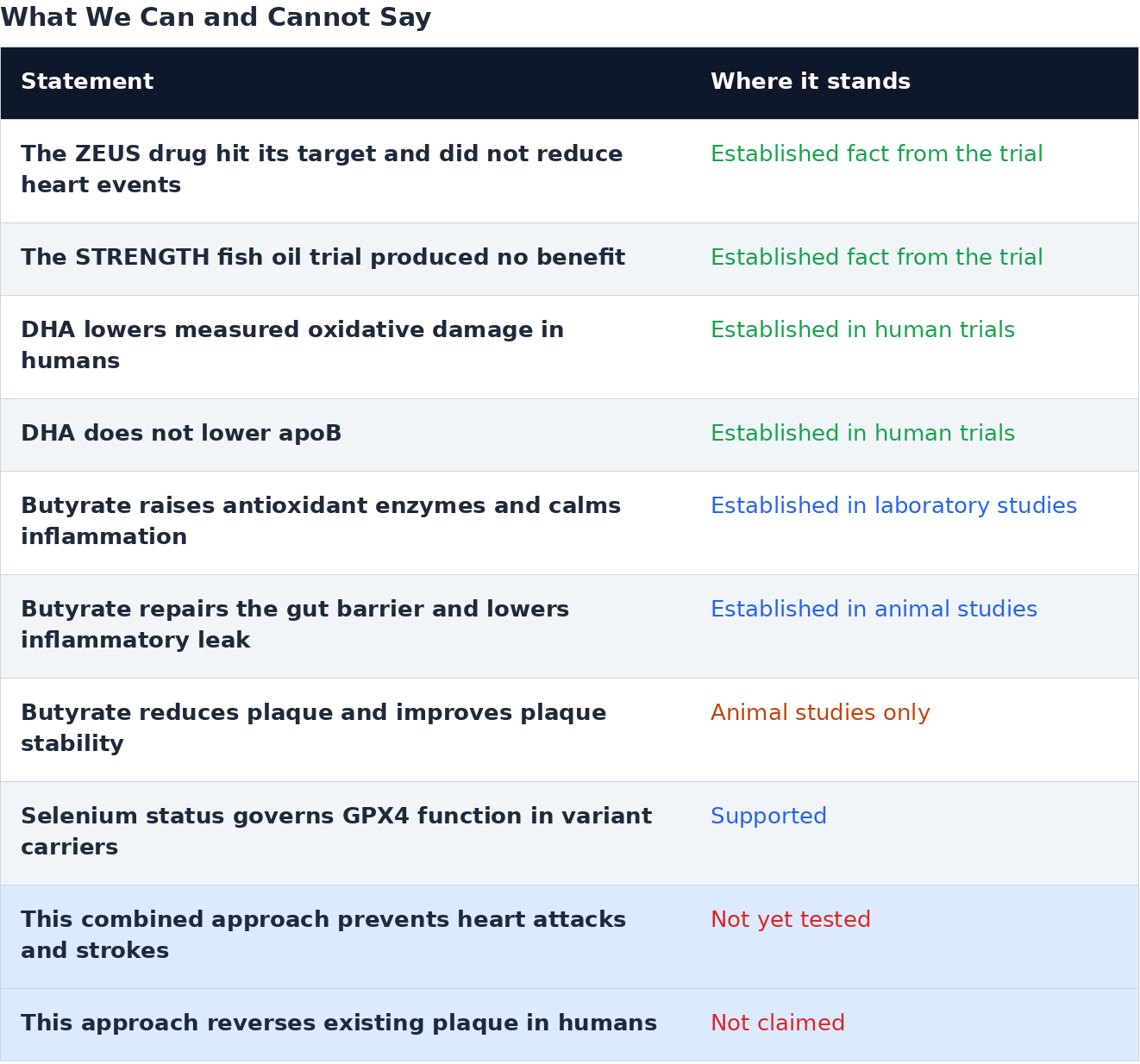
Every claim in this guide, graded by the strength of evidence behind it.
13. The Short Version
Two large, well-funded, well-run trials gave the same answer: no benefit. We do not read that as proof that inflammation does not matter, or that omega-3 fats are useless. We read it as proof that giving the same thing to everybody, without measuring who needs it, produces an average of nothing, even when the underlying biology is sound.
Your capacity to handle oxidative damage is partly written in your genes, partly determined by your nutrient status, and measurable today. Building that capacity first — with butyrate your own microbes produce, in your own colon — adding the right substrate second, and then checking whether the numbers actually moved is a different approach from anything either trial attempted.
It has not been proven at the level of heart attacks and strokes. We say so plainly. But it can be measured in you, in your own results, and that is more than the average of 19,000 strangers can offer.
Author's Note
Everything above this section is written to the evidence, and the grading table means exactly what it says. No one has shown in humans that this protocol lowers existing plaque, and we have not run the trial that could. What follows is our belief rather than our evidence, and we want it labeled that way before you read it.
We designed the ReBalU protocol to be among the largest sustained producers of endogenous butyrate available in any structured program — not a dose swallowed and absorbed early, but a fermentable substrate matrix that turns your own colon into the manufacturing site, continuously, for as long as you stay on it. We believe that distinction is the reason to expect more from this design than from what has been tried before. The butyrate work in animals showed a 50 percent reduction in arterial lesions, with more collagen and more stable plaque composition, at exposures far above what an ordinary diet produces. Those exposures are high. But they are the range a well-fed microbial community, given the right substrate and enough time, is capable of generating in the tissue where it matters — which is precisely what no capsule and no injection has ever attempted.
So we will state our expectation as an expectation. We believe that following the design set out above does not merely stall plaque accumulation but lowers it. We hold that view because the mechanism is coherent end to end: capacity first, substrate second, the gut barrier closed at the source, and the whole loop verified by retest rather than assumed.
We may be wrong. We would rather be shown wrong than believed on faith, which is why the two falsifying experiments exist and why the retest is a gate rather than a formality. Until that work is done, read this section as what it is — the authors' conviction about where the evidence is heading, not a statement about what has been demonstrated.
Where These Facts Come From
This guide summarizes the technical whitepaper SOD-MEC-001, "The Coupled Correction," which contains 53 references. Key sources include the ZEUS trial design and results (JAMA Cardiology 2026; ClinicalTrials.gov NCT05021835; Novo Nordisk Form 6-K); the STRENGTH and REDUCE-IT comparison (Circulation 2021); DHA and LDL particle studies (JCEM 2018; AJCN 2004); F2-isoprostane measurements in humans (Redox Report 2000, and subsequent randomized trials); the butyrate mechanism literature covering antioxidant enzyme upregulation, NRF2 activation via HDAC inhibition, gut barrier restoration, and plaque effects in ApoE-knockout mice; the SOD2 Ala16Val and GPX4 rs713041 variant characterizations; the vitamin E and MitoQ comparison; the GlyNAC trials in deficient and replete older adults; and NHANES selenium data. Reference numbers match SOD-MEC-001 so the two documents can be read side by side.
This document presents a scientific hypothesis for discussion. It is not medical advice. The proposed intervention has not been evaluated by the FDA and is not intended to diagnose, treat, cure, or prevent any disease. Consult a qualified clinician before making any change to your medications, supplements, or treatment plan. © 2026 SOD Sciences Inc.