
The Railroad Got Built. The Bankers Went Broke.


Every great infrastructure boom of the last 180 years was financed the same way. The AI buildout is following that pattern, and history shows who wins when the financing resets.
Key Takeaways
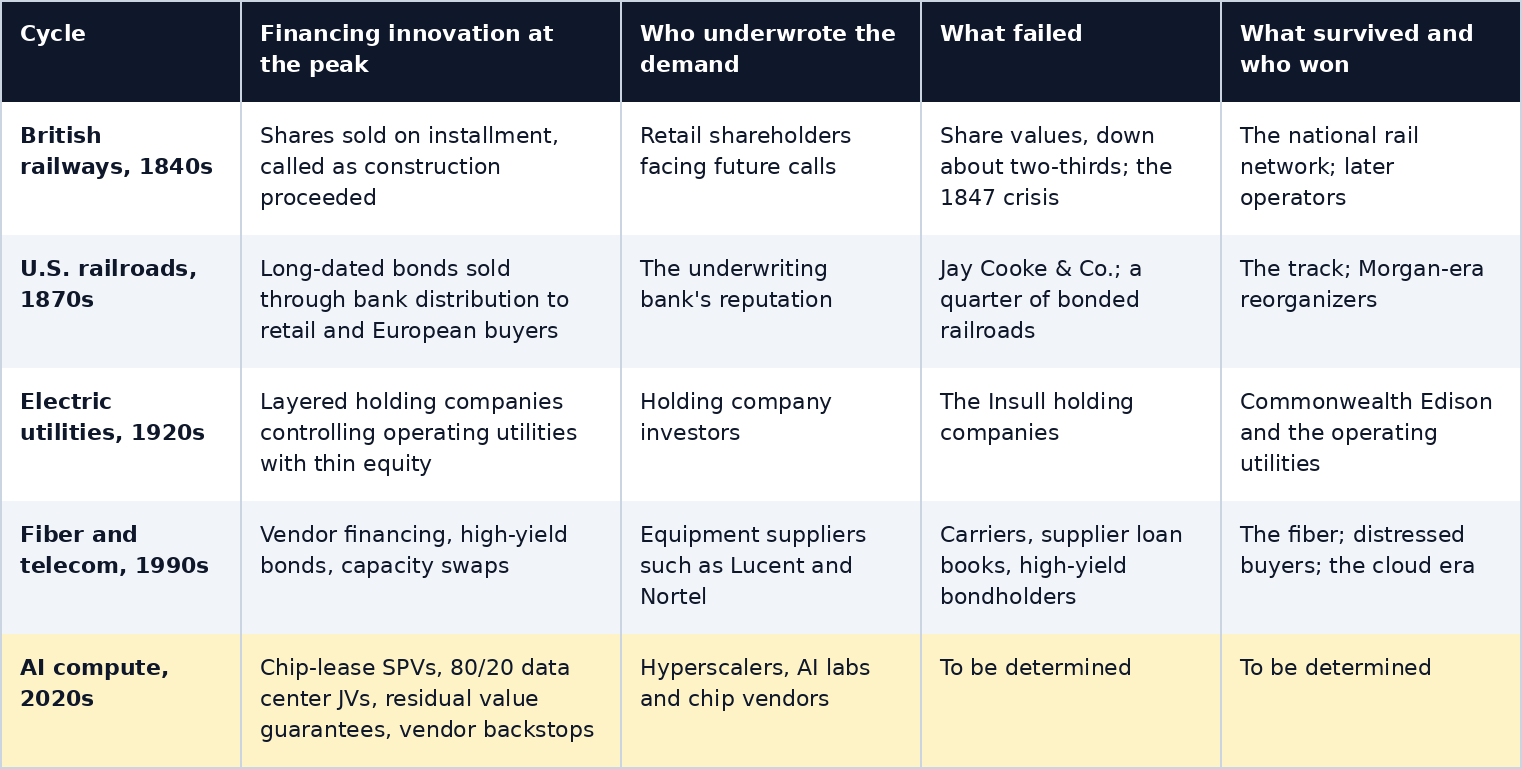
The pattern is consistent. British railways in the 1840s, American railroads in the 1870s, 1920s electric utilities and the 1990s fiber buildout each moved from cash-funded growth to bonds, then to structured and vendor-backed financing, then to a credit market that began to discriminate, and finally to a sorting that wiped out the financial layer while the physical asset survived.
AI financing has entered the late structuring stage. Off-balance-sheet chip vehicles, 80/20 data center joint ventures, 16-year residual value guarantees and a vendor backstop option of up to $125 billion are the modern versions of instruments that defined every prior cycle.
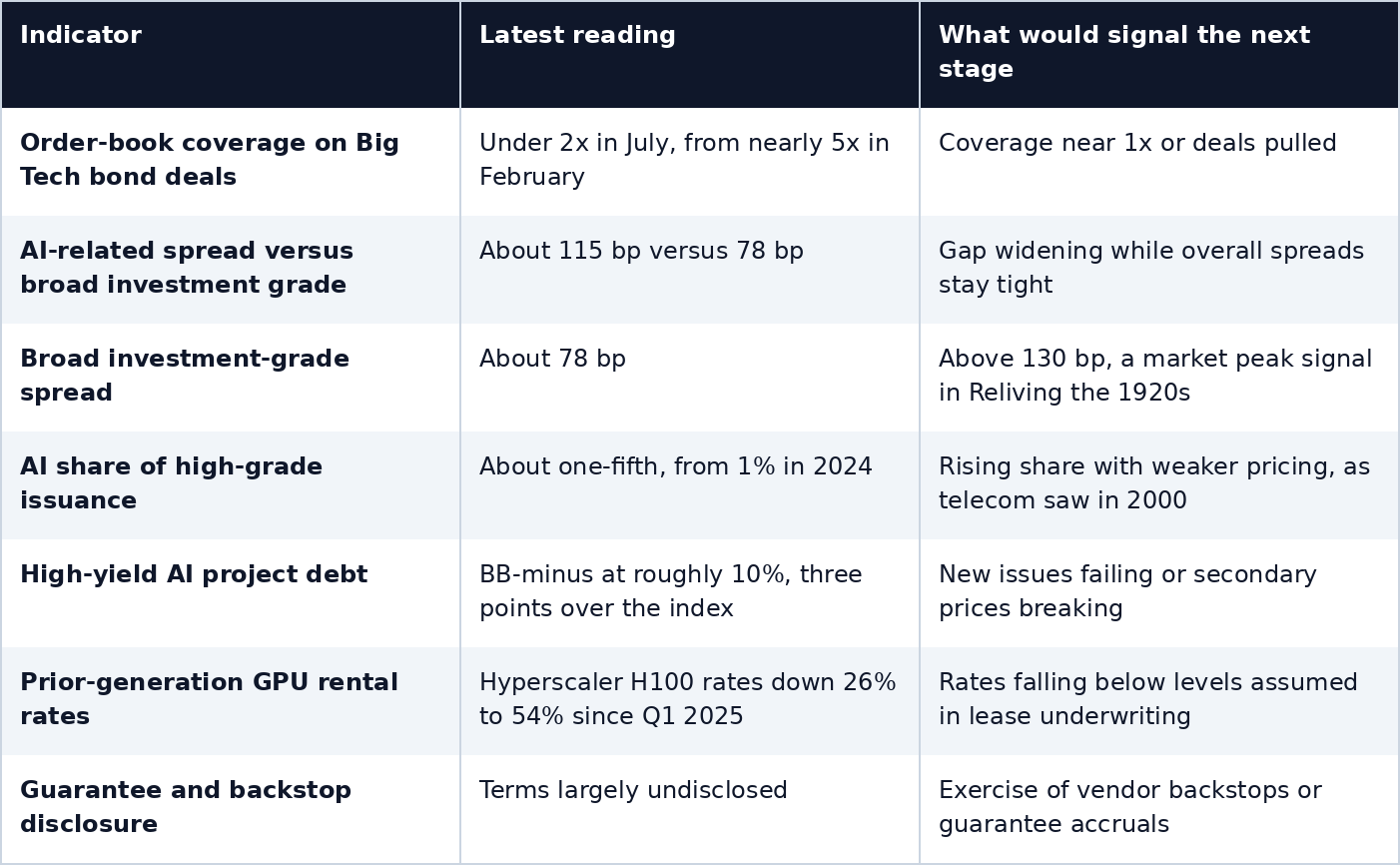
The bond market has started to discriminate. AI-related high-grade issuers price near 115 basis points against 78 for the broad market, and order books on Big Tech deals fell from nearly five times covered in February to under two times by July.
The predictable outcome is a sorting, not a collapse of AI. History says losses concentrate where fast-depreciating assets are financed with long-dated money and where one party has guaranteed another party's demand. The best returns of the cycle go to the capital that arrives after the reset.
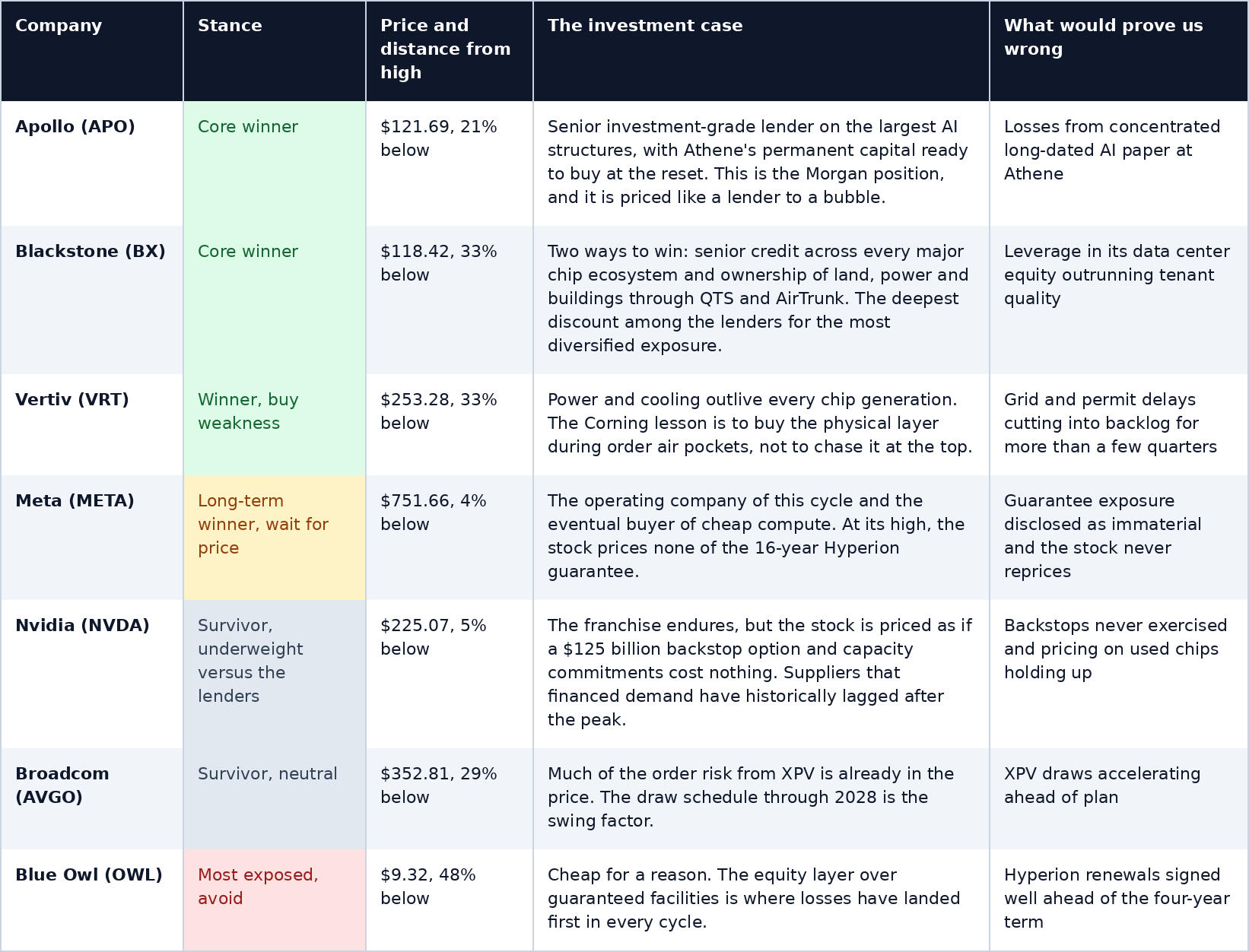
The trade is to own the lender and the land, not the chip or the guarantee. Apollo and Blackstone are the core winners, Vertiv is a buy on weakness, Meta wins at a lower price, Nvidia and Broadcom survive with lower returns, and Blue Owl is the most exposed.
Our timing window is 2027 to 2028. In prior cycles, one to two years separated the first visible credit discrimination from the sorting event. We expect strain at the edges of AI credit first and a broader sorting around the 2028 horizon on which most of today's financing frameworks are built.
The Banker Who Was Right About the Railroad
On the morning of September 18, 1873, Jay Cooke & Company closed its doors. Cooke was not a promoter working the fringe of the market. He was the banker who had sold the Union's war bonds to ordinary Americans, and his name was as close to a sovereign guarantee as private finance offered. He had put that name behind the Northern Pacific Railway, a transcontinental line through country that had almost no traffic yet. When the firm could no longer sell the railroad's bonds, it could no longer stand. The New York Stock Exchange shut for ten days.
The railroad was not a bad idea. The Northern Pacific was finished a decade later, and the territory it opened became one of the great engines of American growth. What failed was the financing: long-dated bonds sold against revenue that did not yet exist, distributed on the strength of a banker's reputation rather than the asset's cash flow. From 1873 through 1875, defaults reached roughly 36% of the par value of the entire U.S. corporate bond market, the worst stretch in a 150-year record, and nearly a quarter of all railroads with bonds outstanding defaulted.
The AI buildout now has its own great banker. In June, Apollo led a $35 billion capital solution for Broadcom's new AI XPV platform alongside Blackstone and a syndicate of global banks, a deal Apollo described as the largest private financing ever executed. The platform is designed to enable more than 20 gigawatts of compute for frontier AI labs through 2028. The structure is instructive. A special-purpose vehicle raises the debt, buys the chips, including Google tensor processing units that Broadcom co-designs, and leases them to Anthropic. The lease payments repay the loan, the senior tranches are rated investment grade, and the hardware stays off Anthropic's balance sheet. Apollo's insurance arm, Athene, is reported to hold a sizable portion.
Meta took a parallel route with its Hyperion campus in Louisiana. Funds managed by Blue Owl own 80% of the joint venture that is financing the roughly $27 billion development, Meta owns 20%, and the venture issued the bonds, so the debt sits off Meta's balance sheet. Meta occupies the site under a four-year lease with renewal options out to 16 years and has provided a residual value guarantee for the first 16 years of operation. The project earned an A+ rating, in part because of that commitment to cover shortfalls in the site's value if Meta walks away.
Then, on August 10, Nvidia signed memorandums of understanding with Apollo, BlackRock, Blackstone, Brookfield, Goldman Sachs and KKR to build financing platforms intended to mobilize more than $500 billion of third-party capital for its customers. Jensen Huang added that Nvidia has the option to backstop up to $125 billion, or 25% of the potential deals. Morgan Stanley estimates the buildout will need roughly $1.5 trillion of outside financing through 2028, most of it from private credit.
None of this means AI is failing. It means AI has reached the stage that every great infrastructure boom reaches, when the capital required outruns the balance sheets of the companies that want the asset and Wall Street builds structures to close the gap. That stage has a long history, and the history is remarkably consistent about what comes next.
Four Booms, One Script
Each of the following cycles was built on a technology that proved every bit as important as its promoters claimed. Each was financed, at its peak, by instruments that separated the party that wanted the asset from the party that carried its risk. And in each case the asset survived while the financial superstructure above it did not.
British Railway Mania, 1843 to 1850. Railway share prices roughly doubled between early 1843 and the summer of 1845 as thousands of new lines were projected, and investors bought stock on installments that could be called later. Railway investment peaked near 7% of national income in 1846 and 1847. The Bank of England began raising its discount rate in the autumn of 1845, share prices turned, and a severe financial crisis followed in 1847. The railway share index ultimately lost about two-thirds of its value. Britain still ended the decade with some 6,000 miles of track, up from 98 miles in 1830.
American railroads, 1869 to 1879. Cooke's failure was the headline, but the damage was systemic. By 1876, 134 railroads were in default on $500 million of bonds out of roughly $2 billion outstanding. The track stayed in the ground. After the next railroad collapse in 1893, J.P. Morgan reorganized much of the national system, and the bankers who arrived with capital after the failures ended up controlling the industry.
Electrification, 1920s. Samuel Insull brought electric power to much of the Midwest, then stacked holding companies on top of his operating utilities to control more assets with less equity. When receivers arrived in April 1932, Insull Utility Investments reported about $254 million of liabilities against $27 million of assets, most of them pledged. Investors lost roughly $750 million, most of it from small holders. Yet Commonwealth Edison, Peoples Gas and Public Service of Northern Illinois, the operating companies that actually generated and delivered power, survived. Congress answered with the Public Utility Holding Company Act of 1935.
Fiber and telecom, 1996 to 2002. The industry spent nearly half a trillion dollars on networks and piled up close to $300 billion of debt. Equipment makers lent customers the money to buy their gear. By the end of 2000, nine suppliers had extended about $25.6 billion of vendor financing, and Lucent alone had agreed to provide as much as $8.1 billion in customer financing and loan guarantees. In 2000, telecom accounted for 40% of all high-yield issuance. By mid-2001 Merrill Lynch estimated only 2.6% of the new fiber capacity was in use. The sector lost about $2.5 trillion of market value, Global Crossing went from a $47 billion valuation to roughly $70 million, and in 2002 about 57% of high-yield default dollars came from telecom. Corning fell from $113 to $1.10 and Cisco from $80 to $8.60, even though both survived. Hutchison Whampoa and Singapore Technologies Telemedia bought control of Global Crossing for $250 million, and dark fiber that had sold for $1,200 a mile traded for $200 or less. A decade later, that same cheap fiber carried the cloud.
The Seven Stages
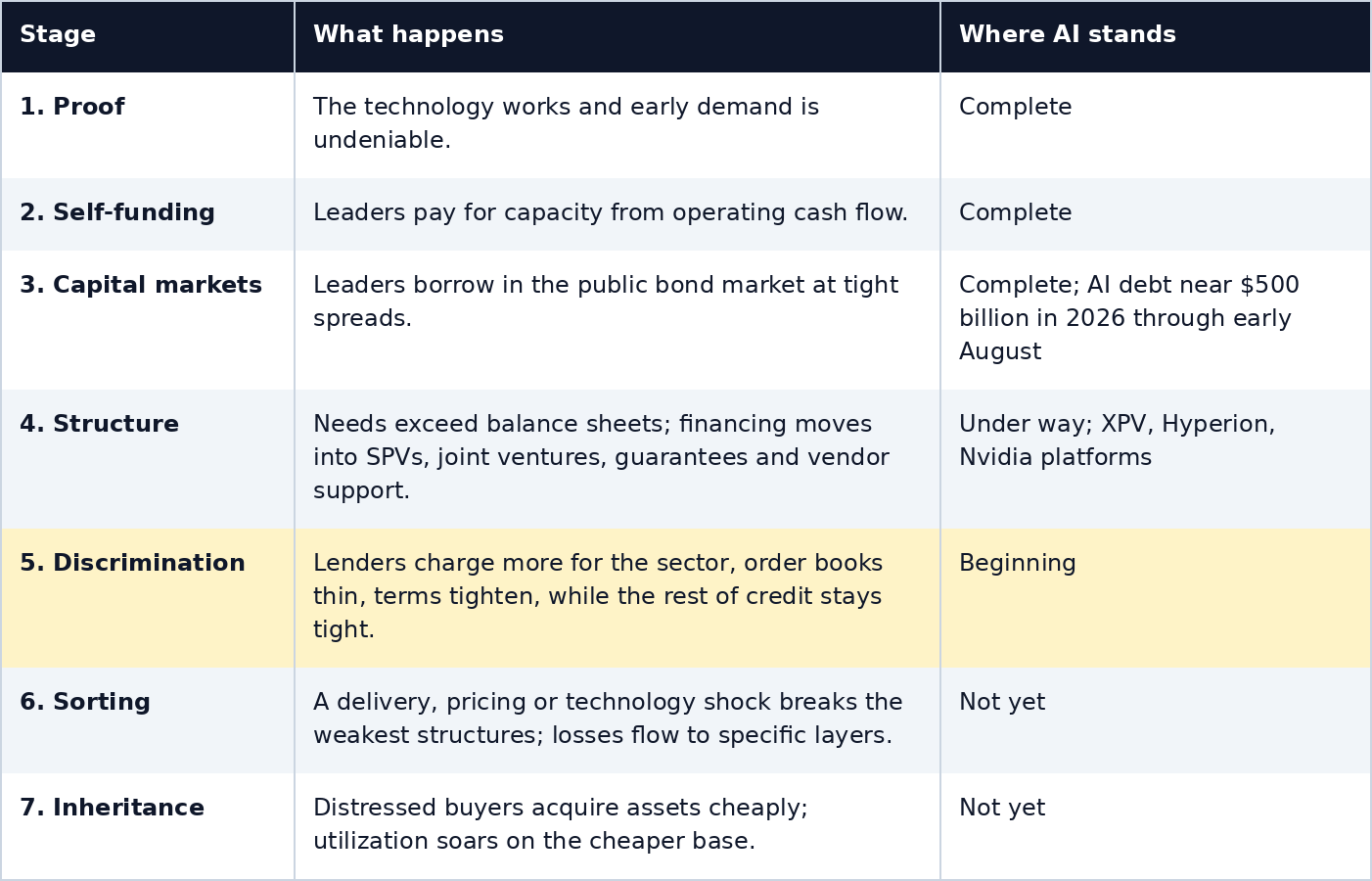
Strip away the particulars and every cycle runs through the same sequence. The value of the framework is that it tells an investor not whether the technology will matter, which history answers yes, but which stage the financing is in and what the next stage typically does to each layer of the capital structure.
The Credit Market Is Already Talking
In every prior cycle, the bond market noticed first. In 2000, U.S. credit spreads widened considerably, led by high yield and telecom, while equity investors were still debating whether the internet story had ended. The same kind of divergence is now visible in AI credit.
AI-related debt sold this year reached nearly $500 billion through early August, about one-fifth of all higher-rated U.S. issuance, up from 1% in 2024. Apollo's own chief economist, Torsten Slok, has pointed out that orders for debt from Alphabet, Amazon, Meta, Microsoft and Oracle fell from nearly five times the amount offered in February to less than two times by July. Reuters reported last week that AI-related issuers trade near 115 basis points against 78 for the broad investment-grade market, that some double-A AI credits are pricing closer to triple-B levels, and that Alphabet needed a large concession to complete an August deal. At the same time, Aon's $13.5 billion acquisition financing drew $65 billion of orders.
The portfolio managers quoted are not predicting defaults by the hyperscalers, and neither are we. Their concern is volume, unpredictable future borrowing and limited visibility into returns on invested capital. Several are approaching single-name limits once parent-backed data center vehicles are aggregated back to the sponsoring company, which is exactly the point: the market is beginning to look through the structures to the party that ultimately owns the risk. Goldman Sachs expects hyperscaler gross issuance of $420 billion in 2027, 60% above 2026 estimates, so the supply pressure is scheduled to rise, not fall.
Lenders are also tightening terms. CyrusOne's roughly $10 billion August financing includes a construction portion that cannot be drawn until permits are secured and leases are signed, and a Texas pause on new grid connections puts nearly 50 gigawatts of proposed projects, about one-fifth of the U.S. pipeline, at risk of delay. Further down the credit spectrum, Galaxy Digital sold $3.5 billion of BB-minus bonds for a CoreWeave campus at roughly a 10% yield, about three points over the high-yield index. That is Stage 5. It is also where the CLECs of 1999 were trading before they became the defaults of 2001.
The Duration Trap
The core problem in every prior cycle was a mismatch between the life of the asset and the life of the money. Railway bonds ran for decades against traffic projections. Fiber was financed as if bandwidth prices would hold while wave division multiplexing kept multiplying the capacity of each strand. The AI version is sharper because the most expensive component depreciates the fastest.
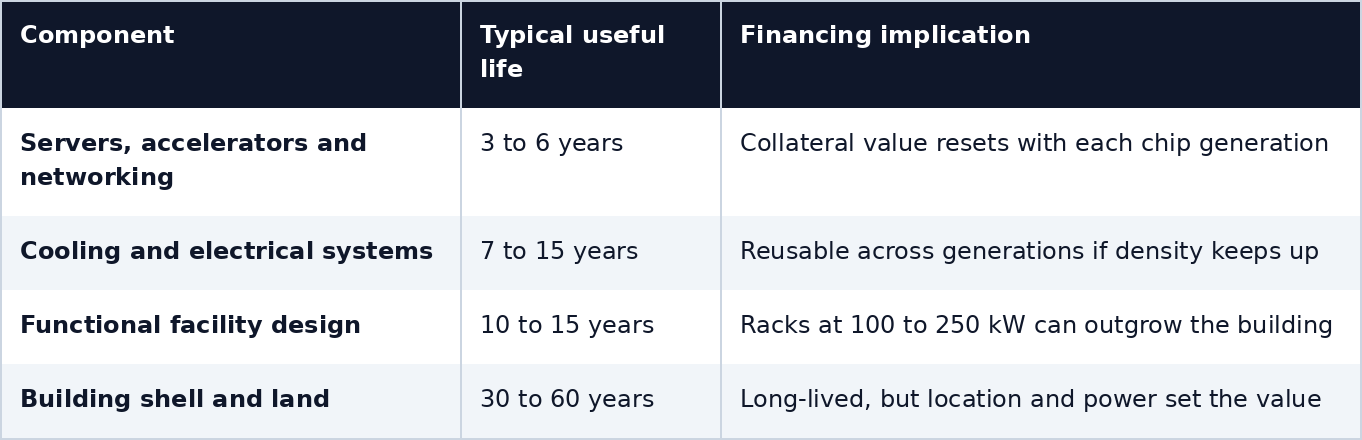
Google rolled out four generations of its tensor processing units in roughly three years, and Amazon has already shortened the assumed life of some servers from six years to five, citing the pace of AI development. Hyperscaler H100 rental rates fell 26% to 54% by region between the first quarter of 2025 and the third quarter of 2026. A repossessed chip is worth only what someone will pay for computing on it at that moment, and if a borrower defaults because demand has cooled, the collateral loses value at the same time. Moody's estimates the five largest U.S. cloud companies carry about $662 billion of data center lease commitments off their balance sheets, equal to 113% of their adjusted debt.
Hyperion shows how the mismatch is being managed rather than removed. A four-year initial lease sits against a building expected to last decades, and the gap is bridged by Meta's 16-year residual value guarantee. That guarantee is what makes the bonds A+ rather than something lower. It does not eliminate the risk. It assigns it to Meta, in contingent form, where it does not appear as debt.
What Is Different This Time
A credible pattern call has to acknowledge where the analogy is weakest, and there are real differences. The anchor borrowers are among the most profitable companies ever built; Nvidia's trailing net income was roughly $160 billion when it announced its financing platforms. North American data center vacancy is about 1%. The telecom carriers of 1999 were leveraged start-ups; today's lessees are Meta, Google and frontier labs with multi-year contracts. And the vendor has learned from Lucent: Nvidia's platforms are structured as independent pools of third-party capital rather than loans on Nvidia's own balance sheet.
These differences change the magnitude of the outcome, not its shape. The borrowers are stronger, but the structures are the same, and the size is far larger. Nvidia's $500 billion target is roughly 20 times the vendor financing that nine telecom suppliers had extended by the end of 2000, and its $125 billion backstop option alone would be more than 15 times Lucent's peak commitment. Strong sponsors do not prevent a sorting. They determine who survives it.
Where the Losses Land
History is most useful here. Losses in every cycle have followed the same map: they start with the thinnest-capitalized borrowers financing the shortest-lived assets, travel next to anyone who guaranteed someone else's demand, and stop at senior, secured capital backed by long-lived physical assets. The table below applies that map to the named participants.
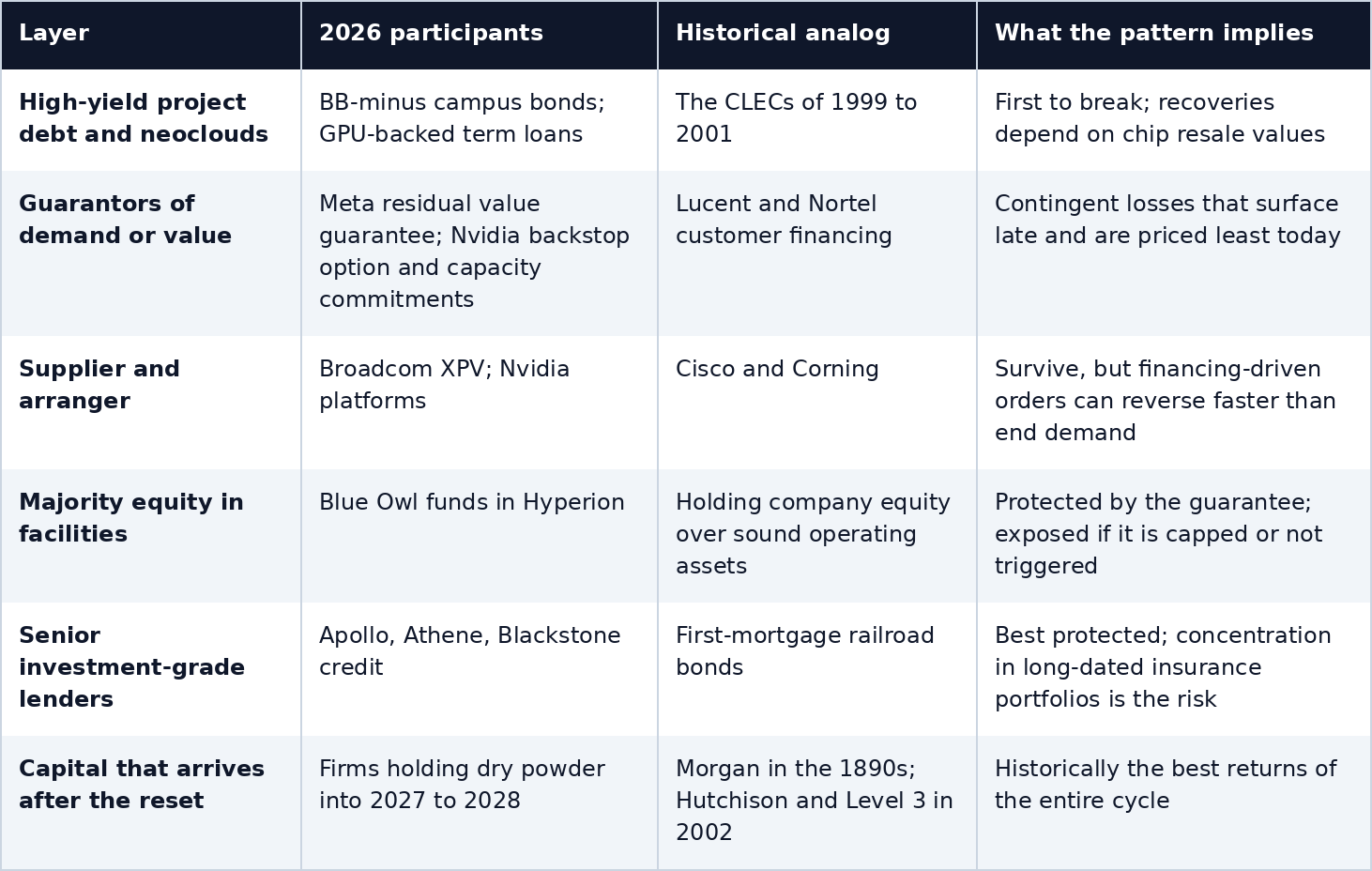
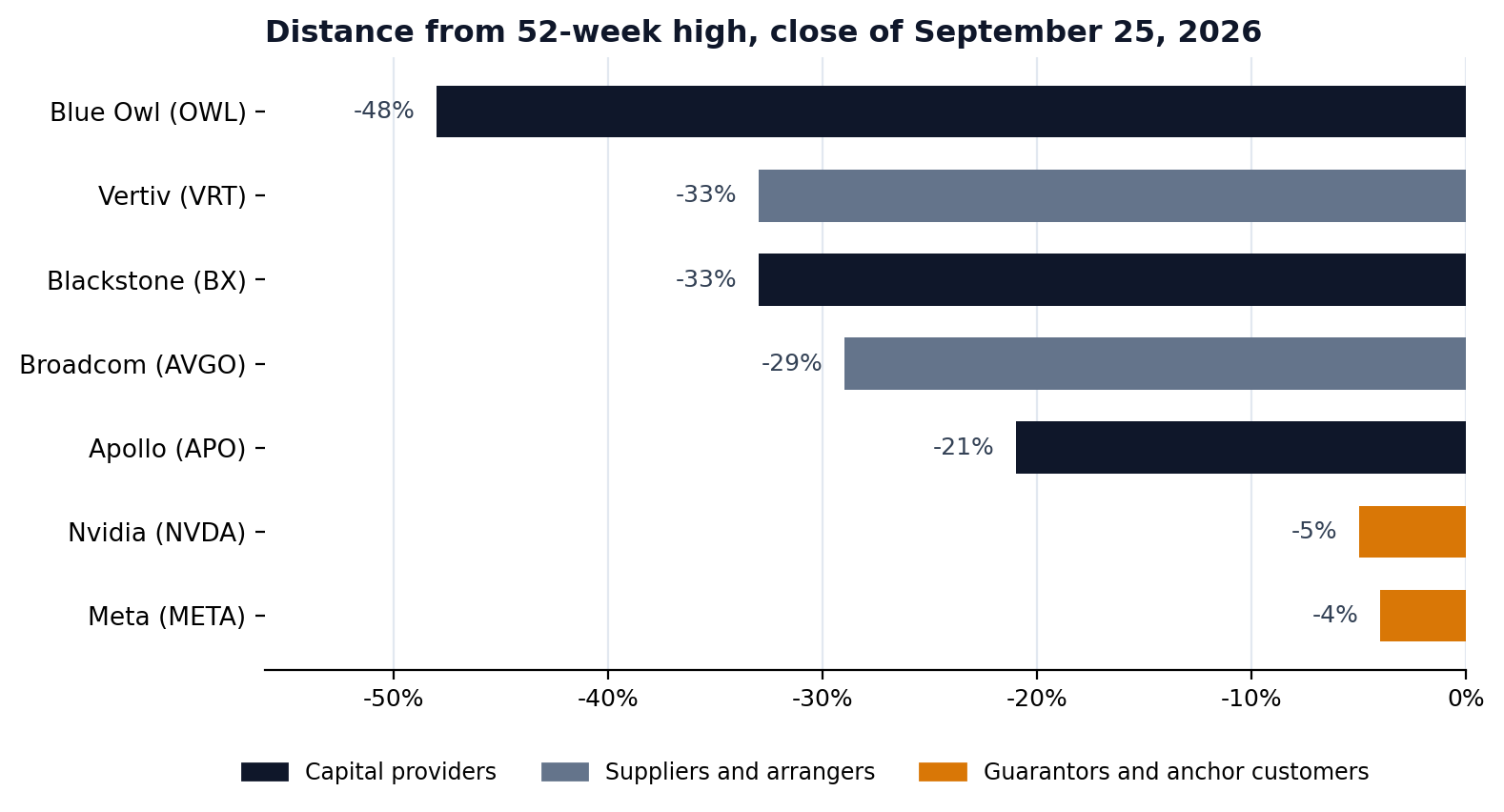
The equity market is already sorting, but not in the order history suggests. As of Friday's close, Blue Owl traded 48% below its 52-week high, Blackstone and Vertiv 33% below, Broadcom 29% and Apollo 21%. Nvidia and Meta, the two names carrying the largest contingent commitments, sat within 5% of their highs. Investors have marked down the lenders and the suppliers. They have not yet marked the guarantors.
Company Positioning
Apollo (APO). The lead position in the largest private financing on record gives Apollo the franchise that Morgan held in railroads: origination at scale, senior placement and balance sheet capacity through Athene. The risk is concentration. Insurers are already among the heaviest buyers of long-dated AI paper, and the pattern favors lenders who keep capital in reserve for Stage 7.
Blackstone (BX). Blackstone participates through its credit and insurance business and has anchored chip-backed loans across Broadcom, Google and Nvidia ecosystems, including an $8.5 billion CoreWeave facility. Diversification across chip platforms is a hedge against any single generation losing value.
Blue Owl (OWL). As the 80% owner of the Hyperion venture, Blue Owl holds the layer that historically carries the most equity risk, cushioned by a residual value guarantee from one of the strongest credits in the world. The stock's drawdown suggests the market is already discounting the model.
Broadcom (AVGO). Broadcom now earns on both the silicon and the financing that enables it to be purchased. That is the Cisco position of 1999: durable franchise, but revenue partly pulled forward by capital that can become more expensive or scarce. Investors should weigh XPV-driven orders against organic demand.
Nvidia (NVDA). Nvidia has avoided Lucent's core mistake by keeping lending off its own balance sheet, yet the option to backstop up to $125 billion and its commitments to buy unsold customer capacity recreate part of the exposure in contingent form. Disclosure of how much of that option is exercised will be one of the most important data points of 2027.
Meta (META). Meta can afford the Hyperion guarantee. The point is that the obligation exists, runs 16 years and does not appear as debt, and similar structures are proliferating across the sector.
Vertiv (VRT). Power and cooling have a longer useful life than chips and can move across generations, which makes Vertiv a better-positioned supplier than Corning was in 2000. The lesson from Corning is that physical-layer orders are the last in and the first out when financing tightens. Vertiv is expanding manufacturing, and its upside depends on projects proceeding on schedule.
The Predictable Outcome
Pattern analysis does not produce certainty, but four historical regularities have held in every cycle reviewed here, and we expect them to hold again.
The technology wins and the infrastructure survives. Railways, power grids and fiber all ended up more heavily used after their financial crises than before. AI compute will follow the same path, and falling costs will expand demand.
The first losses land at the edge, not the center. Expect stress to appear first in high-yield campus bonds, GPU-backed loans to second-tier operators and vehicles whose collateral is prior-generation silicon. The hyperscalers are the Commonwealth Edisons of this cycle, not the Insull holding companies.
Guarantees become the story. As in the Lucent era, the most consequential losses will come from obligations that did not look like debt when they were signed. Residual value guarantees, capacity purchase commitments and vendor backstops are where the market has the least visibility and where repricing will be sharpest.
The best returns go to the capital that arrives last. Morgan in the 1890s and the buyers of Global Crossing and dark fiber in 2002 earned more than the capital that built the assets. The firms that preserve liquidity into the sorting will set the terms for the next phase of AI infrastructure.
On timing, the distance between the first visible credit discrimination and the sorting event ran from roughly one to two years in the cleanest precedents: from the Bank of England's rate increases in late 1845 to the crisis of 1847, and from the telecom spread widening of 2000 to the Global Crossing and WorldCom filings of 2002. Measured from the order-book deterioration between February and July of this year, that points to 2027 and 2028, the same horizon on which the Broadcom platform, Morgan Stanley's financing estimate and much of the current guarantee structure are built.
The same sequence maps closely onto the 1921 to 1929 calendar that Joseph M. Salvani and I use in Reliving the 1920s, where 2020 corresponds to 1921. Proof and self-funding run from 1921 through 1925, as electrification and mass production spread from a Dow of 63 in August 1921. The capital markets stage is 1926 and 1927, when call loans to New York Stock Exchange brokers rose from $3.3 billion to $4.4 billion. Structure arrives in 1928: money placed in investment trusts rose from $175 million to $790 million, Goldman Sachs Trading Corporation launched in December, and the Fed sold securities to tighten credit. Discrimination is 1929. By spring, more than half of brokers' loans came from lenders other than banks, and by October banks held only 30% of call loans, much as private credit is now taking over AI finance from bank balance sheets. The New York Fed's discount rate reached 6% in August, and the Dow peaked on September 3. Sorting followed with the October crash and the Insull receiverships of 1932, and inheritance with the utility holding company law of 1935.
On that calendar, 2026 corresponds to 1927, and AI finance is running roughly a year ahead of it: the structuring of 1928 is already under way and the first discrimination is visible now. That supports the book's August 2028 peak rather than challenging it. In the 1920s, credit tightened for more than a year while stocks kept rising, so strain at the edges of AI credit in 2027 is the counterpart of 1928 and early 1929, and the broader sorting would follow the peak. The book's call rests on a separate framework and is referenced here only for comparison.
Signposts to Watch
The True Winners
The verdict from 180 years of infrastructure finance is unambiguous. The winners of this cycle will be the senior lenders with permanent capital and the owners of long-lived physical assets. Today the market is pricing them as if they were the losers. As of Friday's close, the lenders and the physical-layer supplier trade 21% to 33% below their highs, while the two companies carrying the largest unpriced guarantees trade within 5% of theirs. That gap is the opportunity, and history says it closes in favor of the lender.
How to Position
Own the lender and the land. Apollo and Blackstone are the public companies closest to the position that captured the best returns in 1873, 1893 and 2002: senior claims today and the capital to buy distressed assets tomorrow.
Buy the physical layer on weakness. Vertiv's equipment survives the chip cycle. Weakness caused by project delays is an entry point, not a warning.
Wait for the guarantors to reprice. Meta will be a winner, but not at a price that ignores its guarantees. Better entry points typically arrive when AI credit spreads widen and contingent obligations make the headlines.
Underweight financed demand. Hold Nvidia and Broadcom below the weight of the lenders until revenue that exists because someone financed it is separated from revenue that does not.
Avoid the thin equity layer. Blue Owl, neocloud equity and high-yield AI project bonds carry the first-loss position. They become buys only after the sorting, at distressed prices.
The trade in one sentence: own the lender and the land, not the chip or the guarantee.
The Question That Matters
The Northern Pacific was built. The power plants of the Midwest kept running after the Insull empire fell. The fiber buried in 1999 carries the internet today. In each case the people who were right about the technology were not necessarily the people who made money on it, because returns were decided by the terms of the financing and the order in which the losses were absorbed.
We have spent years asking who will build the most powerful AI. The better question for 2027 and 2028 is whose name is on the guarantee when the next generation of chips arrives and the old ones are worth what the market says they are. The companies and lenders that can answer that question, and price it correctly, will own the next phase of the AI economy. Those that cannot will have financed it for someone else.
This report is provided for informational purposes only and does not constitute investment advice, an offer to sell or a solicitation of an offer to buy any security. The authors and affiliated entities may own, buy or sell securities of companies mentioned in this report at any time without notice. Views expressed are those of the authors as of the date of publication and are subject to change. Historical patterns do not guarantee future outcomes. Market data reflect closing prices on September 25, 2026. Readers should conduct their own due diligence and consult a qualified financial adviser before making investment decisions. The authors hold positions in securities mentioned and reserve the right to buy or sell shares at any time without notice.