
The Longevity Gene You Weren't Born With And How to Get It Anyway


New research from the Buck Institute finally explains why some people age dramatically slower. A precision nutrition protocol called ReBalU is engineered to give everyone else the same advantage.
This is Part One of a two-part series on the ReBalU protocol and longevity biology. Part Two goes deep on how ReBalU's endogenous butyrate and DHA systematically influence every major longevity gene the science has validated, and how the test/treat/retest platform compensates for the genetic insufficiencies that determine how fast you age.
The Lucky 5–10%
Some people are simply built to age more slowly. They carry a gene variant called APOE2, and they are dramatically over-represented among centenarians, people who live past 100. For decades, scientists knew the association but couldn't fully explain it. APOE was understood primarily as a cholesterol-handling gene. The longevity advantage it conferred seemed real but mechanistically murky.
That changed this month. A study from the Buck Institute, published in Aging Cell in May 2026, redefined APOE2 entirely. It is not primarily a cholesterol gene. It is a master regulator of genomic stability, a gene that helps brain cells repair their DNA faster, resist the worn-out inflammatory state that accumulates with age, and maintain the nuclear architecture that keeps cells functioning like younger versions of themselves deep into old age.
That worn-out inflammatory state has a name: senescence. Senescent cells don't just stop working properly. They actively damage the healthy cells around them by leaking inflammatory signals, a process researchers call the senescence-associated secretory phenotype, or SASP. The accumulation of senescent cells is one of the central mechanisms driving nearly every form of age-related decline, from cognitive deterioration to joint stiffness to immune weakening.
APOE2 carriers have a natural defense against this process. Their cells repair DNA damage faster. They resist becoming senescent under stress. They hold their nuclear architecture together longer. Their transcriptional patterns, the daily gene-expression instructions that tell cells how to behave, look younger, and stay younger, far deeper into old age than the rest of the population.
Only about 5–10% of people are born with APOE2. The remaining 90% or so are not.
The Buck Institute research team put it plainly: "strategies aimed at boosting DNA repair or clearing senescent cells could mimic some of the natural protection conferred by APOE2, potentially benefiting people who carry the higher-risk APOE4 variant."
That sentence is the founding charter of the ReBalU protocol.
What APOE2 Actually Does
Think of every cell in your body as a library. Your DNA is the collection of books, the instructions that tell the cell how to function, repair itself, and respond to stress. Over time, books get torn, pages get lost, and eventually the library becomes so disorganized the cell can no longer do its job properly. That broken-down state is senescence, and senescent cells don't sit quietly on the shelf. They leak inflammatory signals that damage the libraries around them.
APOE2 carriers have a better librarian. Their cells accumulate significantly fewer DNA strand breaks than APOE3 or APOE4 cells under identical conditions. Under stress — radiation, chemical damage, the ordinary wear of aging — APOE2 neurons resist entering senescence. They show lower levels of the molecular markers that signal a cell has given up on normal function. Aged APOE2 animals maintain better-preserved nuclear architecture in the hippocampus, the brain region most critical to memory, far into old age.
Critically, the Buck Institute demonstrated that APOE2's protective effect can be transferred. When recombinant APOE2 protein was added to APOE4 neurons, it reduced DNA damage signaling. The protection is not locked into the genome — it can be mimicked. ReBalU operationalizes precisely this strategy, through two of the most powerful longevity molecules known to biology.
The Two Molecules That Mimic APOE2
Butyrate — Your Body's Built-In Anti-Aging Signal
Butyrate is a short-chain fatty acid your gut bacteria make when they ferment fiber. It is among the most studied anti-aging molecules in modern biology, and recent research has revealed something remarkable about it: butyrate is senomorphic. It quiets senescent cells, prevents healthy cells from becoming senescent, and helps the immune system identify and clear the ones that already exist.
In aged immune cells, butyrate lowered DNA damage signals, reduced inflammatory output (IL-6, IL-8), calmed mitochondrial stress, and pushed cells back toward a more youthful functional state. In animal studies, gut supernatants rich in butyrate prevented the in vivo accumulation of senescent spleen cells in aged mice. In human population data, older adults with more dietary butyrate have fewer senescent cells circulating in their bodies and better cognitive function after age 60.
The supercentenarian Maria Branyas Morera, who lived past 117, had a famously butyrate-rich gut microbiome. Her exceptional longevity has been mechanistically linked to butyrate-driven preservation of telomere homeostasis and metabolic efficiency.
DHA — The Omega-3 Your Brain Runs On
DHA is the dominant fatty acid in brain and neuronal membranes. It supports memory, mood, neuronal integrity, and the signaling that keeps the brain resilient as it ages. But DHA only enters the brain efficiently in the right molecular form — a phospholipid form that fits a specific transporter at the blood-brain barrier called Mfsd2a.
People with the APOE4 variant, approximately 25% of the population, have a known transport problem. Their brains don't absorb DHA efficiently, leaving it stranded in the bloodstream. APOE4 mice show 34% higher plasma DHA and 9% lower cortical DHA compared to APOE2 mice — the DHA is there, but it can't get where it needs to go. ReBalU uses refined European marine algal DHA, naturally rich in the polar-lipid forms that the brain's Mfsd2a transporter prefers, directly addressing this bottleneck.
A Critical Distinction: Endogenous, Not Supplemental
ReBalU does not deliver butyrate directly. This is not a semantic point — it is the architecture that makes the protocol work. ReBalU delivers the prebiotic substrate that your own gut bacteria ferment into continuous endogenous butyrate in the colon: Fibersol-2 (a resistant maltodextrin), high-methoxyl pectin, and tagatose — a low-glycemic compound that functions as a prebiotic fiber and antioxidant rather than a conventional sugar. This substrate feeds and gradually rebuilds the butyrate-producing bacterial populations your gut needs. The butyrate that results is made by your microbiome, at the epithelium, continuously. No supplement delivers butyrate this way. Part Two covers the distinction in full.
Why the Delivery System Changes Everything
Most supplements fail not because the ingredients are wrong but because they never reach the right place at the right time. Sodium butyrate supplements — the most common form of butyrate available — are a delivery failure for the longevity application. They release butyrate too early, in the upper gastrointestinal tract, where most of it is absorbed before reaching the colon where it's needed. They produce a brief pulse rather than a continuous flow. They smell and taste terrible, which destroys compliance. They do not remodel the microbiome. And they contain no DHA — eliminating the synergistic pathway entirely.
The ReBalU matrix was designed to solve each of these problems simultaneously. The high-methoxyl pectin forms a gel that protects the DHA through the stomach, releasing it gradually in the small intestine where it is absorbed in its brain-ready form. The Fibersol-2, pectin, and tagatose substrate travels to the colon, where the resident microbiome ferments it over 12 to 24 hours, producing a steady, continuous stream of endogenous butyrate at the epithelium. That butyrate then strengthens the gut wall, lowers systemic inflammation, and reaches the blood-brain barrier — where it helps maintain the very transporter the DHA needs to enter the brain.
This dual-axis release synchronizes peak plasma DHA with active Mfsd2a expression at the blood-brain barrier, supported by butyrate's tight-junction-stabilizing effects. The timing is not incidental. It is engineered.
The 2-2-2 Protocol — Why Six Gummies and Why It Matters
The ReBalU protocol is six gummies every day, taken as two with breakfast, two with lunch, and two with dinner. This is not arbitrary portion sizing. It is engineered to maintain plasma DHA and colonic butyrate at biologically meaningful levels around the clock — the way APOE2 protection operates naturally, from birth, without interruption.
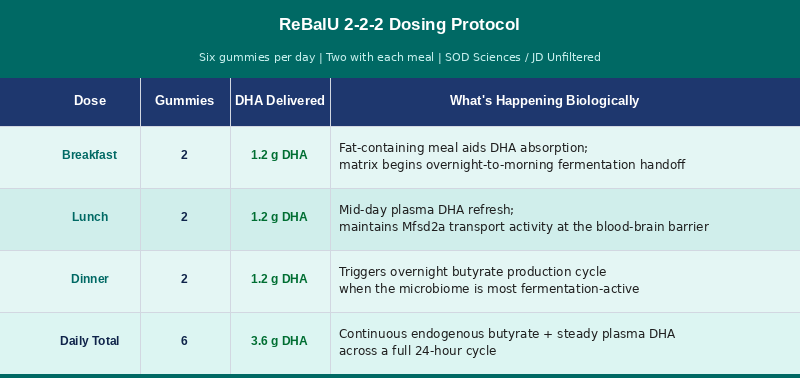
A single six-gummy bolus would overload plasma DHA absorption and produce only a brief fermentation pulse in the colon. Splitting the dose across three meals produces three benefits that once-daily dosing cannot match. First, continuous brain delivery: plasma LPC-DHA stays elevated across waking hours, the window when the brain's Mfsd2a transporter is most active. Second, all-day butyrate: three staggered fermentation waves keep colonic butyrate at therapeutic levels for 18 to 24 hours rather than the 6 to 8 hours a single dose produces. Third, better tolerance and absorption: DHA absorbs best with meals containing some fat, and meal-paired dosing optimizes bioavailability at every dose.
The dinner dose is especially strategic. Your gut microbiome is most fermentation-active overnight, and the evening substrate feeds it precisely when it can most efficiently produce butyrate — aligning with the body's circadian DNA-repair window. This is the same window in which APOE2's genomic protection operates most intensively.
Skipping any of the three shifts creates a multi-hour gap during which butyrate falls and DHA plasma levels drop. That gap is exactly what APOE2 carriers never experience. The longevity logic of ReBalU is built on filling it — every day, indefinitely.
The Two-Step Senescence Loop
Senescent cells accumulate in everyone over time. They are a major reason skin loses elasticity, joints stiffen, immunity weakens, and brains slow down. ReBalU addresses them in two coordinated steps that mirror exactly what the Buck Institute identified as APOE2's mechanism of protection.
Step 1 — Disarm and Prevent. Butyrate stops senescent cells from broadcasting inflammatory signals and prevents healthy cells from being pushed into senescence. It does this by suppressing SASP cytokines (IL-6, IL-8), lowering DNA damage marker expression (γ-H2AX, p53), calming mitochondrial stress, and downregulating the mTOR and NF-κB signaling pathways that accelerate the senescent phenotype.
Step 2 — Identify and Clear. Butyrate restores the immune surveillance that aging normally degrades — the system your body uses to find and remove damaged cells. DHA-derived signaling molecules called resolvins and protectins then recruit immune cells to remove the dying tissue and clear the debris. In laboratory studies, the combination of butyrate and DHA selectively eliminated abnormal cells while sparing healthy ones.
Your body already knows how to clean house. ReBalU gives it the substrate to do the job again, continuously, rather than waiting for the periodic, insufficient cleaning that an aging and depleted microbiome can manage on its own.
What This Means for Every Genotype
The three APOE genotypes interact with ReBalU differently, but all three benefit.
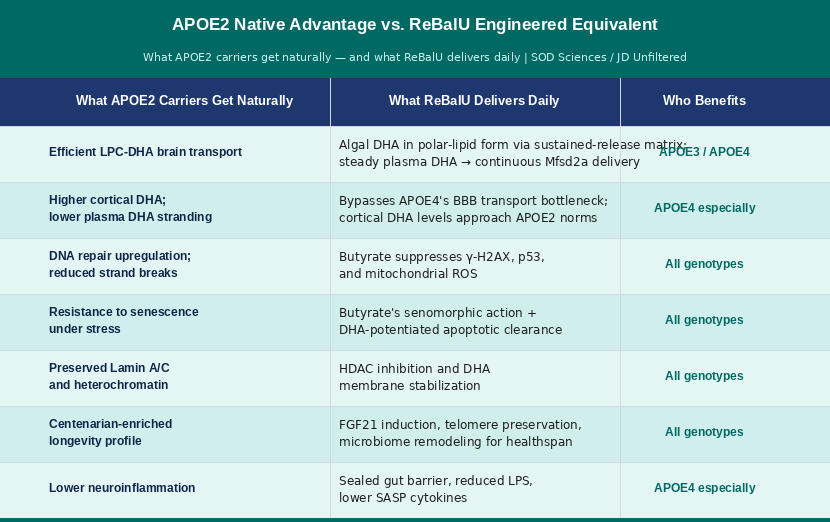
For APOE3 carriers — approximately 75% of the population — ReBalU strengthens the normal aging defenses that a healthy microbiome and adequate dietary DHA partially support but rarely fully optimize. The protocol provides what diet alone almost never delivers: continuous, colon-localized butyrate at therapeutic concentrations, alongside brain-bioavailable DHA in the form the transporter requires.
For APOE4 carriers — approximately 25% of the population, and the group at elevated risk for cognitive decline — ReBalU directly addresses both genetic bottlenecks. The polar-lipid algal DHA bypasses the transport deficit that leaves cortical DHA depleted. The prebiotic substrate selectively feeds the Roseburia and Faecalibacterium populations that APOE4 carriers are known to have in reduced abundance, rebuilding the endogenous butyrate-producing capacity their genotype systematically undermines.
For APOE2 carriers — the fortunate 5–10% — ReBalU amplifies an already protective phenotype, adding continuous nutritional reinforcement to a biological system that is already running in the centenarian-favorable direction.
The Bridge to Part Two
Aging is a daily ledger. APOE2 carriers were born with a better daily balance — more DNA repair, less senescence, more efficient brain DHA delivery, lower neuroinflammation — every single day from birth. ReBalU is engineered to let every genotype write the same ledger, one gummy at a time.
But the mechanism runs deeper than senescence alone. The longevity genes researchers have validated across decades of centenarian studies number in the dozens, and they converge on eight master pathways — insulin/IGF-1/mTOR, DNA repair, mitochondria, inflammaging, lipid handling, autophagy, proteostasis, and circadian regulation. Endogenous butyrate and DHA, delivered continuously through the ReBalU protocol, push every one of those pathways in the centenarian-favorable direction simultaneously.
Part Two goes through each of the 18 validated longevity genes, one by one, and shows precisely how. It also describes the ReBalU test/treat/retest platform — the clinical architecture that identifies exactly where your individual biology is most insufficient and measures whether the terrain actually shifts in response to the protocol.
The goal is not to feel younger overnight. It is to age the way the people who were born with the longevity gene age — by design, not by chance.
ReBalU is a nutraceutical formulation and is not intended to diagnose, treat, cure, or prevent any disease. Always consult your healthcare provider before starting any new supplement regimen. This article is for educational purposes only.