
Every Longevity Gene Science Has Found. One Daily Protocol That Moves Them All.


How ReBalU's endogenous butyrate and DHA systematically influence 18 validated longevity genes, and how the test/treat/retest platform compensates for the genetic insufficiencies that determine how fast you age.
This is Part Two of a two-part series on the ReBalU protocol and longevity biology. Part One introduced the APOE2 longevity phenotype, the science of cellular senescence, and how ReBalU is architecturally engineered to replicate APOE2's protective effects through continuous endogenous butyrate production and targeted marine algal DHA delivery.
The Gene Network, Not the Single Gene
The longevity research field spent decades searching for the gene that explains exceptional aging. Centenarian studies produced candidates — APOE2, FOXO3, CETP, KLOTHO — each associated with longer, healthier lives in population data. The more the field studied them, the clearer a pattern became: the genes themselves were not the story. The pathways they converge on were.
Validated longevity genes cluster around a handful of master biological systems: the insulin/IGF-1/mTOR axis that regulates cellular growth and stress response, DNA repair and genomic stability, mitochondrial function and antioxidant defense, inflammaging and senescence signaling, lipid handling and lipoprotein architecture, autophagy and proteostasis, telomere maintenance, and circadian regulation. These are not independent systems. They talk to each other. They regulate each other. And they share upstream regulators — molecular signals that can shift multiple pathways simultaneously with a single intervention.
Endogenous butyrate and DHA are two of the most potent of those upstream regulators known to nutritional biology. A sustained, continuous elevation of both — the architecture the ReBalU protocol is built around — does not activate one longevity gene. It nudges the entire longevity gene network in the centenarian-favorable direction, every day, simultaneously. The following is a precise account of how that happens, gene by gene.
Why Endogenous Is Everything
Before the gene-by-gene breakdown, a distinction that determines whether any of the biology below is clinically achievable.
Sodium butyrate supplements deliver butyrate exogenously — in a bolus, absorbed primarily in the upper gastrointestinal tract, reaching the colon in quantities far below what the longevity mechanisms require. The half-life is short. The delivery is pulsed. There is no microbiome remodeling — the fermentation step is bypassed entirely, and in some cases the supplemental butyrate may actually suppress the endogenous production it was meant to augment. And critically, no exogenous butyrate supplement co-delivers DHA, eliminating the synergistic apoptotic and membrane-stabilization pathway that makes the combination mechanistically coherent.
ReBalU's prebiotic matrix — Fibersol-2 (resistant maltodextrin), high-methoxyl pectin, and tagatose — produces butyrate the way the body was designed to receive it: continuously, in the colon, by the resident microbiome, at the epithelium where it is needed. This is endogenous production, and three features make it qualitatively superior to any supplemental delivery:
Continuity. The substrate ferments over 12 to 24 hours per dose, and three staggered doses across the day maintain colonic butyrate at therapeutic concentrations for a full 24-hour cycle. The epigenetic reprogramming that makes butyrate a longevity molecule — HDAC inhibition, SASP suppression, tight-junction stabilization — requires sustained, not pulsed, exposure.
Microbiome compounding. The substrate selectively feeds Roseburia, Faecalibacterium prausnitzii, and other butyrate-producing taxa. Over weeks and months of consistent use, these populations rebuild and amplify, producing progressively more butyrate from progressively less substrate. The effect compounds. It cannot be replicated by swallowing a pill.
Synergistic DHA co-delivery. The polar-lipid algal DHA delivered alongside the butyrate-generating matrix creates a dual-channel mechanism — continuous HDAC inhibition from butyrate, membrane stabilization and anti-inflammatory resolution from DHA — that each component cannot produce alone. The two molecules interact across multiple longevity pathways simultaneously, and the interaction is mechanistically coherent, not additive coincidence.
With that architecture established, here is what it does to every major longevity gene the science has validated.
The Pathway Map
Before the gene-by-gene detail, the map. Eight master longevity pathways, their key genes, and the mechanism by which ReBalU acts on each.
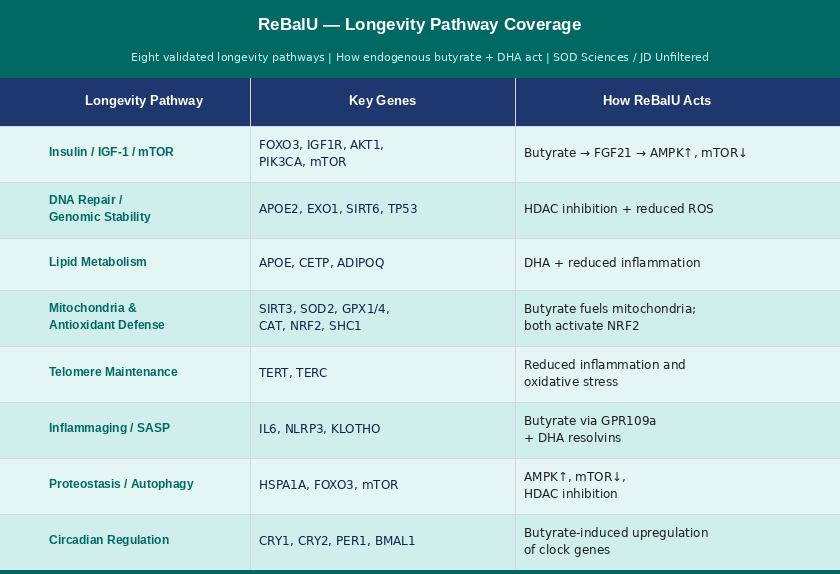
The pattern across all eight pathways is the same: butyrate and DHA act through different but complementary mechanisms on each pathway, and their combined effect approximates — or in several cases exceeds — the daily biological signal that APOE2 carriers receive from their genome. What follows is the detail behind each row of that table.
Gene by Gene — The 18-Pathway Breakdown
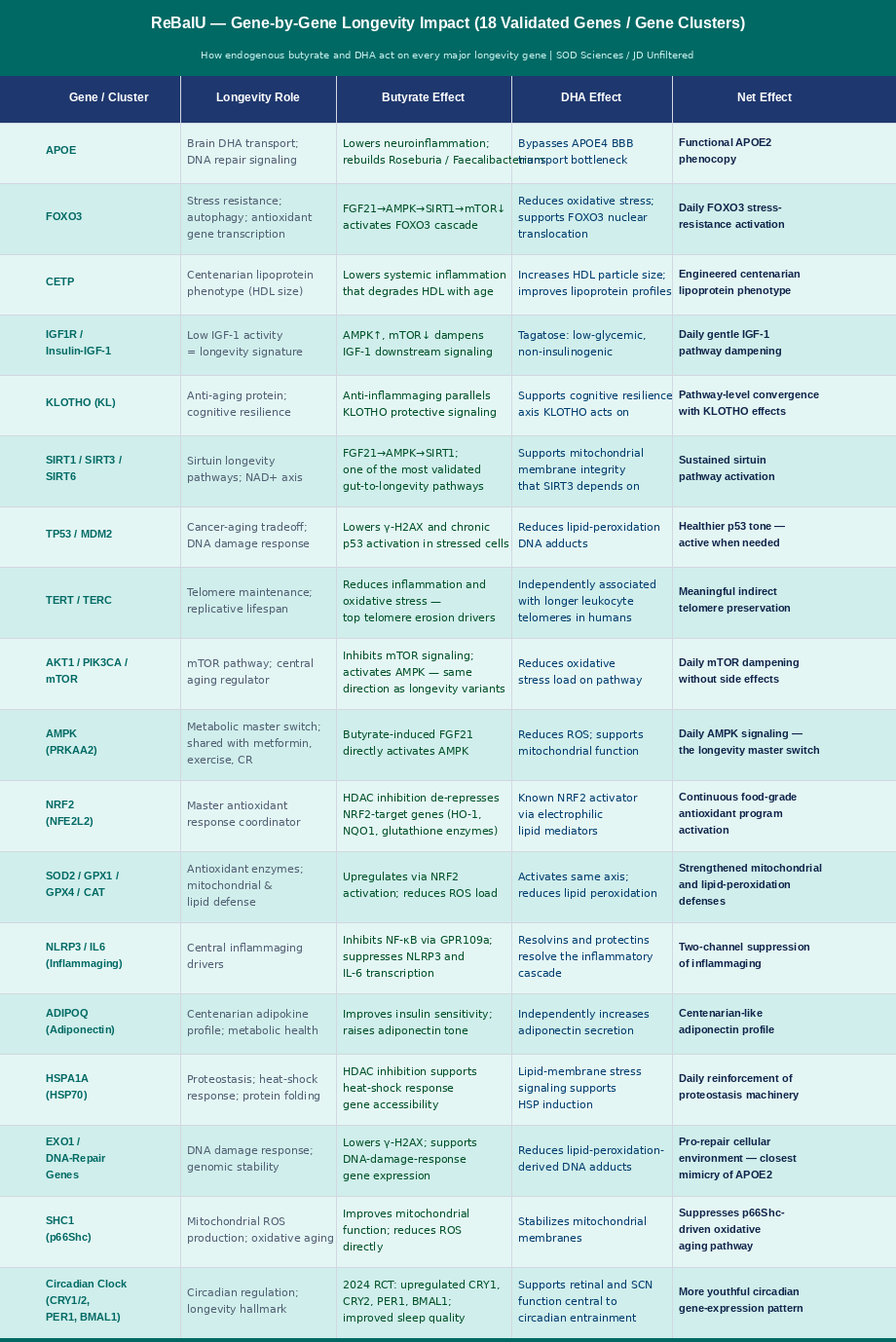
1. APOE — Target: APOE2-Like Phenotype
APOE's role in longevity is now understood to be primarily about genomic stability and neuronal resilience, not cholesterol handling. Butyrate addresses the APOE4 deficits directly: it lowers the neuroinflammation and SASP cytokines (IL-6, IL-8) that APOE4 brains are disproportionately vulnerable to, and it rebuilds the Roseburia and Faecalibacterium populations that are systematically depleted in APOE4 carriers. DHA addresses the transport deficit — refined algal DHA in polar-lipid form bypasses APOE4's blood-brain barrier bottleneck, achieving cortical DHA concentrations closer to APOE2 norms. The net effect is a functional phenocopy of the APOE2 phenotype across the dimensions that matter most: DNA repair support, senescence resistance, and brain DHA loading.
2. FOXO3 — The Second-Strongest Human Longevity Gene
FOXO3 is the most robustly replicated longevity gene in human genetic studies after APOE2. The favorable FOXO3 alleles activate a transcriptional program governing stress resistance, autophagy, and antioxidant gene expression. Butyrate activates this program through the FGF21 → AMPK → SIRT1 → mTOR↓ cascade — the same metabolic signature produced by caloric restriction, exercise, and rapamycin, the three most validated longevity interventions in model organisms. DHA reduces oxidative stress and supports the membrane-receptor signaling that initiates FOXO3 nuclear translocation under metabolic challenge. The net effect is daily activation of the FOXO3 stress-resistance program without requiring the rare longevity allele.
3. CETP — The Ashkenazi Centenarian Lipoprotein Phenotype
A specific CETP variant (VV genotype) is dramatically enriched in Ashkenazi Jewish centenarians and their offspring. It produces larger HDL particles and a lipoprotein profile consistently associated with exceptional longevity. DHA increases HDL particle size and improves lipoprotein profiles, mimicking the favorable CETP-VV phenotype through nutritional rather than genetic means. Butyrate lowers the systemic inflammation that degrades HDL function with age, preserving the quality of the lipoprotein architecture DHA builds. The net effect is an engineered approximation of the centenarian lipoprotein phenotype accessible to any genotype.
4. IGF1R / Insulin–IGF-1 Pathway
Low IGF-1 receptor activity is one of the most consistent signatures of human longevity — centenarians and their offspring show systematically reduced IGF-1 signaling. Butyrate drives this through AMPK activation and mTOR inhibition, recapitulating the longevity signature of low-IGF-1R-activity individuals through metabolic rather than genetic means. Tagatose — the prebiotic component of ReBalU's matrix — is low-glycemic and non-insulinogenic, ensuring that the substrate itself does not provoke the counter-productive IGF-1 spikes that high-glycemic fermentable fibers would. The net effect is daily, gentle IGF-1 pathway dampening, moving in the same direction as the longevity-associated IGF1R variants.
5. KLOTHO (KL) — The Anti-Aging Protein
KLOTHO is an anti-aging protein whose levels decline dramatically with age. Higher circulating KLOTHO is associated with cognitive resilience, lower inflammation, and extended healthspan. Butyrate's anti-inflammaging effects parallel KLOTHO's protective signaling — both suppress the chronic low-grade inflammation that KLOTHO deficiency accelerates. DHA specifically supports the cognitive-resilience axis on which KLOTHO acts, which is especially relevant for APOE4 carriers where both KLOTHO expression and cerebral DHA are simultaneously under pressure. The net effect is pathway-level convergence with KLOTHO's anti-aging protein effects through nutritional rather than hormonal intervention.
6. SIRT1 / SIRT3 / SIRT6 — The Sirtuin Longevity Axis
The sirtuins are among the most studied longevity proteins in biology, and the gut microbiome-to-sirtuin connection through butyrate is one of the most well-established pathways in the field. Butyrate induces FGF21, which activates AMPK, which activates SIRT1 — a cascade that overlaps with NAD+-targeted interventions like NMN and NR supplementation, but delivered through endogenous fermentation rather than direct NAD+ precursor loading. DHA supports mitochondrial membrane integrity that SIRT3, the mitochondrial sirtuin, depends on for function. The net effect is sustained sirtuin pathway activation — the dietary equivalent of NAD+/sirtuin-targeted longevity interventions without the pharmacological complexity.
7. TP53 / MDM2 — The Cancer-Aging Tradeoff
TP53 (p53) governs one of biology's central tradeoffs: strong p53 activity suppresses cancer but accelerates aging by pushing cells toward senescence and apoptosis. The optimal longevity state is not maximal p53 activity but calibrated p53 activity — active when DNA damage requires a response, quiet when it does not. Butyrate lowers γ-H2AX (a DNA damage marker) and chronic p53 activation in stressed cells, reducing the unnecessary activation of the cancer-aging tradeoff that oxidative stress chronically produces. DHA reduces lipid-peroxidation-derived DNA adducts, further lowering the damage burden that triggers p53 in the first place. The net effect is healthier p53 tone — responsive when needed, not chronically overactivated.
8. TERT / TERC — Telomere Maintenance
Telomere length is one of the most studied biomarkers of biological age. Inflammation and oxidative stress are the two largest accelerators of telomere erosion — and butyrate addresses both through its HDAC inhibition, SASP suppression, and antioxidant pathway activation. DHA is independently associated with longer leukocyte telomeres in human population cohorts. The supercentenarian Maria Branyas Morera's exceptional longevity has been mechanistically linked to butyrate-rich gut metabolism preserving telomere homeostasis — an observation that connects directly to the mechanism the ReBalU protocol is designed to sustain. The net effect is indirect but meaningful telomere preservation through the same metabolic environment found in exceptional aging survivors.
9. AKT1 / PIK3CA / mTOR — The Growth-Longevity Axis
The PI3K-AKT-mTOR pathway is the master regulator of cellular growth decisions, and longevity-associated variants in this pathway consistently reduce, not increase, its activity. Butyrate inhibits mTOR signaling and activates AMPK, moving in the same direction as the longevity-favorable AKT1 and PIK3CA variants identified in centenarian genome studies. DHA reduces the oxidative stress load that upregulates PI3K-AKT activity, complementing the butyrate-driven mTOR suppression through a parallel channel. The net effect is daily mTOR dampening without the side effects associated with pharmacological inhibitors like rapamycin.
10. AMPK (PRKAA2) — The Metabolic Master Switch
AMPK is the cellular energy sensor and master metabolic switch that metformin, exercise, and caloric restriction all share as a primary mechanism. Butyrate-induced FGF21 directly activates AMPK — this is one of the most direct and well-documented connections between gut microbiome metabolism and systemic longevity signaling. DHA supports mitochondrial function and reduces ROS, creating the metabolic conditions in which AMPK signaling is most effective. The net effect is daily AMPK activation through an entirely food-grade mechanism, recapitulating the metabolic logic of the three most validated lifestyle interventions in aging biology.
11. NRF2 (NFE2L2) — The Master Antioxidant Response
NRF2 is the transcription factor that coordinates the body's entire antioxidant defense program, activating genes including HO-1, NQO1, and the glutathione synthesis enzymes. Butyrate's HDAC inhibition de-represses NRF2-target genes, making the antioxidant defense program more accessible to transcription. DHA is a known NRF2 activator through electrophilic lipid mediators — specifically the oxidized DHA metabolites that activate NRF2's Keap1-sensing mechanism. The net effect is continuous, food-grade activation of the master antioxidant program — the cellular defense system that longevity researchers consistently find better preserved in exceptional agers.
12. SOD2 / GPX1 / GPX4 / CAT — The Antioxidant Enzymes
The antioxidant enzymes — manganese superoxide dismutase (SOD2), glutathione peroxidases (GPX1, GPX4), and catalase (CAT) — represent the cellular execution layer of the NRF2 program. Both butyrate and DHA upregulate this axis through NRF2 activation and reduced ROS load, and the SOD2 data from cervical tissue studies — where SOD2 expression escalates dramatically and independently of HPV status across disease progression — illustrates how central mitochondrial antioxidant defense is to cellular resilience across multiple disease contexts. The net effect is strengthened mitochondrial and lipid-peroxidation defenses, directly measurable through the oxidative stress biomarker panel in the ReBalU test/treat/retest platform.
13. NLRP3 / IL6 — The Inflammaging Core
Inflammaging — the chronic, low-grade sterile inflammation that accumulates with aging — is the shared driver behind cardiovascular disease, neurodegeneration, cancer, sarcopenia, and immune senescence. NLRP3 and IL-6 are its central molecular mediators. Butyrate inhibits NF-κB through its GPR109a receptor interaction and directly suppresses NLRP3 inflammasome assembly and IL-6 transcription — a two-target simultaneous suppression of the inflammaging cascade. DHA-derived resolvins and protectins actively resolve the inflammatory cascade rather than simply suppressing it, restoring the pro-resolution signaling that aging progressively depletes. The net effect is a two-channel suppression of the central driver behind nearly every major age-related disease.
14. ADIPOQ (Adiponectin) — The Centenarian Adipokine
Higher adiponectin levels are consistently found in centenarians and their offspring, and adiponectin's metabolic and anti-inflammatory properties are increasingly recognized as core features of the longevity phenotype. Butyrate improves insulin sensitivity and adipose tissue function, raising adiponectin secretion. DHA independently increases adiponectin secretion through its effects on PPAR-gamma — the transcription factor that governs adiponectin gene expression. The net effect is a centenarian-like adiponectin profile achieved through nutritional rather than pharmaceutical intervention.
15. HSPA1A (HSP70) — Proteostasis
The heat-shock protein HSP70 is the cell's primary molecular chaperone — the quality-control system that identifies misfolded proteins, prevents aggregation, and maintains the proteostasis that aging progressively degrades. Protein aggregation is a defining feature of Alzheimer's, Parkinson's, and most other neurodegenerative diseases. Butyrate's HDAC inhibition supports the accessibility of heat-shock response genes, making the proteostasis machinery more responsive to stress. DHA's effects on lipid membrane dynamics support the HSP induction pathways that membrane-stress signaling activates. The net effect is daily reinforcement of the proteostasis machinery — the cellular quality-control system that exceptional agers maintain far better than their peers.
16. EXO1 / DNA-Repair Genes — Genomic Stability
EXO1 and the broader DNA-damage-response gene network represent the execution layer of the genomic stability advantage that APOE2 confers. Butyrate lowers γ-H2AX (the primary marker of double-strand DNA breaks), reduces chronic p53 activation, and supports the accessibility of DNA-damage-response gene expression through HDAC inhibition. DHA reduces the lipid-peroxidation-derived DNA adducts that represent one of the largest sources of daily endogenous DNA damage. The net effect is a pro-repair cellular environment — the closest functional nutritional mimic of APOE2's signature DNA-repair upregulation identified in the Buck Institute research.
17. SHC1 (p66Shc) — Mitochondrial ROS and Oxidative Aging
p66Shc is a pro-aging protein that drives mitochondrial reactive oxygen species production and accelerates the oxidative aging process. Its suppression is associated with extended lifespan in model organisms, and its activity is a key mechanistic link between oxidative stress and cellular senescence. Butyrate directly improves mitochondrial function and reduces ROS, addressing the upstream drivers of p66Shc-mediated oxidative aging. DHA stabilizes mitochondrial membranes, maintaining the structural integrity that mitochondrial efficiency and reduced ROS production depend on. The net effect is suppression of the p66Shc-driven oxidative aging pathway through a dual-channel nutritional mechanism.
18. Circadian Clock Genes (CRY1/2, PER1, BMAL1) — The Longevity Rhythm
Circadian disruption is increasingly recognized as a hallmark of aging — centenarians consistently show better-preserved circadian gene expression than age-matched individuals, and circadian rhythm integrity predicts healthspan independently of other aging biomarkers. A 2024 randomized controlled trial found that sodium butyrate upregulated CRY1, CRY2, PER1, and BMAL1 while improving sleep quality — and ReBalU's continuous endogenous butyrate production, delivered with particular intensity through the strategic evening dose that feeds the microbiome during its most fermentation-active overnight window, is even better positioned to maintain this effect around the clock. DHA supports retinal and suprachiasmatic nucleus function that is central to circadian entrainment. The net effect is a more youthful circadian gene-expression pattern — increasingly recognized as one of the most underappreciated determinants of biological age.
The ReBalU Test/Treat/Retest Platform — Compensating for Your Specific Insufficiencies
The gene-by-gene mechanism above describes what the ReBalU protocol does at the population level. The test/treat/retest platform translates that mechanism into personalized clinical intervention — identifying exactly where your individual biology is most insufficient and measuring whether the terrain actually shifts in response to the protocol.
The Baseline Panel
A scientifically defensible ReBalU baseline assessment captures five domains. Redox and antioxidant genetics — SOD2, GPX1, GSTM1/GSTT1, CAT, NFE2L2/Nrf2, NQO1 — establishes the inherited architecture of your antioxidant defense network, identifying which enzymatic layers are structurally compromised before any environmental exposure is considered. Oxidative stress biomarkers — urinary 8-OHdG, lipid peroxidation markers, protein carbonyls, oxidized LDL, glutathione redox balance — measure the actual functional state of that defense network in real time. Microbiome and butyrate indicators — Firmicutes abundance, Faecalibacterium prausnitzii and Roseburia populations, Lactobacillus dominance, SCFA metabolite levels — establish the current butyrate-producing capacity of the gut and the degree to which the prebiotic substrate needs to rebuild it. Inflammatory markers — hs-CRP and selected cytokines — capture the inflammaging baseline that the protocol will act against. And genotype context — APOE status alongside the standard gynecologic or clinical history — places the individual's data within the appropriate biological frame.
For APOE4 carriers, the baseline panel is particularly revealing. The combination of reduced cerebral DHA uptake, depleted Roseburia populations, elevated neuroinflammatory markers, and compromised oxidative stress defense creates a compounded insufficiency profile that maps precisely onto the gene pathways detailed above — and that ReBalU's dual-axis delivery is architecturally designed to address.
The Treatment Phase
The protocol is the 2-2-2 dosing regimen described in Part One: two gummies with breakfast, two with lunch, two with dinner, every day. The treatment phase is not a course with an endpoint. It is a lifelong daily input into biological systems that respond to continuous, not episodic, stimulation. Cellular aging is a rate, not an event, and the protocol's longevity logic depends on daily adherence that mirrors the continuous genomic stewardship APOE2 carriers receive from birth.
The Retest Architecture
ReBalU measures whether the host terrain changes at 8 to 12 weeks, 24 weeks, and 48 weeks of targeted nutritional support. Measurable endpoints include oxidative stress biomarkers (urinary 8-OHdG, glutathione redox balance), microbiome markers (butyrate-producing taxa abundance, SCFA levels), inflammatory markers (hs-CRP, cytokine panel), and — for APOE4 carriers — plasma and where accessible cortical DHA levels. The retest is the differentiator that separates ReBalU from conventional supplementation. It answers the question that no supplement program has previously been able to answer: did the host environment actually shift?
Anticipated Healthspan Outcomes
Based on the convergent mechanisms across the 18 gene pathways above, regular ReBalU use predicts a measurable shift in cellular aging biomarkers across genotypes. In the near term (8 to 24 weeks): reduced circulating SASP cytokines (IL-6, IL-8, TNF-α), lower γ-H2AX and p16 in peripheral immune cells, higher butyrate-producing taxa (Roseburia, Faecalibacterium), improved gut barrier integrity (lower zonulin, lower LPS), and elevated plasma DHA with improved cortical availability in APOE4 carriers. In the medium term (24 to 48 weeks): improved cognitive performance particularly in adults over 60, increased FGF21 with associated metabolic improvements, and progressive microbiome remodeling that compounds butyrate-producing capacity. In the long term: a healthspan trajectory increasingly aligned with APOE2 population norms — measured, not assumed.
The Religious-Adherence Hypothesis
APOE2 does not take days off. It works in neurons and immune cells every minute of every year, from birth to the last day of life. Its protective effect is not a periodic intervention. It is a continuous biological condition that the genome maintains without interruption, across decades, compounding over time.
To mimic a lifelong gene, the intervention must also be lifelong. Episodic ReBalU use — a week on, a week off, or a 90-day course followed by discontinuation — cannot achieve the compounding microbiome remodeling that builds butyrate-producing capacity over months. It cannot sustain the continuous HDAC inhibition that maintains the epigenetic reprogramming across all 18 gene pathways above. It cannot produce the progressive reduction in senescent cell burden that requires chronic prevention plus chronic immune-mediated clearance operating simultaneously. And it cannot generate the FGF21 and telomere-supportive signaling that emerges only with continuous stimulation over extended periods.
Six gummies, three meals, every day — indefinitely. That is not a marketing recommendation. It is the biological logic of the protocol, derived from the biology of the gene it is designed to mimic.
The Bottom Line
Butyrate and DHA, delivered continuously through ReBalU's 2-2-2 dosing, touch every major longevity pathway researchers have validated in human centenarian populations. The 18 genes and gene clusters detailed above represent the full validated architecture of exceptional human aging — and endogenous butyrate and DHA act on every one of them, through mechanisms that are specific, complementary, and synergistic.
The test/treat/retest platform identifies where your individual terrain is most insufficient — which enzymatic layers are structurally compromised, which butyrate-producing taxa are depleted, which inflammatory pathways are chronically overactivated — and measures whether the protocol shifts that terrain in the right direction.
You are not activating one longevity gene. You are nudging the entire longevity gene network in the centenarian-favorable direction, every day, by design.
Most of us were not born with APOE2. But thanks to a clearer understanding of what APOE2 actually does — and how endogenous butyrate and DHA replicate it across every pathway the science has validated — we can now engineer that daily biology through nutrition. One gummy. Three meals. Every day. A small, deliberate act of cellular stewardship that, repeated faithfully over years, lets your body age the way longevity carriers age — by design, not by chance.
ReBalU is a nutraceutical formulation and is not intended to diagnose, treat, cure, or prevent any disease. Statements regarding biological mechanisms are supported by peer-reviewed literature and emerging research. Always consult your healthcare provider before starting any new supplement regimen. This article is for educational and informational purposes only.
Prepared in collaboration with SOD Sciences Inc. / BCII Enterprises Inc.