The Commoditization of Compute

Thesis, scorecard and outlook: petrochemical templates from 1965 to 1999 as forecasting models for NVIDIA, AMD and the compute industry.
Executive summary
In November 2025 we argued that the AI compute industry was repeating the petrochemical industry of 1965 to 1985, and we made a specific market call that could be proven wrong: NVIDIA and AMD would lag the market and lose their valuation multiples, and they would fall or go nowhere even as their earnings surged. We made that call while the broader market kept rising.
Twelve and a half months later, the call has moved from the slow "mark-time" stage into the crash stage, and it is playing out faster than the framework's 2027 to 2030 timetable.
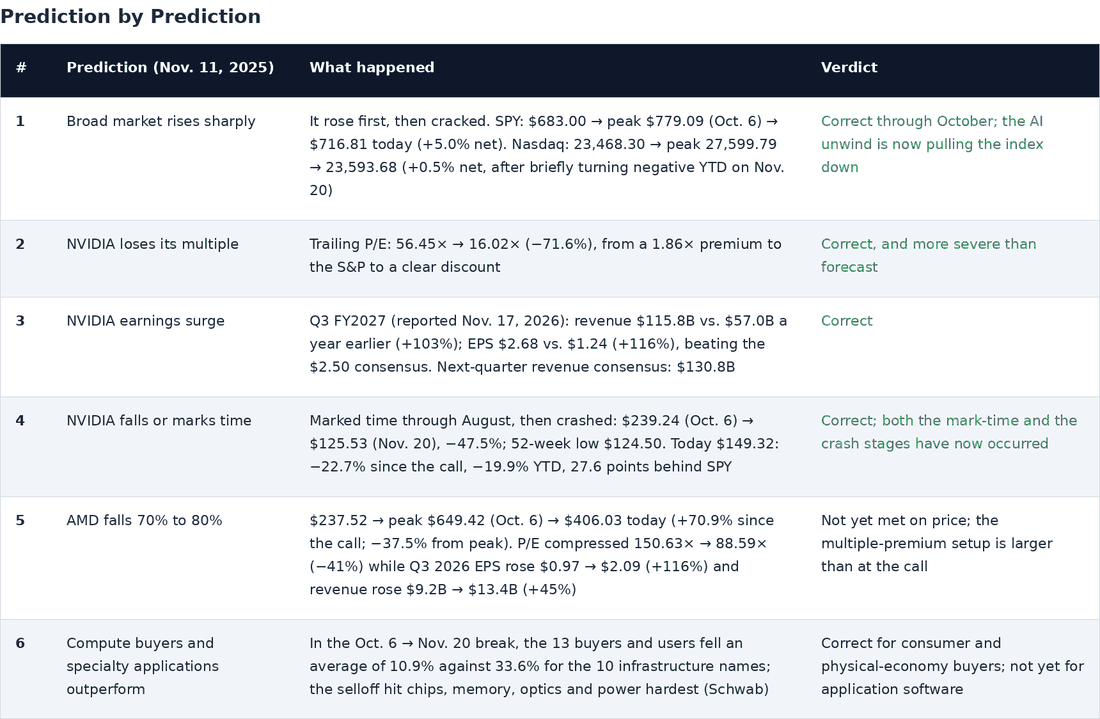
NVIDIA has crashed while its earnings doubled. The stock fell from a record close of $239.24 (October 6, 2026) to $125.53 (November 20), a 47.5% peak-to-trough decline, approaching the 60% to 70% range we originally forecast. It closed today at $149.32. That is 22.7% below its November 11, 2025 price, against a gain of 5.0% for the S&P 500 (SPY) over the same window, so NVIDIA has lagged the market by 27.6 percentage points. Its trailing P/E has fallen from 56.45× to 16.02×, down 71.6%. Over the same year, quarterly revenue doubled from $57.0 billion to $115.8 billion (+103%) and quarterly EPS more than doubled from $1.24 to $2.68 (+116%). Record earnings, collapsing stock, collapsing multiple: this is Union Carbide's 1974 to 1983 sequence in a single year.
The market's rise peaked and then cracked. The S&P 500 set a record on October 6 and then fell more than 10% into a correction. SPY fell 11.5% peak-to-trough and the Nasdaq fell 18.1%. The Nasdaq briefly turned negative for 2026 on November 20, the AP reported. The AI buildout that lifted the index on the way up is now pulling it down.
AMD has started to break but has not yet de-rated. AMD is down 37.5% from its October 6 close of $649.42 and closed at $406.03, falling another 1.75% today after an 8.86% drop yesterday. It is still up 70.9% from the November 2025 call date, so the original 70% to 80% decline has not happened yet. But its trailing P/E of 88.59× is now 5.5 times NVIDIA's 16.02×. That premium is larger than when we made the call, and it sits on top of a sector whose leader has just been re-rated to a value-stock multiple.
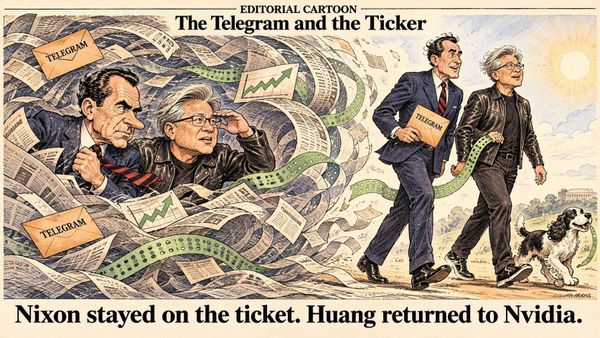
The core mechanism we forecast was multiple compression on rising earnings, followed by price destruction once sentiment on the capacity cycle turns. That mechanism has now run fully at the industry leader. The follower is the remaining open position. The Jensen Huang affair, including his reinstatement, showed how much of the AI overbuild had rested on one person's credibility. It is the defining event that shifts outperformance from the producers of compute to its buyers, led by Apple (+29.2% since the call, and up through the selloff) and Meta. AMD is the next big hurt.
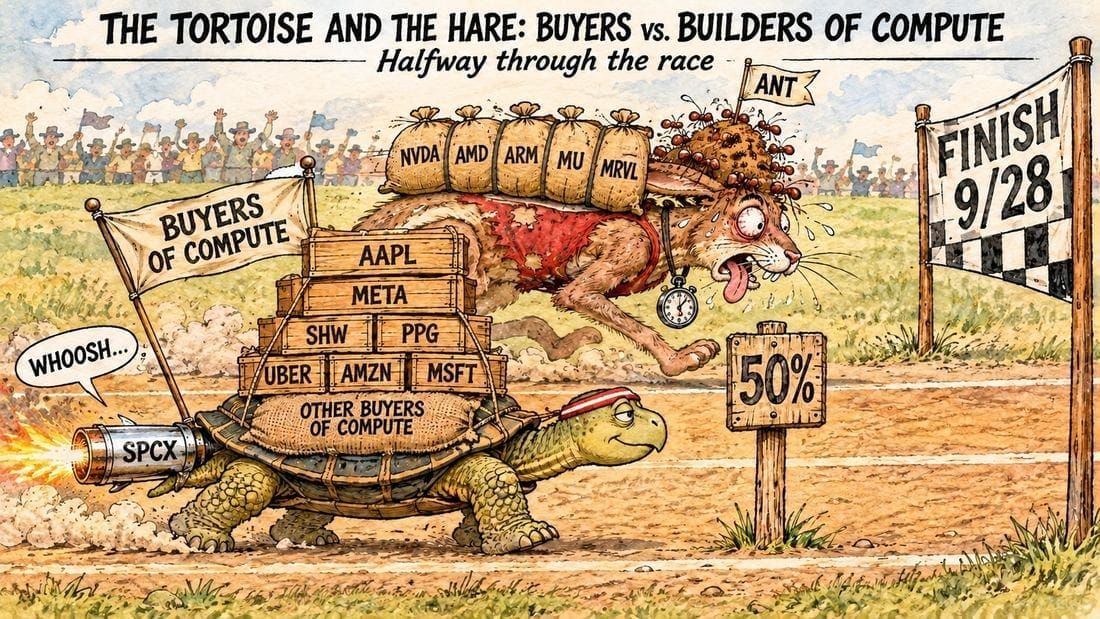
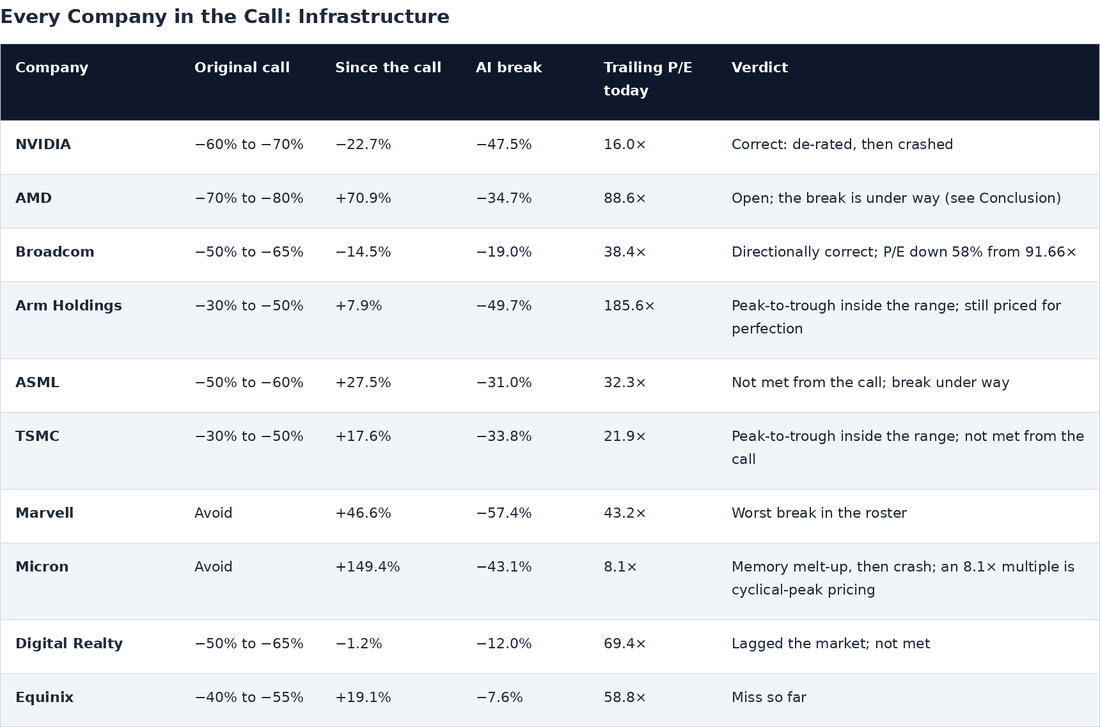
Across all 24 companies named in the original call plus the two mega-IPOs that listed since, the split is now measurable. During the October 6 to November 20 break, the ten compute-infrastructure names we told readers to avoid fell an average of 33.6%, and only one beat the S&P 500's 11.5% decline. The thirteen buyers and users of compute fell an average of 10.9%, and eight of them beat the index. Anthropic is the biggest loser in the roster: the largest IPO in history broke below its $83 offering price on its fourth day of trading and closed below it again today, carrying roughly $900 billion of spending commitments, mostly for compute and most of them non-cancelable.
Part I: The original thesis (November 11, 2025)
1.1 The analogy
From roughly 1940 to 1970, investors treated the plastics industry as a high-growth, high-technology business. It lost that status when its process know-how stopped being proprietary, not when feedstock prices rose. Three forces turned a technology franchise into a cyclical commodity: incumbents overbuilt, oil majors entered the market, and world-scale plant designs were licensed to anyone who would pay. Producers' profits kept growing for years while their multiples collapsed. This "profitless prosperity" showed up first in valuations and only later in margins.
Our November 11, 2025 analysis and its same-day companion mapped 24 AI-era companies onto petrochemical-era equivalents, using trailing P/E relative to the S&P 500 (then about 30.4×). The full roster, as written:
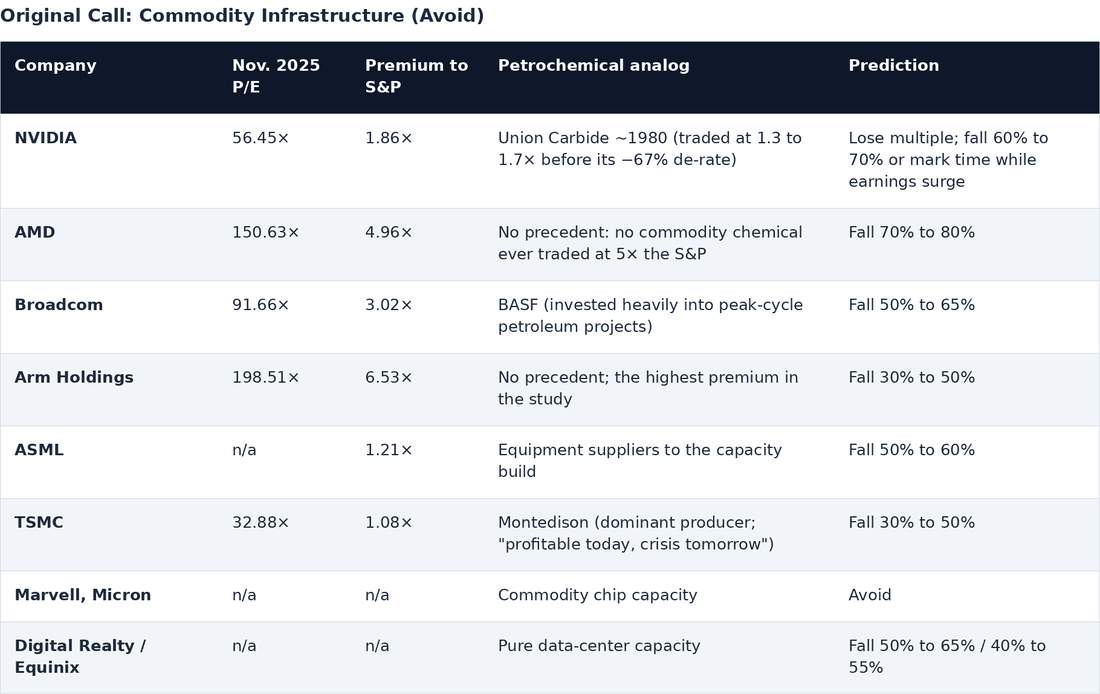
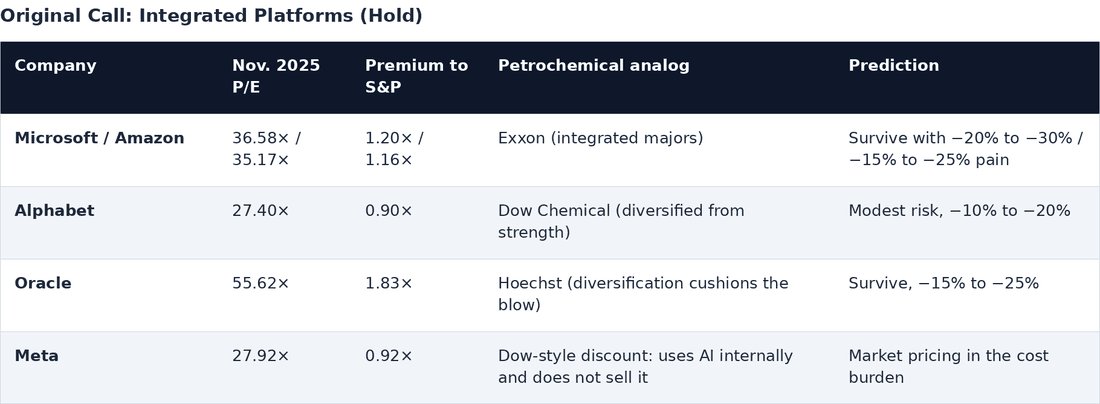
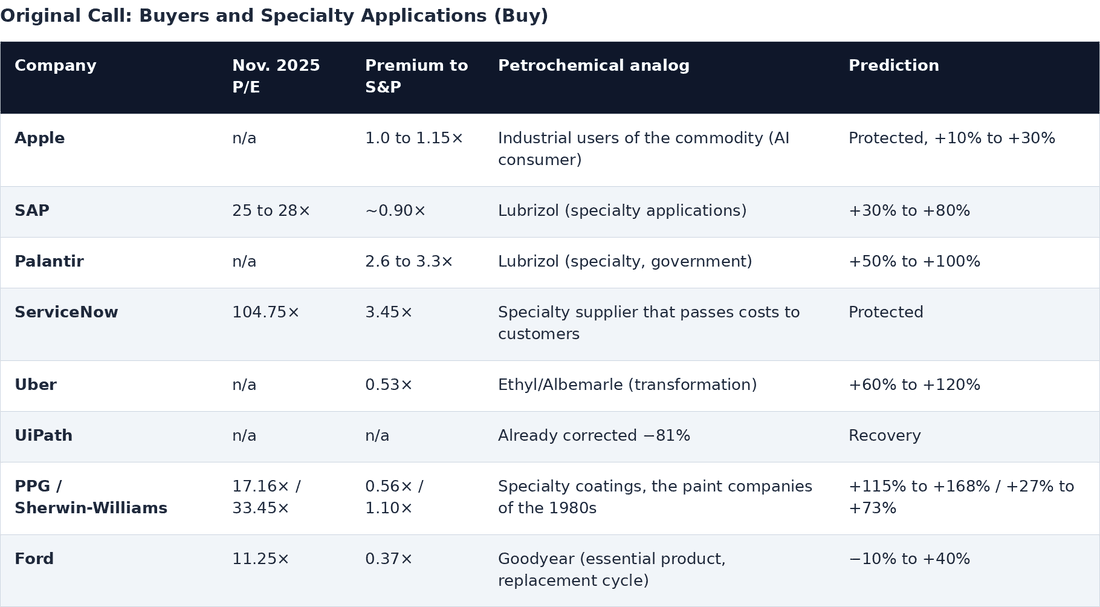
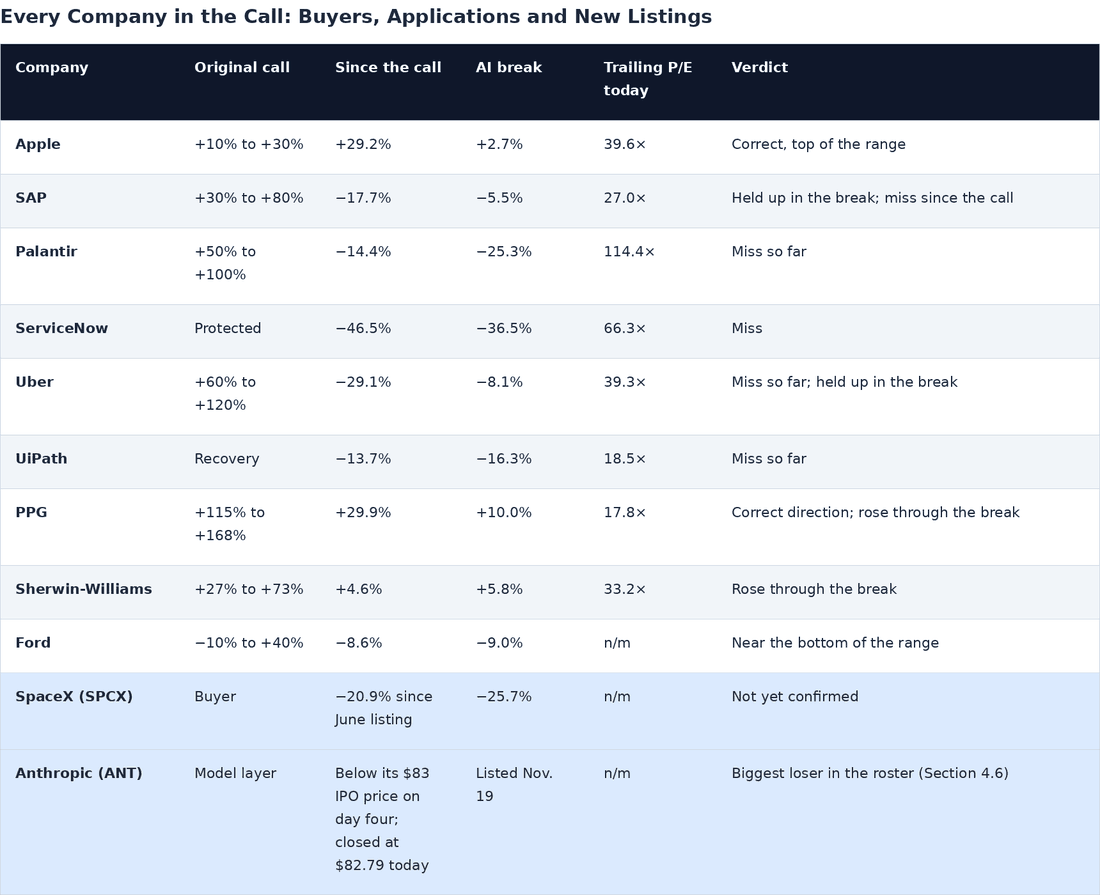
Two companies have listed since and are scored alongside the original roster: SpaceX (SPCX), listed June 2026, on the buyer side; and Anthropic (ANT), listed November 19, 2026, at the model layer that Vector B (Part III) said would lose its pricing rent.
The recommendation as written: "Exit commodity infrastructure (Nvidia, AMD, ASML), buy specialty applications (SAP, Palantir, Uber), hold integrated platforms (Microsoft, Amazon, Apple)."
1.2 The Mideast energy prediction
We predicted that Gulf advantaged energy would do to compute what it did to petrochemicals. SABIC was founded in 1976 on government-set gas prices of about $0.75 per MMBtu, roughly one-tenth of U.S. cost. It partnered with Exxon and Shell for technology and built world-scale export capacity. That capacity fed the worldwide petrochemical glut that cut Union Carbide's profits 91% by 1983. The compute equivalents are HUMAIN (600,000 GPUs, a 14 GW ambition, 6.6 GW by 2034) and Stargate UAE (5 GW). They are the SABIC of computing power: capacity that brings NVIDIA purchase orders today and resets the global price of compute later.
On this template, the winners would be the buyers of cheap compute (applications, industrials, logistics), not the producers of computing power. The same was true of the plastics glut, whose winners were the converters and consumers, not the crackers.
Part II: The scorecard (November 11, 2025 to November 25, 2026)
2.1 Prediction by prediction
2.2 NVIDIA: the full Carbide sequence in one year
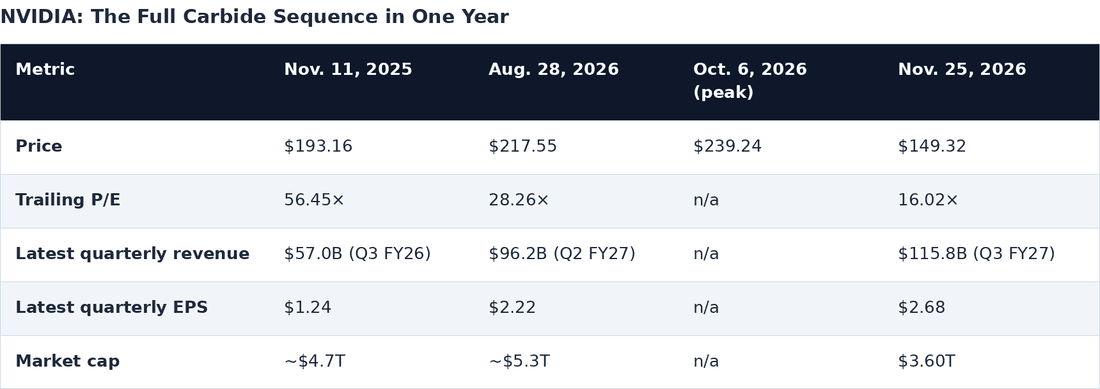
The sequence matches the template step by step.
1. Profitless prosperity (November 2025 to August 2026). Earnings doubled while the stock moved with the index and the multiple halved. This was the mark-time stage.
2. Last rally on peak earnings (August to October 6). The stock reached a record $239.24 as the S&P made its high.
3. Crash on record results (October 6 to November 20). The stock fell 47.5% across a quarter that beat consensus and topped $100 billion in revenue for the first time, Fortune noted. The stock fell 2.9% the day after the report. When a stock falls on a beat, the market has stopped paying for current earnings and started discounting what comes after the peak.
At 16.02 times trailing earnings, NVIDIA's multiple is now below the market's. This is the market's verdict that today's earnings are a cyclical peak, not a base for further growth. It is how investors priced Union Carbide's record profits in the late 1970s.
2.3 What drove the November break, and how much the thesis explains
Being clear about the cause matters, because not all of the November decline came from the commoditization mechanism.
Drivers specific to NVIDIA and outside the thesis
Leadership shock. Jensen Huang resigned amid a personal scandal. The board reinstated him on November 23, eleven days later, and President Trump said he had "convinced" the board to do so, Fortune reported. The stock jumped 31.5% that day, from $125.53 to $165.05.
Regulatory overhang. On November 20, Reuters reported that SEC enforcement staff were examining potential accounting issues at the company. Reuters could not determine what the inquiry covers, and investigations do not establish wrongdoing.
Drivers consistent with the thesis
Doubts about the capex cycle. Investors began pricing in "an end to the idea that AI could keep spending unlimited amounts of money," the AP reported. Analysts told Fortune that Huang's return did not answer the "big questions" about return on AI investment. This is Scenario 2 in our scenario matrix (customers stop spending or credit reprices). It is the demand-side shock the framework identified as NVIDIA's real exposure.
Political limits on capacity. In the midterm elections, candidates who favor slowing data-center construction won at both the federal and state levels, according to the AP. On November 5, the day after the vote, NVIDIA fell 9.3% and AMD fell 17.3%. This is Scenario 6 (a political break) combined with Scenario 7 (power and grid limits). It is the Bhopal-type outside shock: political and hard to reverse.
Repricing at the model layer. Anthropic, the largest IPO in history, fell about 23% from its first-day peak within a day of listing, the AP reported. This is the first public-market mark on the layer above NVIDIA, the layer Vector B says will lose its pricing rent. NVIDIA holds equity in that layer.
The whole supply chain fell together. Memory (Micron −24% on the week), optics (Corning), power (Bloom Energy −58% from its June peak) and data-center operators (CoreWeave, Nebius) all fell with the chipmakers, according to Schwab and Fortune. Several of these companies are ones NVIDIA invested in as part of its Dow-style forward integration: Corning ($3.2 billion) and the neoclouds. The reflexive exposure the framework warned about is now showing up in prices.
Net assessment. The Huang and SEC events set the timing and sharpened the speed of the decline. The direction and size of the move came from the commoditization case. Even after Huang's reinstatement, NVIDIA trades at 16.02 times earnings and 37.6% below its peak, while delivering record results. Governance can explain a gap down. It cannot explain why the market will no longer pay a premium multiple for doubled earnings. That repricing began in November 2025, ten months before any scandal.
2.4 AMD: the open position
AMD has now begun to trade the way the thesis predicted. It fell 17.3% on November 5 and 13.3% on November 20, the AP reported, and it fell another 8.86% on November 24 and 1.75% on November 25. It is 37.5% below its October 6 close, and today's $406.03 sits just above its November 5 closing low of $404.40. Its earnings are still growing fast: Q3 2026 EPS of $2.09 was more than double the prior year's $0.97, and revenue grew 45%. That is the same profile NVIDIA showed in the summer, just before its own collapse.
The original 70% to 80% decline is not met on price, because AMD more than doubled before it broke. The setup for that forecast, however, has grown rather than shrunk. See the Conclusion.
2.5 Course corrections made as events unfolded
1. February 2026: the first wobble. AMD fell 17% on an earnings beat, Broadcom sold off on margin mix, and NVDA traded at $172.90 on a multiple of about 43×. We called this the first market wobble. Early signs of the shift from premium pricing to volume pricing were present, but there was no full glut.
2. April 2026: the Iran war adjustment. Strikes damaged more than 40 Gulf energy and infrastructure assets (over $25 billion to rebuild), paused the Gulf compute buildout, and gave the U.S. a cheap-gas cost advantage. We concluded this delays the multiple contraction: a delay, not a cancellation.
3. June 2026: interim verdict. We wrote: "The pattern has continued in volatility and narrative, not yet in sustained relative price underperformance." The underperformance has since arrived. Since August 28, NVIDIA is down 31.4%, against −6.8% for SPY and −10.6% for the Nasdaq.
2.6 Every company in the original call
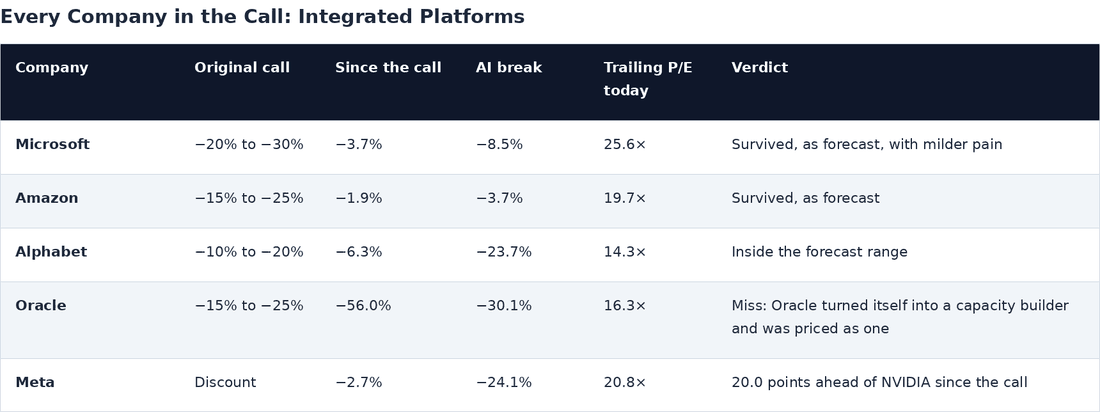
Closing prices, November 25, 2026. "Since the call" is measured from the November 11, 2025 close. "AI break" is the October 6 to November 20, 2026 decline, during which SPY fell 11.5%.
What the full roster shows
1. The break sorted producers from buyers. During the October 6 to November 20 break, the ten infrastructure names fell an average of 33.6% (median −34.3%), and only Equinix beat the S&P 500's 11.5% decline. The thirteen buyers and users of compute fell an average of 10.9% (median −8.5%), and eight of the thirteen beat the index. That is the split the thesis predicted, and it showed up in the first real test.
2. The producers still have the height to fall from. Measured from the call date, the infrastructure basket is still up an average of 30.0% (median +18.4%), carried by Micron (+149%), AMD (+71%) and Marvell (+47%). The buyer basket is down an average of 6.2%. On the template, that is not yet a miss. It is the same profile NVIDIA had in August: a last melt-up in the follower names, ahead of their de-rating. The producers still trading above their November 2025 prices (AMD, Micron, Marvell, ASML, TSMC, Equinix, Arm) are the queue behind NVIDIA.
3. The buyer side works where the buyer owns the customer. The buyers that delivered (Apple, PPG, Sherwin-Williams, Amazon, Microsoft) sell physical goods or consumer platforms and use AI as a cost input. The application-software names (SAP, Palantir, ServiceNow, UiPath) have not delivered. Our reading: software that resells intelligence is exposed to the same Vector B price compression as the model layer. The buyer thesis holds for companies that consume cheap intelligence, not for companies whose product is intelligence.
4. One clear misclassification. We filed Oracle with the integrated survivors. It instead tied its future to building AI data-center capacity, and the market priced it with the builders (−56.0% since the call). The mechanism held. The label was wrong.
Part III: The framework
3.1 The argument in one paragraph
On the supply side, NVIDIA is running Dow Chemical's playbook: integrating forward into its own supply chain at peak margin. Its deals include Enfabrica (more than $900 million), Groq (about $20 billion), OpenAI (about $30 billion), Lumentum ($2 billion), Corning ($3.2 billion), IREN ($2.1 billion) and SK Group (more than $500 billion of HBM4 supply). On the demand side, it carries Union Carbide's exposure: it holds equity in the same customers that buy its GPUs, and those purchases are often financed with debt secured against the GPUs. It faces three commoditization vectors at once, which the petrochemical record shows as separate historical episodes. Its terminal risk is not input costs. The risk is that the layer above it (frontier models) loses its pricing rent while the layer below it (advantaged-energy capacity) resets the global price of compute. November 2026 was the first time the market priced both layers at once: the Anthropic IPO repriced the model layer, and the midterm vote repriced the capacity layer.
3.2 The three vectors
Vector A: Gulf advantaged-energy capacity (SABIC template; largest impact, 2027 to 2030). HUMAIN (600,000 GPUs, 6.6 GW by 2034) and Stargate UAE (5 GW) sit inside the U.S. technology perimeter, which makes them a delivery route China cannot offer. The Iran war delayed these projects but did not cancel them. Higher hydrocarbon prices raise war risk, but they also expand the budgets that fund the buildout, just as 1973 to 1974 funded SABIC. A ceasefire would mean a compressed wave of capacity arriving all at once, which is the classic glut mechanism. The U.S. political turn against domestic data-center construction strengthens this vector. If U.S. capacity growth is restricted at home, more of the world's incremental compute gets built where energy is cheap and permits are easy to get.
Vector B: Open-weight know-how diffusion (process-licensing template; already happened). Free frontier-grade model weights destroy the rent on know-how, not the price of inputs. This is the same mechanism that ended plastics' high-technology status. DeepSeek's August 16, 2026 V4 price increases (+50% to +1,114%, with peak and off-peak pricing) are capacity rationing. They show that the loss-leader strategy is limited by the supply of HBM and accelerators. This vector commoditizes the layer above NVIDIA. That is mildly bullish for hardware and very damaging to OpenAI's and Anthropic's pricing power, which is where NVIDIA's roughly $30 billion equity stake sits. Anthropic's post-IPO slide is the first market price on that risk.
Vector C: Chinese subsidized compute (solar template; limited by its own constraints). Utilization is 20% to 30%, supply is limited by HBM, and output is absorbed domestically. This vector becomes dangerous only if China exports the capacity, or if cheap government-set renewable power turns the subsidy into a lasting cost floor.
3.3 Where NVIDIA sits on the Dow clock
In August we placed NVIDIA at 1972 to 1973 on the Dow calendar: peak reported profitability, the first visible margin erosion, and a quiet valuation de-rating. In fiscal 2026 (ended January 2026), gross margin was 71.1% (down 3.9 points), operating margin 60.4%, ROIC 135%, and R&D 8.6% of revenue. November has moved the clock forward. A 16× multiple on record earnings and a 47% drawdown in one quarter match the market's treatment of commodity-chemical producers in 1974 to 1975: record profits, a falling stock, and a market looking past the peak. Dow's response, diversification from a position of strength, bought it fifteen good years before the unwind. Today Dow Inc. is a $30 stock with a 6.3% gross margin and a negative operating margin. Diversification buys time, not a permanent escape.
3.4 Monitoring dashboard (November 25, 2026)
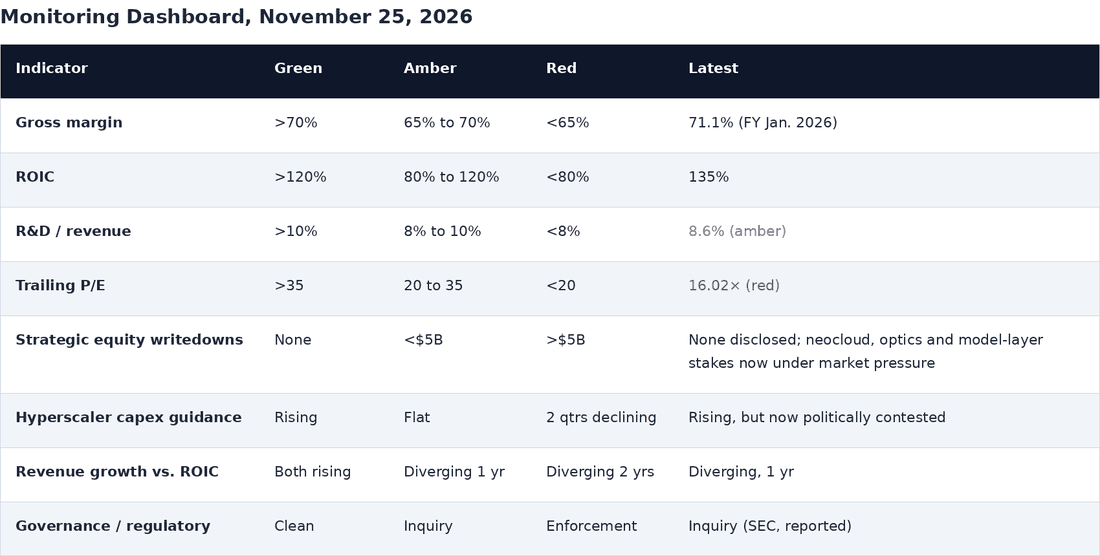
Key tripwires
Gulf compute marketed to Western enterprises, which is the SABIC export signature.
Gulf power purchases disclosed below $0.03 per kWh.
U.S. data-center restrictions passed at the state level following the midterms.
Anthropic and other model-layer equities trading below their IPO price ($83 for Anthropic). Triggered November 24, 2026 (see Section 4.6).
Custom ASICs exceeding one-third of accelerator units.
Any writedown of more than $5 billion on NVIDIA's strategic equity holdings. This would be the reflexivity unwind, the scenario with no historical precedent.
3.5 Forward predictions
1. NVIDIA has finished its de-rating and entered the price stage. At 16 times trailing earnings, further declines now depend on earnings rather than the multiple. The deeper Carbide stage (earnings themselves rolling over) requires a capex pause, a credit event, or the Gulf capacity wave. The midterm result has pulled the first two closer. The full 60% to 70% decline from the peak would put the stock at about $72 to $96. That requires earnings to fall, not just a lower multiple.
2. AMD is the late-cycle capacity adder, and its de-rating comes next. See the Conclusion.
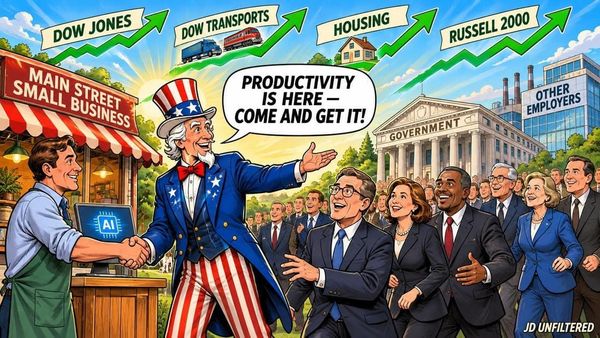
3. The market call is maturing into its second stage. The index rose first and is now absorbing the AI unwind. On the template, compute buyers outperform compute producers through the glut, so the winners should be the companies that consume cheaper compute, not the ones that sell it.
4. The Mideast mechanism is intact and its timeline has shortened. The war delayed the buildout and also enlarged its funding. U.S. political resistance to domestic capacity now adds a third push toward the Gulf. Watch for all paused projects resuming at once after a ceasefire. That is the signature of the 1980s glut.
Part IV: The Jensen debacle, when Superman becomes human
4.1 The scandal exposed the vulnerability; it did not create it
Section 2.3 separates the drivers specific to NVIDIA from the structural ones. That split describes the timing of the decline. It understates what the episode revealed. The Jensen Huang affair is the defining event of this cycle. It did not change NVIDIA's economics. It showed how much of the AI buildout's valuation rested on one person's credibility.
For three years, the overbuild case was argued as an engineering question: whether demand will absorb the capacity. Behind that question sat an act of faith. Investors believed the spending would pay off because Jensen Huang said it would, and because he had been right every time before. Each hyperscaler capex plan, each GPU-backed neocloud loan, and each sovereign AI campus was underwritten in part by that confidence.
When Huang resigned, the market did not lose a CEO. It lost the guarantor of the buildout's return on investment. Within eleven days, $8 trillion of market value was gone and the Nasdaq had turned negative for the year, according to Fortune and the AP.
4.2 The reinstatement confirmed the fragility
Huang's return on November 23 produced Wall Street's best day since April 2025. NVIDIA rose 33%, and the President said he had "convinced" the board to bring him back, Fortune reported. The rally showed the vulnerability rather than resolving it.
A single point of failure. A company worth trillions that needs a specific person back in the job within eleven days has a single point of failure. Its value depends on that person, not only on its franchise.
A matter of national policy. Political involvement in bringing back a private-company CEO makes the AI buildout look like a matter of national policy, not just a market outcome. It becomes subject to political cycles, and the midterms just turned against data-center expansion.
A partial recovery. The rally recovered only about $3 trillion of the $8 trillion lost. Analysts noted that Huang's return "doesn't answer the big questions" about return on AI investment, according to Fortune. NVIDIA remains 37.6% below its peak.
Huang now returns to salvage the narrative rather than to lead an unchallenged one. From here, every executive statement on demand will be weighed against the knowledge that the market once priced NVIDIA without him and found the stock worth about half as much.
4.3 The Tiger Woods parallel
Tiger Woods did not lose his swing in November 2009. He lost his aura, and his aura had been worth strokes. Opponents who had folded on Sunday afternoons stopped folding once the invincible figure was shown to be fallible. He won again, including the 2019 Masters. But the era in which his presence alone decided outcomes was over.
The same mechanism applies to NVIDIA. Huang's aura was a balance-sheet asset. It let customers commit capital ahead of proven returns, let lenders accept GPUs as collateral, and let investors pay 56 times earnings for a hardware company. Once the person behind that aura is shown to be human, every party in the chain recalculates without it. Customers ask for returns before placing the next order. Lenders widen spreads on GPU-backed debt. Investors price the earnings as cyclical, which they already have at 16.02×. Huang can still win. But the period in which his say-so could justify the overbuild has ended. That is the change the commoditization thesis needed. The overcapacity was always there. The scandal removed the confidence that kept the market from pricing it in.
4.4 Why this defines the buyers-versus-builders split
The commoditization template has always said that the winners of a capacity glut are the buyers of the commodity, not its producers. The Jensen episode is the event that sets the timing. Once confidence in the overbuild breaks, three things follow.
1. Compute prices fall. Capacity that was justified by faith has to be justified by usage, so suppliers compete on price.
2. Producers' multiples compress further. NVIDIA has already gone from 56× to 16×. AMD, at 89×, is next (see Conclusion).
3. Buyers' margins expand. Every company that rents, embeds or deploys AI gets the same capability for less money. Producers sell into a glut. Buyers purchase from one.
4.5 The winners: the buyers of compute
The ranking below puts the companies in the order the thesis expects them to win, led by Apple and Meta.
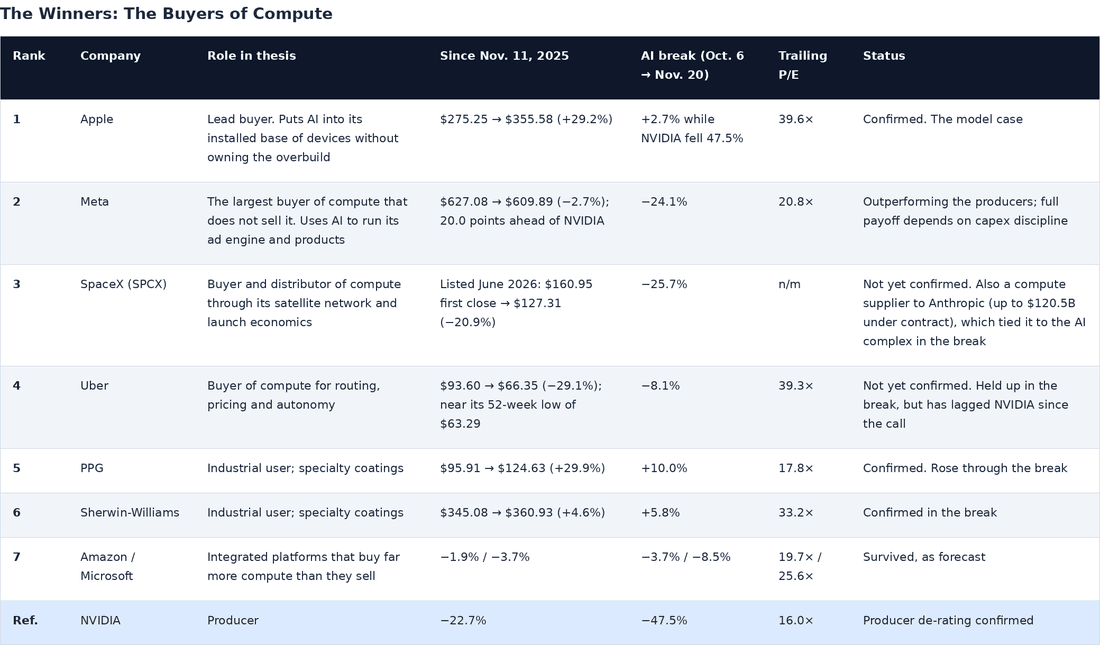
Apple shows the thesis most clearly. It has outperformed NVIDIA by 51.9 percentage points since the call. It rose through the worst AI selloff since 2008, and it now carries a trailing multiple 2.5 times NVIDIA's (39.62× against 16.02×). The market has fully reversed its ranking of buyer and builder. In November 2025, investors paid more for the company making the chips. Today they pay more than twice as much for the company that buys the intelligence and sells it to consumers.
Meta is the second winner, and the purest buyer in the roster. In November 2025 we noted that Meta "uses AI internally, doesn't sell" it, and that the market was applying a Dow-style discount for the cost burden. That is exactly the position the glut rewards. Every fall in the price of compute goes straight into Meta's margins, because it has no compute revenue to lose. Since the call, Meta is 20.0 points ahead of NVIDIA and now trades at 1.3 times NVIDIA's multiple (20.78× against 16.02×), a gap that did not exist a year ago. It fell 24.1% in the break because the market still treats its own capex budget as part of the overbuild. Its winning condition is simple: once compute is cheap, Meta can spend less on it and keep the gains. That is the next stage of the cycle, and Meta is positioned to collect it.
SpaceX and Uber are the glut-stage names. Both fell with the AI complex. SpaceX also sits on the supply side of one contract: Anthropic's prospectus lists up to $120.5 billion of compute purchases from SpaceX, CNBC reported, so part of its break was counterparty exposure to the model layer, not its buyer business. The thesis says their gains arrive when compute becomes cheap enough to lower their operating costs (autonomy and dispatch for Uber, network and data economics for SpaceX). That stage is next, not current. The November 2026 prices give a clear starting point to measure it from.
4.6 The losers, led by Anthropic
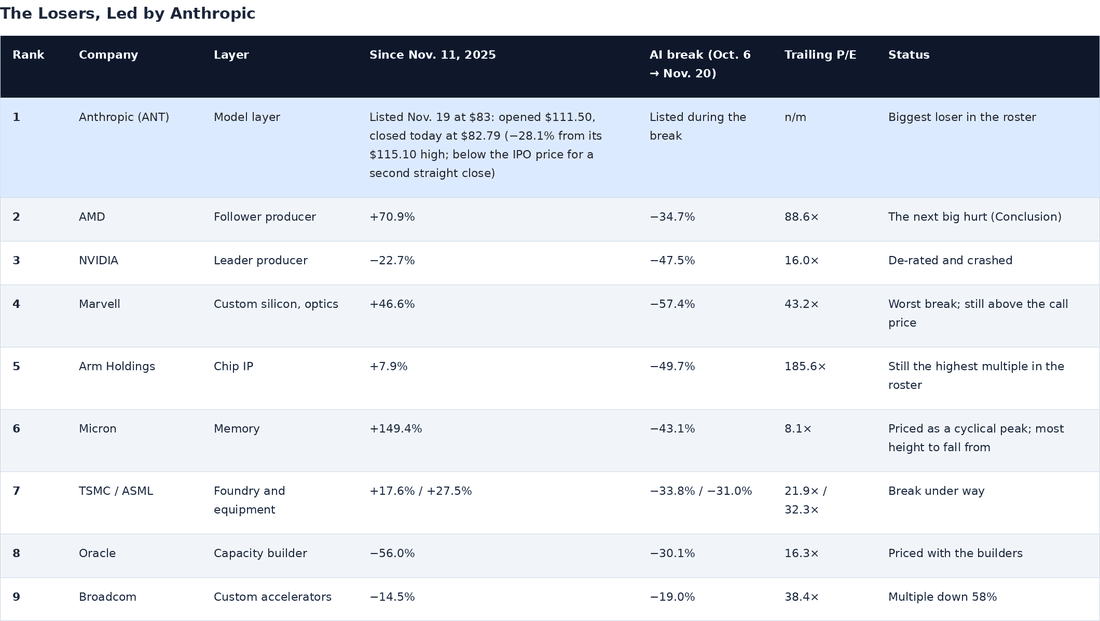
Anthropic is the loser the framework was built to find. On paper it is a buyer of compute. In practice it is the opposite of the winners above. The winners buy compute on flexible terms and sell something else (devices, ads, rides, paint). Anthropic locked in compute at boom-era prices and sells the product the glut commoditizes.
The largest IPO in history broke issue in four days. Anthropic priced at $83 and raised $81.3 billion, Forbes reported. It opened at $111.50 and closed its first day at $97.17, a valuation of about $1.76 trillion, according to CNN. On November 24 it traded as low as $75.61, MarketWatch reported, and closed at $81.91, going below its IPO price on its fourth day of trading, faster than SpaceX, Dealroom noted. Today it closed at $82.79, still below the offering price, for a market value of $1.12 trillion. Roughly $640 billion of value is gone since the first close.
It signed the take-or-pay contracts at the top. The prospectus shows about $900 billion of future spending commitments, largely compute infrastructure, with roughly half due by the end of 2030, CNBC reported. Most cannot be canceled, and the Microsoft, Google and Amazon agreements require payment "regardless of actual usage," according to GeekWire. In petrochemical terms, this is the late entrant that contracted feedstock at peak prices and then had to sell into the glut. When compute gets cheaper, the winners above pay less. Anthropic keeps paying the contracted price.
It sells the product Vector B commoditizes. Revenue was $16.3 billion in the first half of 2026, against an $80.7 billion net loss, Fortune reported. Free open-weight models are compressing the price of exactly that product, which is the know-how-diffusion mechanism that ended plastics' high-technology status.
Its commitments are the producers' backlog. The prospectus names about $161.2 billion of Broadcom equipment leases and expected spending above $20 billion with AMD, according to FourWeekMBA. If Anthropic's stock is the first public price on the model layer, it is also a price on the order books of the chipmakers below it. This is the reflexivity the framework flagged: the producers financed and booked demand from customers whose own economics now look weakest. Anthropic's break is a direct hit to AMD's case.
The Section 3.4 tripwire, model-layer equities trading below their IPO price, was triggered on November 24 and held on November 25.
Conclusion: AMD is the next big hurt, and NVIDIA's multiple contraction is the proof
In November 2025, we expected AMD's crash first and NVIDIA's de-rating second. The market reversed the order. That reversal makes AMD's eventual crash larger, not smaller. NVIDIA is the evidence.
NVIDIA is the controlled experiment. The market took the sector leader, with the CUDA software moat, 71% gross margins, 135% ROIC, and quarterly earnings that more than doubled, and cut its multiple from 56.45× to 16.02×. It then crashed the stock 47.5% across a quarter that beat consensus. This is the market showing what it pays for a compute supplier once it views the earnings as a cyclical peak: a below-market multiple and no premium for the franchise. If the monopolist's flawless execution earns 16×, that multiple is the proven endpoint for the whole category.
AMD is priced against that endpoint in the wrong direction. While NVIDIA de-rated to 16.02×, AMD's trailing multiple settled at 88.59×. That is a 5.5 times premium to the sector leader's proven multiple, carried by the number-two producer, which has structurally lower margins and no CUDA equivalent. Its earnings base is growing at more than 100% a year, and that kind of growth normalizes hardest when the capex cycle turns. In November 2025, AMD's excess was measured against the S&P. Today it is measured against a live example, inside its own sector, of what the market actually pays. The comparison has gotten worse while the price has gotten higher.
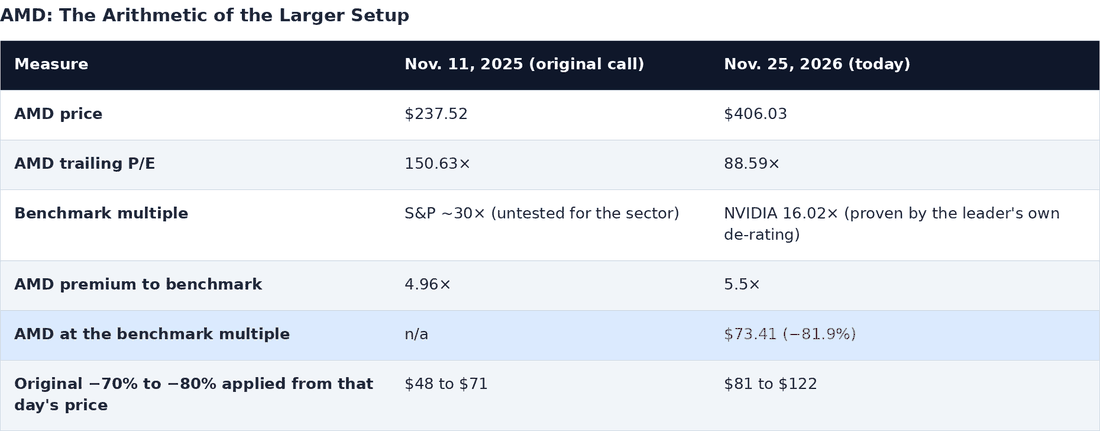
If AMD's multiple simply converges to the one NVIDIA has already been given, at AMD's current earnings, the implied price is $73.41. That is an 81.9% decline. It exceeds the original 70% to 80% forecast before any drop in earnings, before the Gulf capacity wave, and before any part of the 2027 to 2030 glut. If the original scenario is added on top, with the number-two producer's earnings rolling over as advantaged capacity comes online, the downside is larger still. The price at the multiple endpoint alone is roughly one-third of AMD's price on the day we made the call.
Why the leader de-rated first and the follower will de-rate harder. The petrochemical record shows this sequence. The market re-rated Union Carbide, the incumbent with a mature earnings base, years before it re-rated the late-cycle capacity adders, whose earnings were still growing fast as they took share during the boom. When the glut arrived, the late entrants fell furthest, because their multiples still assumed growth the industry could no longer deliver to anyone. AMD's first break (37.5% from peak in seven weeks) is how that process begins. NVIDIA's contraction showed where the category ends up. AMD's doubling only raised the height it falls from.
The final ranking. The Jensen episode ended the period in which confidence could stand in for returns on AI infrastructure. From here, the market will reward the companies that buy compute and penalize the ones that build it or contract for it at peak prices. Winners: Apple, then Meta, then SpaceX, Uber, and the industrial users led by PPG and Sherwin-Williams, with Amazon and Microsoft surviving as forecast. Losers: Anthropic first and by the widest margin, a trillion-dollar model-layer company already below its IPO price with roughly $900 billion of compute bills to pay into a falling price of intelligence. Then AMD, at 5.5 times the leader's proven multiple and only seven weeks into its first break, with Anthropic's commitments sitting in its own order book. NVIDIA's de-rating is done. Behind AMD in the queue are the producers still trading above their November 2025 prices: Micron, Marvell, ASML, TSMC and Arm. AMD is the next big hurt.
Market data from Perplexity Finance, retrieved November 25, 2026. November 2026 market events from the AP, Fortune, Reuters, Charles Schwab and CNBC; the Anthropic IPO and prospectus from Forbes, CNN, MarketWatch, Dealroom, CNBC, GeekWire, Fortune and FourWeekMBA. Industry and corporate history from Dow and Union Carbide corporate records, court filings and contemporaneous press. Gulf buildout, open-weight pricing, China compute and precedent sources as cited in the original analysis.
This paper presents the authors' independent analysis and opinions for informational purposes only. It is not investment advice or a recommendation to buy or sell any security.
The authors hold positions in securities mentioned and reserve the right to buy or sell shares at any time without notice.