The Boss and The President: Understanding Trump Through the Steinbrenner Model

Executive Summary
Donald Trump has told the world exactly who his model is. In his first book, in interviews spanning four decades, and in private letters now made public, Trump identified George M. Steinbrenner III, "The Boss" as his idol, mentor, and closest friend. Yet the political class, media analysts, and foreign policy establishment have largely ignored this self-declared roadmap to understanding the 47th President.
This analysis argues that Steinbrenner's ownership of the New York Yankees provides the single most accurate predictive framework for Trump's leadership style, decision-making patterns, and political trajectory, including the current Iran conflict. The parallels are not metaphorical. They are operational, behavioral, and structural, confirmed by every person who knew both men intimately. And they extend one generation further: if Trump is studying the Steinbrenner succession model and given that Randy Levine, who witnessed it firsthand, now sits in the White House, the logical conclusion points toward a dynasty, and a specific heir.
Part I: The Mentor-Protégé Bond
Origins of the Relationship
The friendship between Donald Trump and George Steinbrenner was forged in the cauldron of 1980s New York, a city of tabloid wars, real estate empires, and outsized personalities. Both men were "kindred spirits" who craved media attention, demanded loyalty, and measured everything by winning. Trump frequently sat in Steinbrenner's private box at Yankee Stadium, where he observed the bold, confrontational management style that would later define his own career.
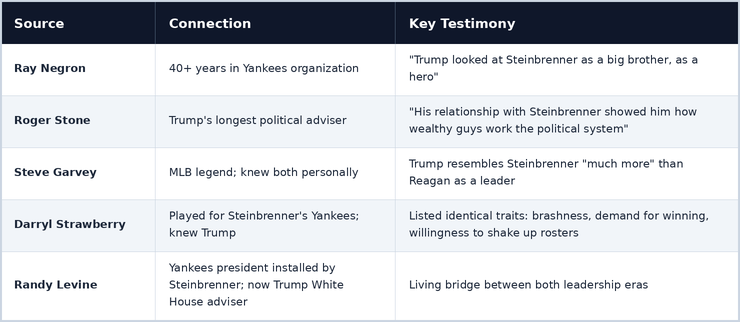
Ray Negron, who spent over 40 years in the Yankees organization and knew both men closely, told Business Insider that Trump "looked at Steinbrenner as a big brother, as a hero, and you know he don't look at anybody that way." Negron called Steinbrenner a "very strong mentor" to Trump and confirmed that their relationship went far deeper than casual friendship.
The 1989 Letter
In a letter written on official Yankees letterhead, which Trump himself resurfaced and shared publicly in January 2026, Steinbrenner wrote: "You articulate the truth… you ought to consider running for President someday and set the whole thing right." This letter is remarkable not merely as a historical curiosity, but as evidence that Steinbrenner saw in Trump a version of himself capable of operating on a larger stage. Trump called Steinbrenner his "best friend" and a "big time winner" after his death in 2010.
Roger Stone, Trump's longest-serving political confidant, provided perhaps the most revealing assessment: "I think his relationship with Steinbrenner showed him how wealthy guys work the political system. Steinbrenner was a guy who gave millions and millions of dollars to politicians and political parties. And he worked 'the system.'"
Part II: The Turbulent First Act
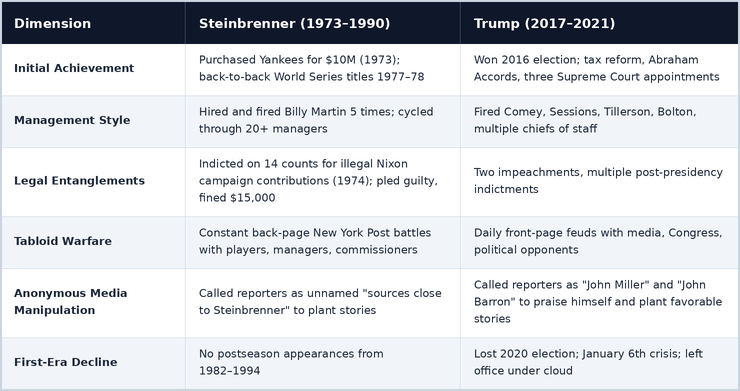
Both men's initial chapters were defined by extraordinary wins mixed with chaos, controversy, and tabloid warfare. The structural parallels are striking.
The Pseudonym Playbook
One behavioral overlap deserves special attention. Steinbrenner was notorious for phoning journalists as an anonymous source, when reporters wrote "sources close to George Steinbrenner say Lou Piniella is in danger of losing his job," it was widely understood the source was Steinbrenner himself. Trump employed the identical tactic throughout the 1980s and 1990s, calling reporters as "John Miller" or "John Barron" to lavish praise on himself and float business claims. Both men, in the same city, during the same era, independently developed the same media manipulation strategy — or, more likely, one learned it from the other.
Part III: The Exile
Steinbrenner's Banishment (1990–1993)
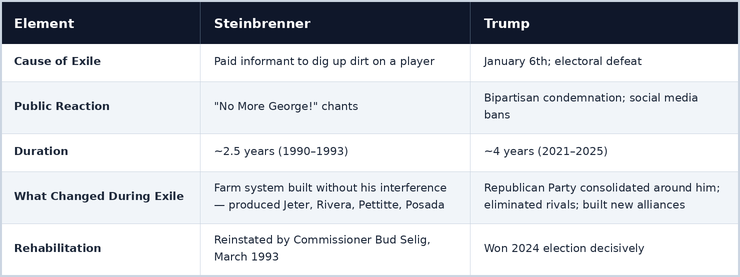
On July 30, 1990, Commissioner Fay Vincent permanently banned George Steinbrenner from day-to-day management of the New York Yankees. The cause: Steinbrenner had paid a known gambler, Howard Spira, $40,000 to dig up damaging information on outfielder Dave Winfield. Fans at Yankee Stadium that night chanted "No More George!" the public appeared to be finished with him.
Steinbrenner retreated from baseball, humiliated but never relinquishing ownership of the franchise. During his exile, something transformative occurred. Freed from Steinbrenner's daily interference, the Yankees' front office, particularly Gene Michael, quietly built a farm system that would produce Derek Jeter, Mariano Rivera, Andy Pettitte, Jorge Posada, and Bernie Williams. The irony is profound: Steinbrenner's absence allowed the infrastructure for his greatest triumph to be constructed.
Trump's Political Exile (2021–2024)
After January 6, 2021, a twice-impeached, electorally defeated president left Washington with a modest departure ceremony, vowing "We will be back in some form," before retreating to Mar-a-Lago. Like Steinbrenner, he was widely written off, banned from major social media platforms, facing multiple criminal indictments, with pundits across the political spectrum declaring his career over.
And like Steinbrenner, Trump used the exile period to rebuild. He consolidated control of the Republican Party, eliminated potential rivals, built a more loyal inner circle, and cultivated new alliances with figures like Elon Musk. The infrastructure for his comeback was constructed during the very period when his opponents believed he was finished.
Part IV: The Triumphant Return
Steinbrenner's Dynasty (1996–2000)
Reinstated by Commissioner Bud Selig in March 1993, Steinbrenner returned as a fundamentally more disciplined owner. The crucial difference: he learned to trust his front office and his manager. The hiring of Joe Torre in 1995, a move widely mocked at the time, became the defining decision of his career. The result was the greatest dynasty in modern baseball: four World Series championships in five years (1996, 1998, 1999, 2000). The franchise he had purchased for $10 million became the most valuable in professional sports. The same man who had been banned from baseball was now hailed as "the greatest owner in professional sports."
The second-act Steinbrenner was not a different man, he was the same man with better discipline. He still demanded excellence, still dominated headlines, still fired people. But he had learned the difference between creative chaos and self-destructive chaos.
Trump's Second Presidency (2025–Present)
Trump became the first president since Grover Cleveland in 1893 to lose the office and win it back. His 2024 victory was more decisive than 2016, described as a "stunning comeback" that "redefined American politics." Like Steinbrenner's second act, Trump's second presidency has been characterized by more consolidated power, broader coalitions, and an astonishing pace of executive action.
The connection remains active and visible. In March 2026, Trump appointed Yankees president Randy Levine, the man personally installed by Steinbrenner, to a key White House policy panel. Levine is the living bridge between the two eras, a man who served "The Boss" and now advises the president who modeled himself after him.
At a White House event in March 2026, Trump reminisced openly: "I have a passion for sports, and I would watch my friend alongside George Steinbrenner, we would sit in his suite, just the two of us. He would have nobody else but me. He liked me… He liked almost nobody."
Part V: The Shared Operating System
The Trump-Steinbrenner parallels extend beyond biography into a shared set of operational principles confirmed by multiple people who knew both men.
Firing and Rehiring: Steinbrenner hired and fired Billy Martin five times. Trump fires subordinates, lets them twist publicly, then sometimes rehabilitates them. Both men used termination as theater, a tool of dominance rather than mere personnel management.
Loyalty as Cardinal Virtue: Both men treated disloyalty as the unforgivable sin and rewarded fierce allegiance disproportionately. Steinbrenner kept Ray Negron in the organization for 40+ years because of loyalty shown as a teenager. Trump's inner circle is defined almost entirely by personal loyalty.
Working the Refs: Steinbrenner battled umpires, commissioners, and league offices relentlessly, accepting fines as the cost of doing business. Trump battles judges, regulatory agencies, and media institutions using the identical calculus.
Negotiation by Intimidation: Both men made outrageous opening demands, whether in free agent negotiations, stadium deals, or international diplomacy, that observers called insane, only to settle on terms still highly favorable to them.
Media Obsession: Both men were "infatuated with media coverage of themselves," monitoring press clippings obsessively, calling reporters directly, and treating tabloid coverage as a scoreboard.
The "Boss" Identity: Steinbrenner's nickname was literally "The Boss." Trump runs the White House with the same singular authority, everyone answers to one man, and the organization's identity is inseparable from its leader.
Part VI: The Steinbrenner Model Applied to Iran
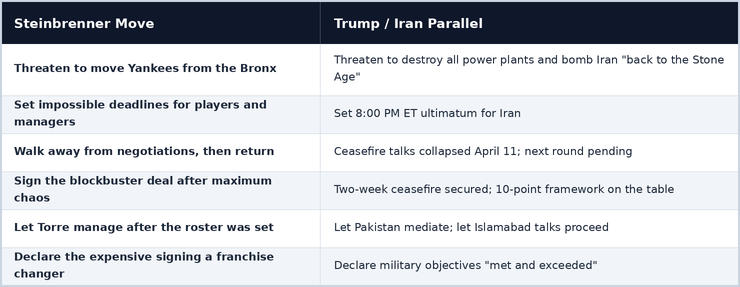
The current Iran conflict provides a real-time test case for applying the Steinbrenner framework. Steinbrenner's approach to every major negotiation followed a consistent pattern: open with maximum intimidation, set artificial deadlines, walk away entirely, then return with leverage amplified by the opponent's fear of permanent rupture, and finally close the blockbuster deal while letting the professionals manage the details.
The Iran campaign maps onto this playbook with remarkable precision.
A fitting historical footnote: a U.S. diplomatic cable released by WikiLeaks once described Iran's Mahmoud Ahmadinejad as "the George Steinbrenner of Iran" for his habit of meddling with Iran's national soccer team the same way George meddled with his Yankees roster. Trump, Steinbrenner's protégé, now finds himself negotiating with a country whose own leadership style was compared to his mentor's. It is, in a very real sense, Steinbrenner vs. Steinbrenner on the world stage.
What "The Boss" Would Advise Right Now
Based on Steinbrenner's documented patterns, the advice at this moment would likely be:
- "You've made your point — now close." The bombing campaign has established credibility of force. Continuing past the point of demonstrated capability risks the kind of self-destructive overreach that characterized Steinbrenner's first act. The second-act Steinbrenner learned that the threat of future action is often more powerful than the action itself.
- "Don't blow the deal on social media at 2 AM." Steinbrenner's worst moments came when he couldn't resist calling reporters late at night to issue threats that undermined his own negotiating position. The Truth Social posts that escalate rhetoric beyond what diplomats can manage are the modern equivalent.
- "Let the professionals work the details." After 1993, Steinbrenner stopped trying to manage every at-bat and trusted his front office to execute the vision he set. The Islamabad talks are the equivalent of Joe Torre managing a playoff game — the owner sets the roster and the strategy, but the manager calls the pitches.
- "Remember — you're building a dynasty now, not just winning one game." A deal with Iran that holds is worth more than a bombing campaign that makes headlines for a week.
Part VII: The Succession Question and Ivanka as Hal, Corrected
The Children of "The Boss"
If the Steinbrenner model predicts Trump's behavior, it also illuminates the most consequential question about his political legacy: who comes next?
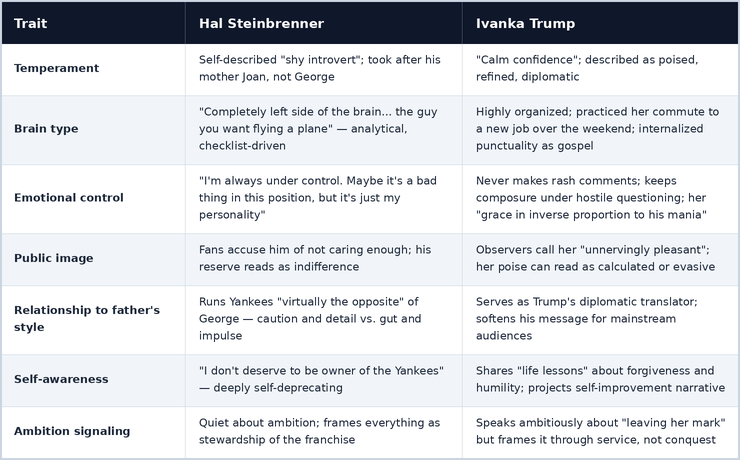
Both Ivanka Trump and Hal Steinbrenner inherited empires built by volcanic, larger-than-life fathers. Both have been defined, sometimes unfairly, by how they differ from those fathers. Hal told ESPN bluntly: "My dad and I are similar in some ways and we are different in some ways. We just have different personalities." Ivanka has navigated the same dynamic, serving as what Huffington Post called the "polished counterweight to Donald's brash and combative personality."
The personality parallels are striking and instructive.
The Critical Difference And Why It Favors Ivanka
Hal Steinbrenner's biggest problem is that fans see him as a lesser version of his father, a budget-conscious operator who runs the Yankees "like a small businessman" more concerned with balance sheets than championships. He is described as "extremely patient, relies on his front office too much, and doesn't pull the trigger on hard decisions," the anti-George.
Ivanka, by contrast, has managed something Hal never quite achieved: she inherited her father's status radar and killer instinct while wrapping it in an entirely different package. A former friend told Vanity Fair that beneath the polished exterior, Ivanka had "the Trump radar for status, money, and power, and her dad's instinct to throw others under the bus to save herself." She had the same competitive fire, she just presented it through what one publicist called "the daughter everyone wants."
The Steinbrenner Succession Playbook
The succession case breaks down into what Hal got wrong and what Ivanka could get right.
What Hal got wrong: He inherited the franchise but not the mythology. George's personality was the brand. Hal's analytical restraint, while financially sound, drained the Yankees of their fearsome identity. The Dodgers and Mets have now surpassed them in aggressiveness. Fans don't just want wins, they want swagger.
What Ivanka could get right: Unlike Hal, who seems almost apologetic about occupying his father's chair, Ivanka has spent her entire life learning to channel Trump energy through a diplomatic filter. Trump himself has said that if Ivanka "were to run for president, she'd be very, very hard to beat." CNN noted that dynastic women, from Indira Gandhi to Benazir Bhutto to Park Geun-hye, have historically been the most successful path to a first female head of state.
The Simpsons factor is worth noting: a viral clip appearing to predict Ivanka as president in 2028 racked up over 700,000 views immediately after Trump's 2024 win. The cultural expectation is already being seeded.
The Dynasty Thesis
The lesson for Trump, looking at the Steinbrenner succession, is clear: don't make the Hal mistake. George's empire lost its edge when it passed to a successor who had the competence but not the charisma, the spreadsheets but not the swagger. If Trump wants to build a political dynasty that outlasts him, he needs a successor who can combine his energy with a temperament that broadens the coalition.
The irony is that the very traits that make Hal a disappointment to Yankees fans, the calm, the restraint, the analytical mind, are exactly what make Ivanka a potentially formidable presidential candidate. In baseball, fans want George's fire. In a general election, voters might want Trump's agenda delivered through someone who can sit at a G20 table without making headlines for the wrong reasons.
Ivanka is what Hal should have been: the steady hand that still carries the old man's sword.
Conclusion: The Playbook Has Been in the Archive All Along
The failure of political analysts, media commentators, intelligence agencies, and foreign governments to systematically study the Trump-Steinbrenner connection represents a significant blind spot. Trump has told the world who his model is. The people who knew Steinbrenner best, Negron, Stone, Garvey, Strawberry, Levine have confirmed it repeatedly. The behavioral patterns match at granular levels: the pseudonyms, the firing cycles, the negotiation-by-intimidation, the exile-to-dynasty arc.
Anyone seeking to predict Trump's next move, whether on Iran, trade policy, or domestic politics, would be well served to study the Steinbrenner archive: the back pages of the New York Post from 1973 to 2010, the oral histories of Yankees managers and executives, and the documented negotiation tactics of the most controversial and ultimately most successful owner in professional sports history.
The playbook has been sitting in the Yankees archive all along. George Steinbrenner wrote it. Donald Trump is executing it on the world stage.
"George was the boss, and he was a great guy. More than anything, George Steinbrenner knew how to win. There was no one like him."
— Donald J. Trump, 2010
This analysis represents independent political and historical research. The views expressed are those of the authors and do not constitute investment, legal, or political advice.