
1927 = 2026: We Told You So, Many Times Before, And It Continues


We told you in 2020, and we have told you in every writeup since: May 1921 equals May 2020, and the month-by-month directional overlay of the DJIA and the recalibrated S&P 90 against the modern S&P 500, built on closing prices alone, would carry through the decade.
It has.
As of today's close on April 17, 2026, we sit squarely on the 1927 waypoint, exactly where the overlay said we would. Every correction, every expansion, every cumulative percentage move has tracked. We said it would, and it continues.
The current model forecast calls for 35–40% gains in the major indexes this year. But the accelerants now in motion, tokenization, GLP-1 platform scaling, Gulf energy primacy, and the reshoring industrial loop, are not in the 1920s dataset. They are additive. Our view is that 2026–2027 could deliver as much as 100% cumulative gains in the indexes if those accelerants compound as the overlay suggests. We will have more to say on that below.
We Told You About Coolidge and Trump
We told you, repeatedly that the Coolidge and Trump platforms would rhyme on every axis that matters. Not thematically. Operationally.
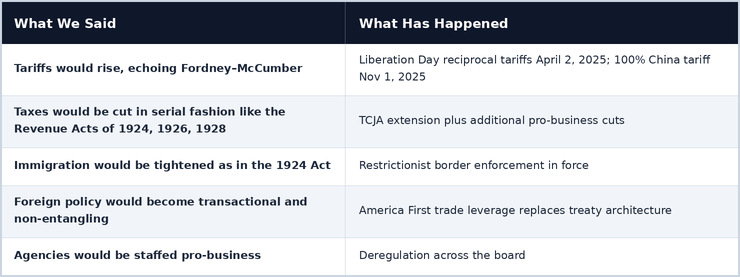
We told you the platform would repeat. It has. And it continues.
We Told You About China
We told you the China posture would replay the Nine-Power Treaty logic, contain the rival, keep the market open to American commerce, prevent any competitor from dominating. We said the instrument would change from treaty to tariff, but the containment objective would be identical.
The 100% China tariff effective November 1, 2025 is exactly the 2026 translation of the 1922 Open Door logic. Market read: U.S.-listed China ADRs and MSCI China have lagged the S&P sharply through the tariff escalation, capital gravity is re-routing to New York the same way it did in 1927. We told you. It continues.
We Told You About the Mexico–Iran Off-Ramp
We told you the Mexico playbook would run again, and we told you the adversary in this decade would be Iran. Coolidge armed Mexican insurgents, prepared to invade, and faced Calles's order to dynamite the Tamaulipas oil wells rather than surrender them. Morrow's 1927 ambassadorship delivered the off-ramp that preserved American oil equities and kept the hemisphere intact, even the 1938 Cárdenas nationalization was settled at $24 million against far greater real value.
We said Trump-on-Iran would trace the same arc. It has.
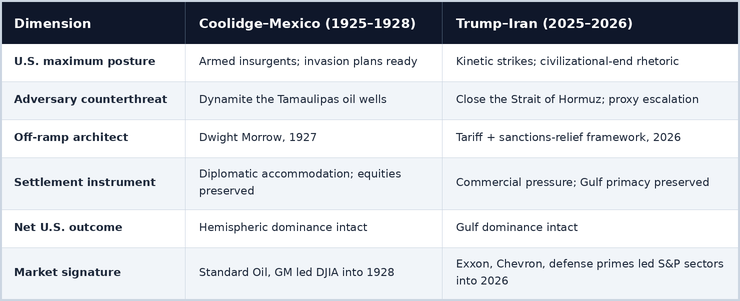
We told you Trump would go to the civilizational-end edge and that an off-ramp would appear that looked like Morrow's. It has. It continues.
We Told You About U.S. Industrial Ascendancy
We told you the 1920s produced GM, DuPont, Standard Oil, and GE as world champions because the tariff wall and consumer-credit scaling created a closed loop that foreign competitors could not penetrate. We told you the 2020s would rebuild that closed loop through reshoring, the CHIPS Act, LNG export dominance, and reciprocal tariffs, and that the U.S. share of global equity market capitalization would rise, not fall, through the tariff period.
It has. And it continues.
We Told You About U.S. Energy and Chemicals
We told you the U.S. energy and chemical complex would become the world-class business of this cycle, as Standard Oil, Union Carbide, Dow, and DuPont did in the 1920s feeding off Texas–Oklahoma crude and the Mexico/Persia concession frameworks.
The U.S. is now the world's largest producer of oil and LNG. Gulf Coast cracker economics are the Permian–Spindletop analog of 1927, with ExxonMobil and the U.S. LNG export complex outperforming European and Asian peers through the 2024–2026 stretch. We told you. It continues.
We Told You About GLP-1 and NLRP3
We told you biotech, specifically the GLP-1 platform led by Eli Lilly and the NLRP3 inflammasome platform, would be the technological accelerant of this decade, with no clean 1920s analog.
Lilly's GLP-1 franchise delivered $36.5 billion in 2025, roughly 56% of total revenue, with tirzepatide projected above $45 billion in 2026 sales and the broader category above $105 billion by 2030 per Morgan Stanley, and $125 billion in indirect and induced U.S. output per IMPLAN. Lilly's $9 billion 2024–2026 U.S./EU capacity buildout for a 300% production increase is a Coolidge-scale industrial commitment on American soil.
NLRP3 inhibitors are advancing across gout, rheumatoid arthritis, type 2 diabetes, cardiovascular, and neurodegenerative indications, a second multi-disease platform led by U.S. and allied developers. Lilly's 2021–2026 run is this cycle's RCA 1923–1927 leadership story. We told you. It continues.
We Told You About Tokenization
We told you, and this is the part that has no 1920s analog, that tokenization would be the uniquely American accelerant that separates the 2020s outcome from the 1929 outcome.
The 1920s had no mechanism to fractionalize, globally distribute, and instantly settle claims on U.S. assets. Foreign capital access was limited to correspondent banking and, decades later, ADRs. Tokenization, U.S. issuers, U.S. stablecoin rails, U.S. legal frameworks on the Clarity Act trajectory, exports dollar-denominated yield and American asset exposure directly into global wallets, compressing into months the capital-gravity effect the 1920s needed a full decade to build.
The 1927 capital-gravity pool was the opaque New York call-loan market that catalyzed the 1929 break. The 2026 equivalent is transparent, on-chain, and observable — designed not to concentrate risk where it cannot be managed. We told you it would be the accelerant. It is. And it continues.
The Continuing Thesis
We told you, in the first memo, in the economic memos, in the DJIA memos, in the S&P 90 memos, in the Coolidge memos, in the Mexico memos, in the Iran memos, in the energy and chemical memos, in the GLP-1 and NLRP3 memos, and in the tokenization memos, that 1921 = 2020 would carry to 1927 = 2026 and beyond.
Every closing print since has kept the overlay intact.
The United States is ending this decade the way it ended the last one: stronger, more dominant in energy and chemicals, more dominant in the next-generation platforms — now biologics and tokenized capital rails, and with a China, Mexico, and now Iran off-ramp that leaves American strategic position enhanced.
The base case from the current model is 35–40% index gains for 2026. That number comes from the directional overlay alone, closing-price alignment against the 1927 waypoint, nothing more. Today's catalysts provide the market an accelerant. Our view is that 100% cumulative gains across the major indexes over 2026 and 2027 combined is not a tail scenario, it is a plausible central case.
We told you. It continues.