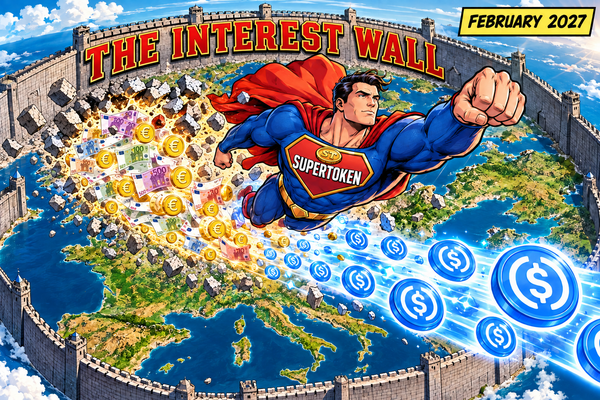
The BCII Super Coupon Token as Schumpeter's 2026 Gale


Joseph Schumpeter defined creative destruction as the "industrial mutation that incessantly revolutionizes the economic structure from within, incessantly destroying the old one, incessantly creating a new one." He did not envision a tokenized coupon when he wrote those words in 1942. But the BCII Super Coupon Token is a textbook example of that gale beginning to blow through the $491 billion U.S. advertising industry, and the economic case for why it succeeds is rooted not in speculation, but in the internal logic of capitalism itself.
What BCII Actually Built
BCII's patent-pending architecture allows any company, charity, influencer, or creator with a distribution list to issue a tradable super coupon token that embeds third-party coupons for free, surfaces every embedded offer in a companion app, and settles peer-to-peer in USD via a dollar-backed stablecoin on Horizon GmbH's Layer-2 infrastructure.
The foundational insight, and the one the accounting establishment has never formalized until now, is that every organization with a subscriber or customer list is sitting on an invisible asset that appears nowhere on its balance sheet. The list has real economic value: it is the distribution infrastructure through which offers reach verified, opted-in individuals. BCII is the first platform to recognize, monetize, and formally capitalize that asset. The super coupon token is the instrument through which a previously unrecognized balance-sheet item becomes legible, tradable, and income-generating.
Three structural features make this more than a product launch:
CFO Squad's favorable accounting opinion converts the discount value into a balance-sheet asset rather than an expense — a distinction with enormous implications for public-company EPS calculations.
The 55-month cycle. Each token cycles across five distribution rounds, producing vesting-like retention for issuers, transaction-fee revenue, and on-chain proof of awareness that replaces the opaque impression counts the legacy ad stack has relied on for decades.
Zero-cost embedding. Third-party advertisers embed their coupons into existing tokens for free. The marginal cost of participation is negative as advertisers gain distribution and pay nothing until redemption.
Why Capitalism Will Force Adoption
The mechanism Schumpeter identified was not voluntary. Firms do not choose creative destruction; they are compelled by competitive pressure. BCII's architecture contains four forcing functions that make adoption systemic rather than optional.
The asymmetric CFO incentive. Once the first public issuers book ad spend as a balance-sheet asset rather than an expense, every competitor faces a structural EPS disadvantage if they do not follow. CFOs cannot watch peers improve reported equity and net income through a legally recognized accounting treatment while continuing to expense identical activity. The accounting opinion does not merely benefit early adopters, but punishes late ones.
The free-to-embed flywheel. Embedding costs $0. This eliminates the standard barrier to network participation. Every advertiser has a negative marginal cost to participate, which means the advertiser side of the two-sided market fills rapidly and nearly automatically once issuer distribution reaches threshold scale.
The consumer ownership model. This is where BCII departs most sharply from the surveillance economy that Google and Meta built. The individual holds the token and benefits directly from the intrinsic value added by embedded third-party coupons — value that accrues to them, not to an intermediary. Critically, the user opts in. Their identity is never disclosed to the advertiser. They are not being tracked, profiled, or spammed. The token is theirs: they own it, they trade it, and they capture the economic upside as its embedded value grows. In the legacy ad stack, the consumer is the product. In the BCII model, the consumer is the beneficiary.
Two-sided network effects. Issuer distribution lists plus advertiser coupon inventory produce the same winner-take-most dynamic that built Google, Meta, and Alibaba. The platform that aggregates the most issuers attracts the most advertisers, which makes the token more valuable to holders, which attracts more issuers. This is not a new dynamic, it is the most well-documented growth engine in the history of digital platforms, and BCII is the first advertising infrastructure to deploy it in a tokenized form.
The accounting and patent moat. Google and Meta cannot replicate the asset-recognition treatment without rebuilding their entire business model. Their revenue comes from selling impressions, an expense to the buyer. Pivoting to a tokenized coupon structure that converts that expense into an asset would require dismantling the CPM pricing architecture that generates their combined $300B+ annual revenue. The moat is not technical; it is structural.
The Creative Destruction Math: What Gets Destroyed vs. Created
The existing digital advertising stack is, in economic terms, an extraordinarily inefficient rent-extraction mechanism. Roughly 40–60% of every dollar spent on digital advertising is captured by intermediaries, DSPs, ad exchanges, data brokers, and verification layers, before it reaches a consumer. An additional 30–40% is estimated to be waste: fraud, non-viewable impressions, and bot traffic. The advertiser receives somewhere between 10 and 30 cents of real consumer attention per dollar spent, with no cryptographically verifiable proof of any of it.
BCII attacks this structure at every layer simultaneously.
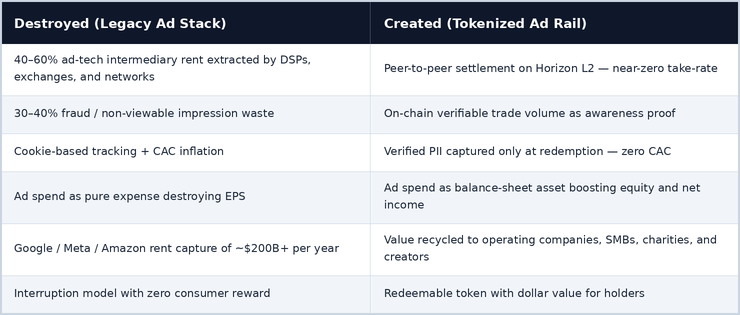
The transition is not painless. Schumpeter was explicit on this point: "lost jobs, ruined companies, and vanishing industries are inherent parts of the growth system." The ad-tech intermediary layer, DSPs, exchanges, cookie-based data brokers, will contract materially between 2027 and 2029 as budget flows migrate to tokenized rails. These losses will be concentrated and visible. The gains will be distributed across millions of SMBs, charities, creators, and consumers who today cannot access Google and Meta CPM markets at viable economics.
That asymmetry, concentrated destruction, distributed creation, is the standard signature of a Schumpeterian transition. It is also why incumbents fight it and why it happens anyway.
The U.S. Economy-Wide Impact of 10% Adoption
The advertising industry's economic multiplier is well-documented. The Advertising Coalition estimates that every dollar of ad spend generates approximately $21 of economic activity through the downstream effects on consumer awareness, purchase behavior, employment, and tax receipts. At 10% adoption of tokenized advertising rails by 2030, the second-order economic impact is material at the macroeconomic level.
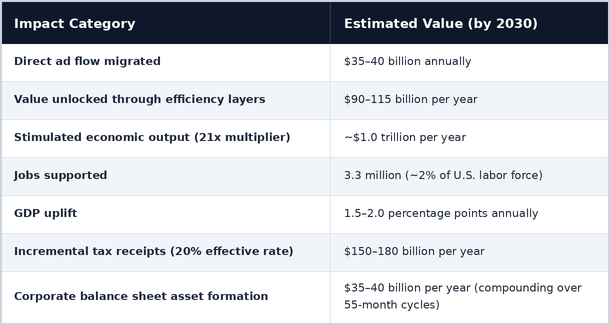
A $150–180 billion annual expansion of the tax base at no rate increase is not a trivial footnote. It is the kind of productivity gain that fiscal policymakers spend decades trying to engineer through structural reform. BCII's mechanism generates it as a byproduct of replacing an inefficient intermediary stack with a direct-settlement rail.
The Five-Year Creative Destruction Roadmap
The transition follows a predictable Schumpeterian arc: early adopters capture asymmetric advantage, competitive pressure forces broader adoption, the intermediary layer contracts under volume loss, and the new infrastructure achieves scale as global tokenization markets mature around it.
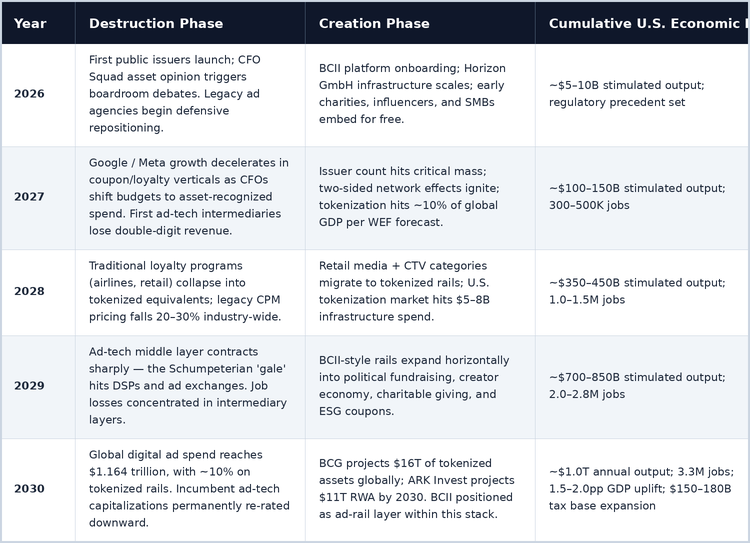
The 2027–2029 window is the most consequential. This is when the Schumpeterian gale moves from theoretical to operational, when ad-tech intermediaries begin reporting double-digit revenue declines, when legacy CPM pricing falls 20–30% industry-wide under competitive pressure from verifiable on-chain alternatives, and when the two-sided network effects ignite at scale. The platform that controls the issuer-advertiser matching layer at that inflection point controls the architecture of digital advertising for the decade that follows.
Why BCII Specifically Is the Gale, Not Just a Breeze
Not every innovation that attacks an incumbent industry succeeds. The distinction between a Schumpeterian gale and a passing squall comes down to structural durability — whether the new model's advantages compound over time or erode as incumbents respond.
BCII's position has five durable structural features:
First-mover with patent protection on the coupon-as-tradable-asset architecture. The specific combination of tradability, embedding, and on-chain settlement is patent-pending, creating a window during which the architecture cannot be legally replicated.
One-of-one accounting opinion converting ad expense into a balance-sheet asset. This opinion is not available to competitors who do not use the same tokenized structure, and as noted above, incumbents cannot adopt the structure without dismantling their existing business model.
Institutional-grade infrastructure via Horizon GmbH, purpose-built for H2 2026 public-company onboarding. The Layer-2 settlement architecture is designed to meet the compliance and auditability requirements of publicly traded issuers, not just crypto-native participants.
Positioning within a $16–30 trillion tokenization wave. BCG, Ripple, ARK Invest, and McKinsey have each projected that real-world asset tokenization will represent $16–30 trillion of global capital markets by 2030. BCII is not building a standalone product — it is building an ad-rail layer within the broadest capital-markets transformation since the introduction of the public equity. The infrastructure spend on tokenization is coming regardless; BCII is positioned to capture the advertising-specific layer of that buildout.
Attack vector at the foundation, not the margin. Schumpeter was precise about where creative destruction generates its largest productivity dividends: not at the edges of incumbents but "at their foundations and their very lives." BCII does not offer a cheaper impression. It replaces the impression model entirely. That is the difference between incremental competition and structural displacement.
The Bottom Line
Over the next five years, the BCII Super Coupon Token is positioned to deliver a textbook Schumpeterian gale: destroying the $200B+ per year rent capture of the legacy ad-tech oligopoly while creating roughly $1 trillion in annual U.S. economic activity, 3.3 million jobs, 1.5–2.0 percentage points of GDP growth, $150B+ of new tax receipts, and $35–40B per year of new balance-sheet asset formation by 2030.
That is not incremental innovation. It is the most consequential act of creative destruction in the U.S. media economy since the launch of Google AdWords, and because the same tokenization wave is simultaneously reshaping $16–30 trillion of real-world assets globally, BCII sits at the intersection of the two largest productivity catalysts of the late 2020s.
Schumpeter called it "the essential fact about capitalism." The entrepreneur holding the match rarely looks like a systemic threat until the fire is already burning. By the time the ad-tech intermediary layer fully recognizes what is happening, the accounting treatment will be locked in, the network effects will be compounding, and the patent protection will have done its work.
The gale does not ask permission.
The views expressed in this article represent independent economic and strategic analysis. This is not investment advice. Readers should conduct their own due diligence before making investment decisions related to any of the companies or technologies discussed.