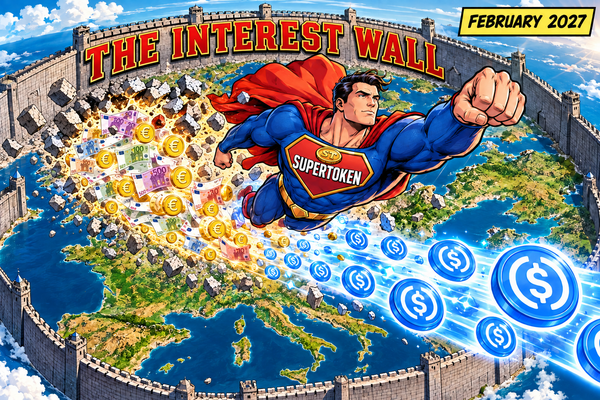
The Bessent/Warsh Accord and the Total Dominance of the US Dollar


A Codicil to "The Second Twenties"
Preamble
This codicil extends "The Second Twenties," published August 10, 2026. That report established the analog: the AI-stablecoin boom of 2026 through 2028 repeats the vacuum-tube and cracked-gasoline boom of 1927 through 1929, fueled by money the Federal Reserve does not control and cannot sterilize, ending in a periphery-first banking break around September 2028 and a V-shaped American recovery.
This document addresses what the main report left implicit. The policy architecture behind the boom is not an accident. Two appointments, Scott Bessent at Treasury and Kevin Warsh at the Federal Reserve, have assembled, whether deliberately or by convergence, a coordinated machine whose output is the total dominance of the US dollar. We name that machine the Bessent/Warsh Accord, and this codicil describes its parts, its reaction function, and its endgame.
Two Appointments, One Architecture
The original Fed-Treasury Accord of 1951 separated the central bank from the government's financing needs. The Bessent/Warsh Accord runs the film in reverse, re-integrating monetary and fiscal power around a single objective: making the dollar the operating system of global money.
On the Treasury side, Secretary Bessent championed the stablecoin framework that became the GENIUS Act, and stated its purpose without disguise, arguing that legislation backed by Treasuries would expand US dollar usage through stablecoins around the world, cementing reserve-currency status and creating demand for at least an additional $2 trillion of Treasuries, a figure he said could be greatly exceeded. The Treasury Borrowing Advisory Committee has formally studied stablecoin demand as a financing channel.
On the Fed side, Kevin Warsh took office as chairman on May 22, 2026 and immediately launched five task forces re-examining everything the Fed does: communications, data, inflation frameworks, the balance sheet, and the productivity effects of artificial intelligence. He has separately proposed a new Fed-Treasury accord governing the size and composition of the central bank's balance sheet, and has said that Fed officials are not entitled to the same special deference in areas affecting international finance.
Read together, the two agendas interlock. The Treasury builds a statutory pipeline that converts global deposit flight into T-bill demand. The Fed reorganizes itself around the two tools that still work in that world, the balance sheet and the productivity bet, and formally couples the balance sheet to the Treasury. Whether this was designed in consultation or arrived at by convergence, the effect is identical. Monetary and fiscal policy now face the same direction, and that direction is dollar expansion.
The Statute That Moved Money Creation to the Treasury's Doorstep
The GENIUS Act is conventionally described as consumer-protection legislation. Its monetary content is more consequential than its consumer content.
First, it mandates 1:1 reserves in Treasury bills of 93 days or less, hard-wiring every dollar of stablecoin growth into the front end of the Treasury curve. Second, it prohibits issuers from paying any form of interest or yield to holders. That single clause creates the seigniorage engine, because the entire carry on the reserve portfolio accrues to the issuer. Every Federal Reserve rate increase therefore widens issuer margins, funds more aggressive float expansion, including through the third-party rewards channel where exchanges may still pass yield to users, and accelerates the very inflows a hike would classically restrain.
The float is roughly $320 billion, approximately 99 percent dollar-denominated, growing 34 to 49 percent year over year, with Citi's base case at $1.9 trillion by 2030. Tether alone holds roughly $141 billion of Treasury exposure, a top-20 holder at sovereign scale. Galaxy's scenarios run from $162 billion to $3.5 trillion of incremental bill demand.
This is money creation at private issuers, statutorily channeled into government paper, outside the Federal Reserve's perimeter.
In substance, the GENIUS Act moved the marginal money printer from the banking system, where the Fed regulates it, to the Treasury's doorstep, where the Fed merely watches it.
The Neutered Rate, What the Fed Lost
The main report established that the Fed cannot sterilize tokenized-dollar inflows. This codicil states the stronger conclusion: conventional interest-rate policy is now asymmetric to the point of uselessness, and the Fed's own research infrastructure concedes the mechanics.
Cuts transmit fully. Lower the funds rate and the classical channels all fire: credit, housing, equities. The accelerator works.
Hikes leak. Raise the funds rate and the yield gap between interest-bearing reserves and yield-prohibited stablecoins widens, pulling more foreign deposits into dollar tokens whose reserves are forced buyers of bills. The BIS finds stablecoin inflows compress three-month bill yields with limited spillover to longer tenors. Fed Governor Miran cited estimates that widespread fully-backed stablecoins could put as much as 40 basis points of downward pressure on rates. The IMF's modeling concludes stablecoins weaken the effectiveness of monetary policy outright. The New York Fed documents stablecoin disintermediation of the banking system, and the Board's own notes describe the erosion of the deposit channel, the classical transmission mechanism, from underneath.
What survives is quantities. The administered floor of interest on reserves and the reverse repo facility still pins the overnight rate, and the balance sheet still moves markets with its full old force, because quantitative easing and tightening operate on quantities directly rather than pushing a price signal through a channel that leaks. A Fed reduced to QE and QT is precisely the Fed that Warsh's balance-sheet task force and proposed Treasury accord are being built to run. The brake is gone; the Accord is institutionalizing the accelerator.
There is precedent inside the analog. The Fed hiked from 3.5 to 6 percent in 1928 and 1929, and the rate that mattered, the call rate, was set by outside money it did not control. Its own historians concede the tightening failed. In 1929 the neutering was an accident of market structure. In 2026 it is codified in statute, and the Treasury is its beneficiary.
The Reaction Function, Service Deflation and the Second Coup de Whisky
The Accord's rate policy has a predictable trigger, and Warsh has published it in advance.
He has called AI the most productivity-enhancing wave of our lifetimes and structurally disinflationary, arguing that this gives the Fed room to cut. He has said the anecdotes will emerge before the data, and that policymakers must therefore take a chance on the productivity surge before it shows up in the official statistics. In July 2026 congressional testimony he called the AI supply shock faster than he would have projected 18 months or two years ago. Asked in the same session whether it hands the Fed an opportunity to cut, he said he thought it could.
Now run the arithmetic his framework will face. Compute prices are collapsing toward an infinitesimally small number. Inference costs are down roughly 1,000x in three years and still halving every two months, as Part VI of "The Second Twenties" sets out. As that deflation propagates through the service sector, measured service prices fall. Services are roughly 60 to 65 percent of the consumer basket. A 30 percent service-price decline over three years, the aggressive case, is roughly minus 11 percent a year on services, dragging headline inflation to roughly minus 5 to minus 7 percent annually even with goods and energy flat. Against a funds rate held at 3.50 to 3.75 percent, that is a passive real policy rate of 9 to 11 percent, the highest real rate in American history, imposed by doing nothing. Real rate differentials, not nominal ones, dictate capital flows. A real-rate gap of that size is a dollar magnet without precedent: asset flight into the United States from every banking system on earth.
No chairman sits on that. The Accord's reaction function is therefore aggressive cuts, publicly pre-justified by the AI-disinflation doctrine and privately necessitated by the need to restrain the dollar and relieve China, Japan, and Europe. And the analog already contains this exact event at this exact point on the clock. In August 1927, the mapped month, Benjamin Strong cut the discount rate specifically to relieve the flow of gold into the United States and take pressure off the European periphery, the famous coup de whisky. The cut failed to stop the inflows and ignited the final melt-up.
The second coup de whisky will fail the same way, for a stronger reason. Even cutting to zero against minus 5 to minus 7 percent inflation leaves the US real rate at plus 5 to plus 7 percent while the tokenized rails run. The magnet cannot be switched off. The cuts transmit with full force into the one channel that still works perfectly: domestic asset prices.
Both doors lead to the melt-up. Hold, and passive real rates soar, the dollar magnet strengthens, and periphery deposit flight accelerates into US assets. Cut, and the domestic boom is stoked directly while the real-rate gap barely narrows.
The 1920s ran the same configuration. Consumer prices were flat to falling from 1926 to 1929 while the Dow tripled, because a central bank targeting product prices during a productivity deflation runs a policy that is violently easy for asset prices without ever seeing it in its target variable.
The consensus caveat is stated for the record. The Financial Times economist panel puts the two-year AI effect on inflation below 0.2 percentage points, and sticky shelter costs dominate measured services. The Accord thesis does not require the full 30 percent. Even 5 to 10 percent cumulative market-services deflation flips the real-rate calculus, hands Warsh his anecdotes-before-the-data justification, and triggers the cutting cycle. The size of the number determines the violence of the melt-up, not whether it occurs.
Total Dominance, the Digital Dollarization of Everyone Else
The Accord's foreign consequence is the heart of this codicil. The Fed loses a brake; every other central bank loses the steering wheel.
The ECB's research shows stablecoin adoption drives deposit substitution and forces banks onto wholesale funding, weakening their policy transmission, and its leadership now frames private dollar tokens as altering the international monetary order itself. A periphery central bank facing dollar-token deposit flight is in the interwar gold-standard bind. Cut to support your banks and you accelerate the flight; hike to defend your deposits and you strangle your economy. You lose either way, because the token pays the holder convenience and the American issuer the carry regardless of your policy rate. Monetary sovereignty outside the United States becomes a fiction maintained by exchange-rate management.
The 1920s version of dominance was gold. By the late 1920s the United States and France had absorbed the majority of the world's monetary gold, and every country defending a gold parity was forced to import American monetary conditions, hiking into weakness as reserves drained, until Germany rolled over in 1928 and the Creditanstalt detonated in 1931. The 2020s version is faster and deeper, because the drain is not metal in vaults but deposits on phones. It is front-loaded, rate-insensitive, and running at internet speed out of Chinese, Japanese, and partially European banks, as Part V of "The Second Twenties" sets out. B2B stablecoin payments are up 733 percent year over year across more than 140 Fortune 500 deployments.
Every increment of periphery banking stress increases the float. Every increment of float increases the bill bid. Every increment of bill bid eases American financial conditions. Foreign fragility is, mechanically, an American subsidy.
This is total dominance in the precise sense. The dollar is becoming not merely the reserve asset but the operating system: the unit in which the world's deposits flee, the collateral its payments run on, and the bid beneath its hegemon's debt. The Accord did not merely fail to prevent this. Its two halves were built for it. Bessent said so in plain language. Warsh's institutional redesign assumes it.
The Endgame and the Positions
With the Accord installed, the sequence restates as follows.
Now through mid-2027, service disinflation emerges, Warsh's task forces supply the intellectual cover, and the cutting cycle begins. That is the second coup de whisky, and it puts melt-up fuel at maximum flow: float growth, the real-rate magnet, aggressive cuts.
2027 through mid-2028 is the vertical year. Periphery deposit flight accelerates, Chinese, Japanese, and partially European banking systems bleed toward crisis, and flight capital front-runs the break into US assets. This is the last and steepest leg to the peak around September 2028.
In late 2028 the periphery seizes and the float stalls or reverses. That is the exit signal. The US market breaks roughly 50 percent, the last and highest to fall.
2029 is where the analog parts from 1930. Flight to quality accelerates the dollar inflows through the bust, and the Fed that could not sterilize the boom cannot sterilize the cushion either. This time, unlike 1930, it does not try. QE plus the tokenized bid produces the V-shaped recovery by December 2029, and the dollar emerges from the crisis not weakened but as the sole standing monetary standard. It is the 1944 outcome without the conference.
The allocation conclusions of "The Second Twenties" survive the codicil unchanged and strengthened. Own the users of AI and stablecoin productivity rather than the producers of compute: the Dow Industrials, the Dow Transports, the Russell 2000, and the real-economy S&P 500. Expect the integrated hyperscalers to outperform only slightly. Expect roughly 2.5x on the S&P 500 by roughly September 2028. What the codicil adds is the policy engine underneath those numbers: an American Treasury that wants the bid, an American Fed that will cut into a productivity deflation, and a world whose money has nowhere else to go.
Watch the float. Watch the real rate. The dollar wins both halves of the cycle.
Sources
Policy statements and appointments are sourced to Reuters, the Federal Reserve, CNBC, CNN, the New York Times, and Schwab. Statutory and official-sector material draws on the text of S.394, the Congressional Research Service, the OCC implementing proposal, the Treasury Borrowing Advisory Committee, and Federal Reserve History. Research and market figures draw on BIS Working Paper 1270, a November 2025 Federal Reserve speech, an IMF working paper, New York Fed Staff Report 1185, a December 2025 Federal Reserve note, ECB Working Paper 3199 and June 2026 ECB remarks, Galaxy Research, Tether's quarterly disclosure, Reap, Datawallet, Spark, the Financial Times economist panel, and Stablecoin Insider.
A JD Unfiltered Market Analog Report, Codicil I to "The Second Twenties." This document presents a historical-analog market thesis for discussion purposes and is not investment advice. The "Bessent/Warsh Accord" is the author's name for a described policy convergence, not a claimed formal agreement. Policy positions attributed to Secretary Bessent and Chairman Warsh are sourced from their public statements, cited inline. The authors hold positions in securities mentioned and reserve the right to buy or sell shares at any time without notice.