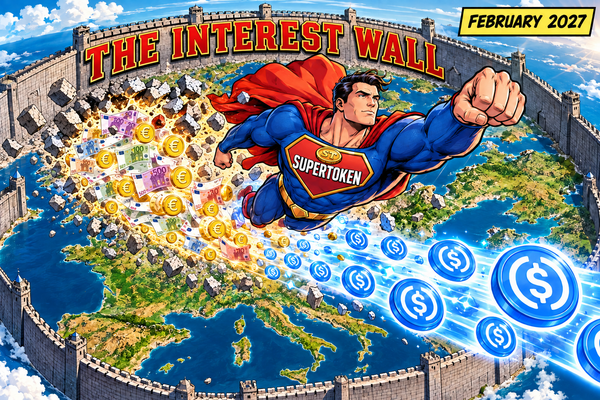
BCII: The Pick and Shovel to Worldwide US Stablecoin Acceleration


What the Super Coupon Token Does to Worldwide Stablecoin Adoption, and What It Means for BCII
The Thesis in One Paragraph
The GENIUS Act built the rails that turn stablecoin adoption into US Treasury demand, and then froze price competition among issuers at zero by prohibiting yield. Every forecast of the stablecoin market's future, from JPMorgan's cautious $500 to $600 billion out to Citi's $4 trillion bull case, is therefore really a forecast about distribution: how fast adoption spreads when no issuer is allowed to pay for it. The Super Coupon Token, BCII Enterprises' patent-pending architecture, is the first legal instrument that lets an issuer buy adoption rather than wait for it. It is a 5 percent purchase-price coupon, structured as an ASC 606 sales promotion rather than prohibited yield, running on a fixed 300-million-token economy whose tokens boomerang back to the issuer's balance sheet every cycle, with a built-in trading tax that pays the platform and a coupon book that lets advertisers, not the issuer, fund ever-richer enticements. If it works at one issuer, it becomes the standard at every issuer. This report lays out what that does to the worldwide adoption curve, and what the adoption curve does to BCII.
The Instrument, Defined
A coupon token is two instruments engineered to travel together. The first is a tradable utility token, a bare carrier with no claim on any asset and no share of anyone's profits, freely bought and sold on a marketplace. The second is the coupon itself, a fixed, non-transferable discount contract released by smart contract to the verified holder at redemption, entitling that person alone to buy a specific asset at a stated discount, on a stated schedule, for a stated term. The token trades; the discount does not. Nothing about it is a security. There is no common enterprise and no expectation of profit from the efforts of others, only a purchase discount accounted for under ASC 606 as a sales promotion.
The Super Coupon Token is BCII's industrial-scale version: a fixed 300-million-token economy per implementation, the two-state Forever and 11-month lifecycle, an 11-month license of monthly discounts, a 6 percent in-kind trading tax, ADV throttles, a recycling treasury that re-arms expired coupons indefinitely, and an advertiser coupon book. It is built for underlyings that are not securities and that the seller wants bought in volume, meaning stablecoins and commodity tokens, because a purchase discount on a product is retail while the same discount on a security would drag the structure into securities law. For a GENIUS-era stablecoin issuer barred from paying yield, it is the one legal instrument that incentivizes the purchase itself, and every incentivized purchase mints new float.
The Baseline: A Forecast Spread That Is Really a Distribution Bet
Stablecoin float sits at roughly $310 to $320 billion in mid-2026, about 99 percent of it dollar-denominated, with USDT and USDC holding roughly 83 percent of the market. The institutional forecasts diverge wildly.
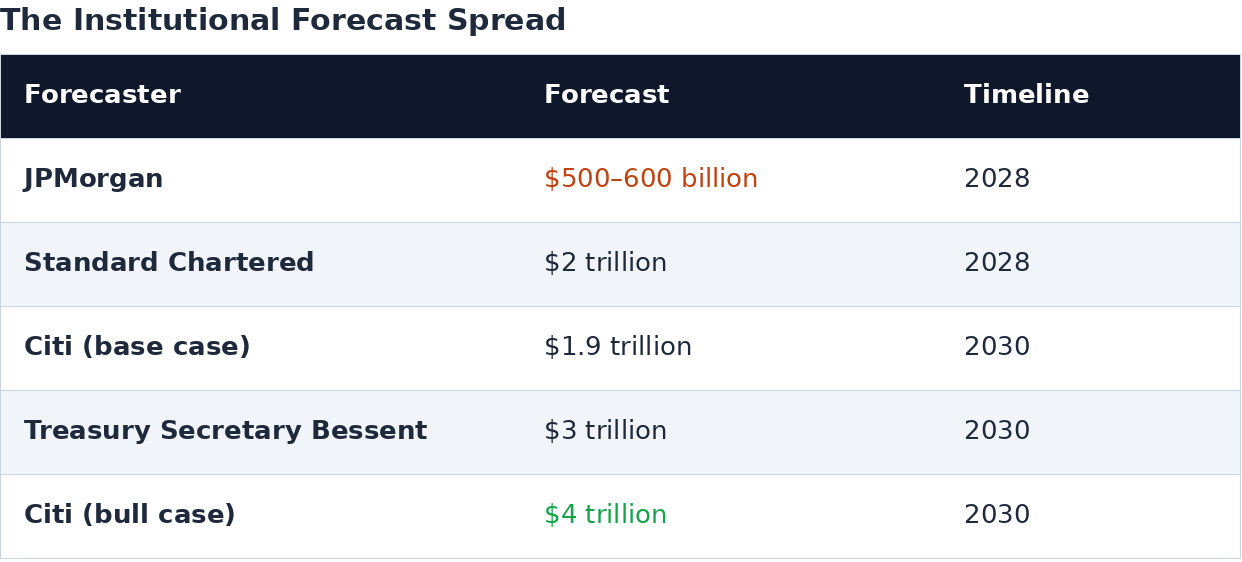
Sources: CryptoRank forecast compilation; Citi Stablecoins 2030.
The spread between $600 billion and $4 trillion is not a disagreement about whether people want digital dollars. It is a disagreement about distribution, meaning how fast adoption compounds when the product cannot be promoted on price. The market added only about $8 billion of net supply in the first five months of 2026, a pace that lands near the bottom of every forecast. Citi's own bull case is explicit that it requires adoption at scale by banks, fintechs, corporates, and payment ecosystems, and that is adoption current organic growth is not delivering.
The reason is structural. The GENIUS Act prohibits issuers from paying any interest or yield to stablecoin holders. The entire reserve carry, the seigniorage on hundreds of billions of dollars of T-bill reserves, accrues to the issuer, and not one basis point of it may legally be shared with the holder. The only workaround being debated is third-party rewards paid by exchanges, which enriches the exchange channel rather than the issuer's own distribution.
Stablecoins in 2026 are a product with extraordinary unit economics that is illegal to advertise on price. That is the freeze the Super Coupon Token breaks.
What the Architecture Does
It Ends the Price-Competition Freeze
The Super Coupon holder buys newly minted stablecoin at 95 cents per $1.00 of token. It is a purchase-price discount, delivered by a redeemer-specific smart contract as a fixed contract right at the point of sale, under the same FASB and ASC 606 material-right treatment for which BCII has already obtained a favorable accounting opinion. The holder is not paid for holding; the holder receives a discount for buying. That is a sales promotion, the oldest instrument in retail, and it is the first scalable, legal channel through which a GENIUS issuer can price-compete for float. In consumer-finance terms, it is the sign-up-bonus era of credit cards arriving in a market that has never been allowed one.
It Detonates in the Emerging-Market Lane
The effect compounds where the users already are. About 66 percent of global stablecoin supply is held by individuals in emerging markets, and the average global remittance still costs 6.5 percent of the transfer. A worker who buys dollars at 95 cents and sends them home has a negative-cost remittance. The coupon does not merely undercut the money-transfer operators; it pays the sender to switch. Latin America is already the fastest-growing region for real-world stablecoin usage, and Standard Chartered estimates up to $1 trillion could shift from emerging-market bank deposits into stablecoins over three years. The coupon puts a cash bounty on exactly that shift. This is the deposit-drain flywheel of the Bessent/Warsh Accord codicil with an accelerant attached, and the BIS is already warning that stablecoin flows erode capital controls in emerging markets, which is before anyone is paid five points to move.
It Turns the Arbitrageur into a Distributor
Retail discounted mint is ordinary, fully fungible stablecoin, with no lock, no gate, and sellable at par the moment it lands. The architecture openly invites the obvious cycle: buy the coupon token, redeem it, exercise the month's right at 95 cents, sell the stablecoin at par on the market, then run the same dollars again next month.
The issuer should welcome that cycle. A stablecoin sold on the market does not return to the issuer. It passes to a buyer who paid par because they wanted dollars, so every churned coin is float distributed to a real user at a 5 percent acquisition cost that coupon sales prefunded. The toxic version of the loop, buying at 95 and redeeming at 100 against the issuer's own window, barely exists. Tether direct redemption requires a $100,000 minimum and a fee of the greater of $1,000 or 0.1 percent, and Circle's direct redemption is institutional-only, with no retail redemption right at all. The $5,000 monthly cap and once-a-month cadence bound the arbitrage at $250 per token per month, which is a rate limiter rather than a spigot.
And the churn is doing the system's most important work, which is price discovery. Each coupon carries a hard, realizable $250 a month, so the marketplace arbitrages the token toward the present value of the full $2,750 stream. Every inventory pool, meaning BCII's 60M, the issuer's 40M treasury, and the market makers' 50M, reprices to intrinsic. Treasury sales at intrinsic fully prefund the discounts those coupons will claim, and the 6 percent tax is levied on richer volume the whole way up. The arbitrage extinguishes itself at intrinsic, because a token bought at intrinsic has no excess return left, and the churner's profit decays to zero exactly as his work is completed. Float residency survives the churn as well. A sold stablecoin stays outstanding in a new holder's hands, and at the current 3.50 to 3.75 percent funds rate, reserve carry alone repays the 5 percent discount at roughly 16 months of average float residency, measured on the coin rather than its first owner, before counting coupon-sale proceeds and trading-tax share.
The Elite Lane Is the Term-Funding Engine
The one place a lock survives is the elite lane, because it must. Unlimited discounted mint with immediate par liquidity would be an unbounded draw that no coupon sale prefunded. Elite mint is therefore issued as a term-locked series, transferable on-chain but not redeemable at par against the issuer until Month 11, or on payment of a 5 percent early-redemption fee. That converts unlimited volume into eleven months of contractually committed funding at a net cost of roughly 1.7 percent after reserve carry, which is cheaper than any deposit, CD, or wholesale alternative.
Term float is also the highest-quality float. An issuer that knows a dollar cannot come back for eleven months can hold reserve duration with confidence, deepening the T-bill bid per dollar. Citi already pencils roughly $1 trillion of fresh on-chain Treasury demand from a $1.9 trillion float, and coupon-acquired elite float is the contractually committed slice of it. Two lanes, two engines: retail delivers adoption, distribution, and price discovery, while elite delivers duration. Each lane's constraint is the other lane's engine.
It Regenerates: The Boomerang Balance Sheet
The coupon tokens themselves are Forever Tokens, and they come home. Every distributed token returns to the issuer's balance sheet at the end of its 11-month license, or earlier as the license is exercised and runs off, where it sits in treasury as a Forever Token until re-armed with a fresh discount contract carrying a fresh $2,750 of intrinsic value. The issuer is not spending its 300M stack on holders. It is lending it, on an 11-month term, and taking it back.
Distributions are therefore a term loan of an appreciating instrument rather than a marketing expense, and the stack is a perpetual, non-depleting asset that mints new salable inventory every cycle, indefinitely. The issuer take stacks five deep, across the 3.4-percent-less-admin trading tax, the 40M treasury coupon sales, the recycled-pool re-sale every cycle, the reserve carry on every coupon-acquired dollar of float, and the elite membership fees, while the inventory generating all of it is never consumed. The issuer is not merely renting BCII's architecture. It is acquiring a permanent balance-sheet machine.
It Carries an Advertising Business Inside It
The coupon token is a book rather than a single coupon. The architecture lets third-party advertisers attach their own coupons to it, paying for placement in front of a verified, transacting audience. That is the exact asset that built retail media. Amazon converted its buyer list into a $68.6 billion advertising business in 2025, Netflix converted its subscriber base into an ad business doubling to roughly $3 billion in 2026, and retail media as a category reaches an estimated $196.7 billion in 2026, about 16 percent of all global ad spend. A stablecoin issuer running the coupon program holds one of the largest verified dollar-holder lists in the world, identity-verified at redemption with purchase behavior attached, which is better targeting substrate than either Amazon's or Netflix's.
The advertising layer does double duty for adoption. Placement fees are a new revenue stream on top of the coupon economics, and every advertiser offer added to the book raises the coupon's effective value above the $2,750 stablecoin intrinsic at zero cost to the issuer, because the enticement is funded by the advertisers themselves. No conventional loyalty program has that property; airlines and card issuers pay for their own rewards. The flywheel closes on its own. A richer book drives coupon demand, demand grows the verified list, the list commands higher placement rates, and higher ad revenue funds a richer book, with every trade of the more-valuable token still paying the 6 percent tax.
The Capacity Math
Each implementation's 150 million coupon-bearing tokens, meaning the 125M holder distribution pool plus the 25M elite pool, carry a $5,000-per-month purchase right for 11 months. That is roughly $55,000 of discounted-mint capacity per coupon, and several trillion dollars of theoretical capacity per cycle per issuer.
Capacity is not the constraint; conversion is. Even 1 to 2 percent utilization is $70 to $140 billion of new float in a single cycle, a 20 to 45 percent step-change to the entire worldwide market from one program at one issuer. The elite lane compounds this, offering unlimited discounted mint during the 11-month license at a net cost to the issuer of roughly 1.7 percent for eleven months of contractually locked funding.
The Contagion Effect Is the Real Answer
The largest impact is competitive, not arithmetic. The moment one issuer runs a working coupon channel, zero-incentive float is uncompetitive everywhere. Every issuer, and every bank deposit-token entrant Citi expects to contest the market, must build or license a coupon rail or watch its float migrate to the issuer that has one. That is what moves the market off the base-case path. Successful deployment converts Citi's $1.9 trillion base toward its $4 trillion bull, pulls Standard Chartered's 2028 timeline forward, and makes Bessent's $3 trillion the conservative case rather than the aggressive one.
The Adoption Curve, Re-Drawn
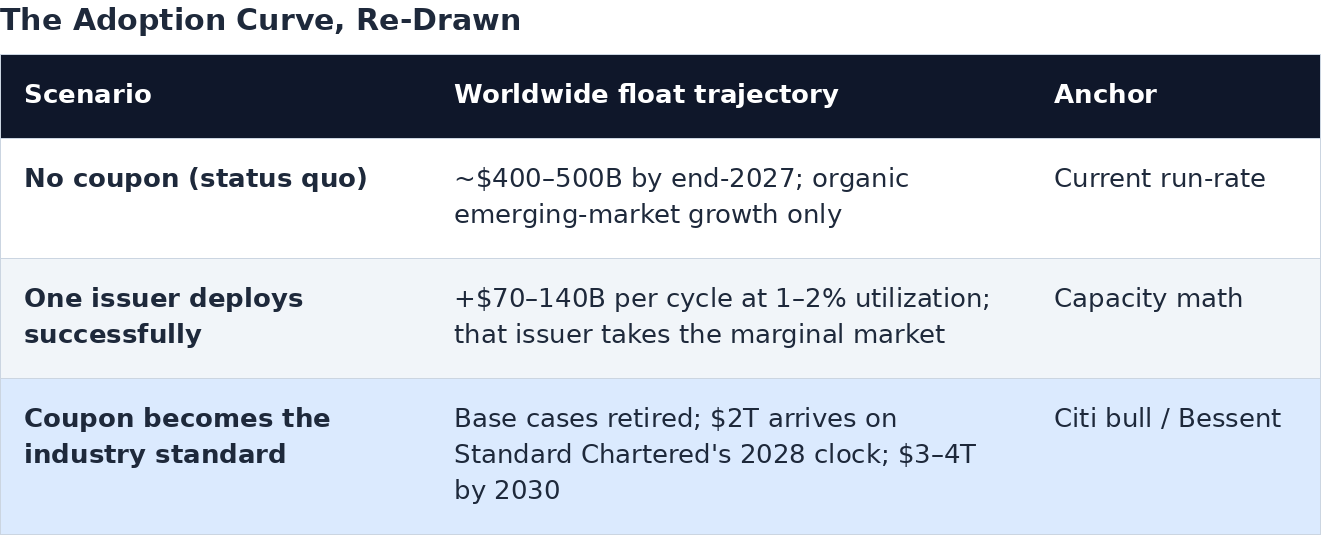
Three paths for worldwide float, depending on whether the coupon rail deploys and spreads.
In the standard scenario, the coupon does for stablecoins what the sign-up bonus did for credit cards and free checking did for retail banks. It converts a commodity product into a distribution war, and the war itself grows the category. The GENIUS Act built the rails; the coupon builds the ridership.
What It Means for BCII
The Revenue Architecture
BCII's position in every implementation is fixed by the architecture, and it is the same for Tether, Circle, Aurica, or any future licensee.
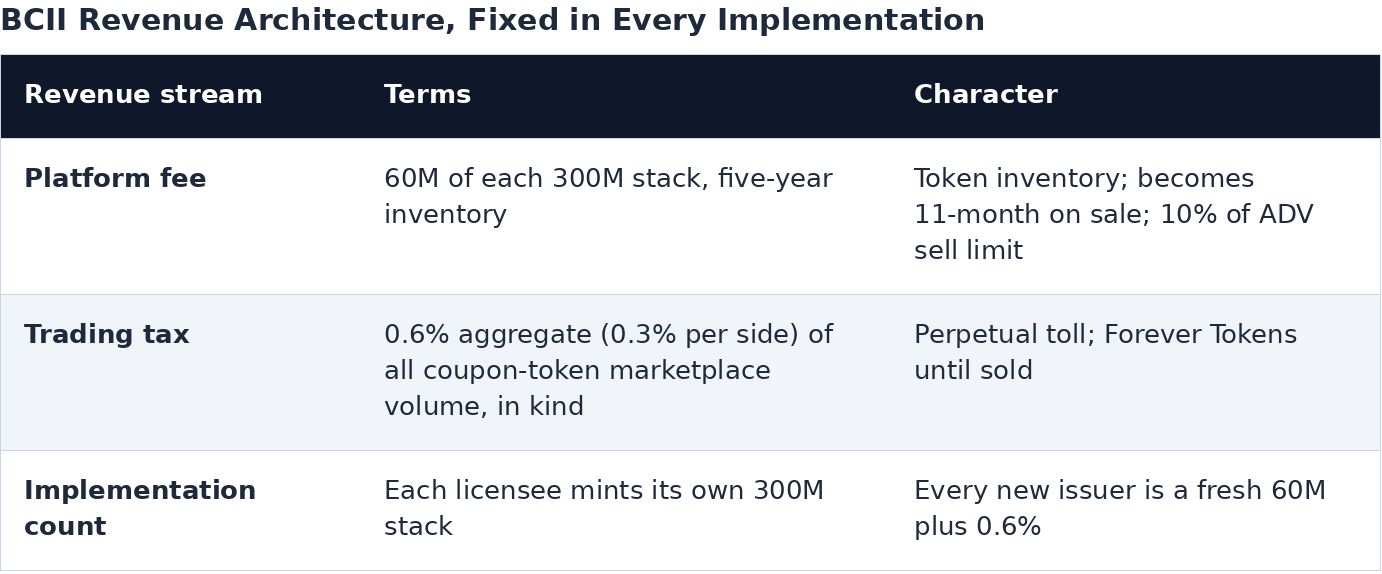
The three streams, identical across licensees.
The trading tax is the annuity. Per $1 billion of annual coupon-token marketplace volume, BCII receives $6 million in kind, perpetually, with no incremental cost. The 60M platform-fee inventory is the equity-like upside, sold into a marketplace where the coupon's intrinsic value is $2,750 per token, being 11 months at $250, and throttled by the 10 percent ADV limit that keeps BCII's realization disciplined and the market orderly. The advertiser layer compounds both streams without BCII lifting a finger, because every merchant offer attached to the book raises the coupon's effective value, which supports the marketplace price BCII sells into and enlarges the volume the 0.6 percent tax is levied on.
Just as important for the sale itself, the license is easy to buy because the issuer wins bigger than BCII does. The boomerang mechanic hands the issuer a perpetual, non-depleting token treasury. The coupon book hands it an Amazon-style advertising option on its own user list, with placement-fee economics that are a negotiable term of each implementation. BCII is not asking an issuer to pay for a marketing program. It is licensing a balance-sheet machine plus a media network starter kit, and keeping a toll on the machine it installs. That is why the counterparty conversation is a sales pitch and not a plea.
Sales Scenarios
The honest way to size BCII's sales is by marketplace volume and implementation count, not by intrinsic value, because the ADV limits exist precisely so that no holder, including BCII, can dump inventory at intrinsic. Illustratively, per implementation:
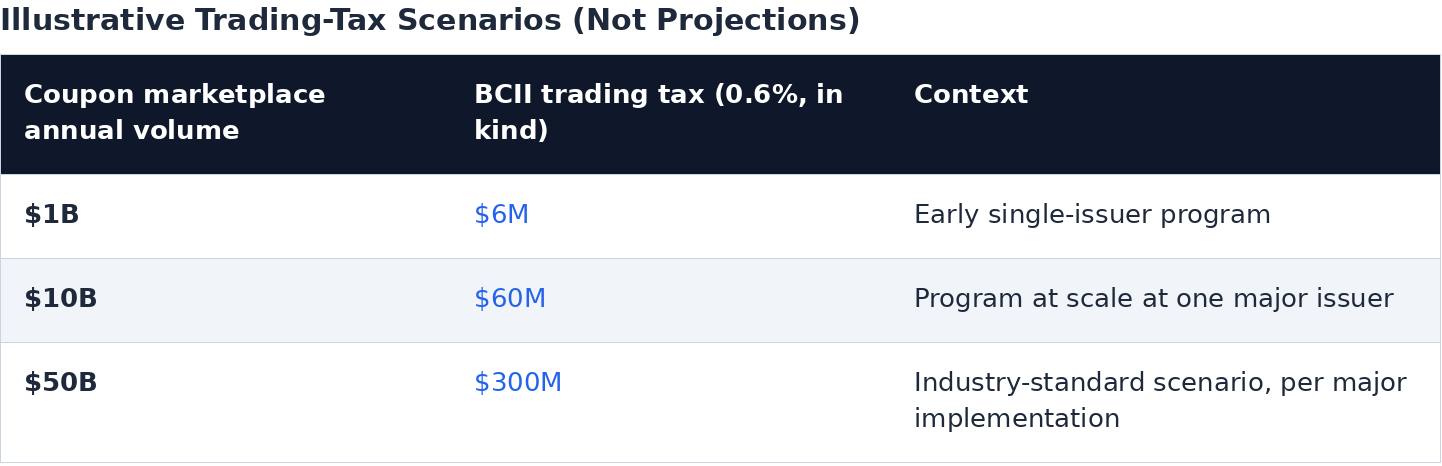
Illustrative only. These are scenarios, not projections.
Layer on inventory. If the 60M platform-fee tokens realize even 10 to 20 percent of the $2,750 intrinsic across the five-year sell-down, a conservative haircut for market depth, tax friction, and ADV throttling, that is roughly $16.5 to $33 billion of gross inventory value per implementation, realized only as fast as the 10 percent ADV limit allows. That is the architecture working as designed, because BCII's inventory is valuable precisely inasmuch as it cannot flood its own market. Even at a 1 to 2 percent realization rate in an early, thin marketplace, the inventory is a nine-to-ten-figure asset per implementation.
And the implementation count is the multiplier. Two stablecoin issuers, Tether and Circle, plus Aurica is three stacks. The contagion scenario, in which every major issuer and bank token program licenses a coupon rail, is five to ten stacks by 2030, each carrying its own 60M fee inventory and its own perpetual 0.6 percent toll. BCII's sales scale with implementations rather than headcount. It is a licensing and toll-collection business sitting on the distribution layer of a market that credible institutions project at $1.9 to $4 trillion.
The Patent Position Is What Converts Contagion into Revenue
Without intellectual property, the contagion effect is a threat: competitors copy the mechanic and BCII collects nothing. With the patent application on the Super Coupon Token architecture on file, the contagion effect becomes the business model, because every issuer that must add a coupon rail must license the patent-pending architecture. That covers the two-instrument design of tradable utility carrier plus non-transferable, redeemer-specific fixed discount contract, the fixed-supply token economy with in-kind trading tax, the two-state Forever and 11-month token mechanic, and the elite term-locked mint series.
The filing establishes the priority date and patent-pending status at exactly the right moment, before any issuer deployment makes the mechanic public. What matters now is execution on the IP calendar, and three things govern it.
Coverage should track the adoption geography. The emerging-market lane is where the adoption is, so international protection by the PCT route should follow the deployment map, and the stablecoin mapping, the elite term-locked series, and the elite unlimited-trading term should all be captured in the claim set as the filing program advances.
Claim strategy has to survive the Alice and Section 101 risk. A bare business-method claim on giving a discount via token would be vulnerable. The defensible claims are the technical implementation: the smart-contract release mechanism binding a non-transferable discount contract to a verified redeemer, the two-state token ledger, and the term-locked mint series that travels with the coin. The architecture's genuine technical novelty is the moat's substance.
And the accounting opinion and the patent are complements. The ASC 606 opinion makes the product safe to adopt; the patent makes it impossible to copy without a license. Together they are the full toll gate.
Outlook
The sequence for BCII writes itself. Aurica is the proof-of-concept in a hard asset. The first stablecoin implementation, most plausibly where the counterparty is weakest, whether that is Tether's US onshore entry under GENIUS or Circle's fight for non-exchange retail float, is the demonstration at scale. The contagion phase is the harvest: a patent-pending architecture, a favorable accounting opinion in hand, a perpetual 0.6 percent toll on every marketplace it licenses, a 60M-token royalty stake in every implementation, and, in every implementation, an issuer counterparty that gets richer than BCII does, holding a regenerating token treasury and a retail-media business the way Amazon and Netflix do, in a category the US Treasury Secretary himself projects to triple or better by 2030.
The unique-product claim is earned. There is no second instrument in the market that lets a GENIUS issuer legally pay for adoption. As long as the yield prohibition stands, the coupon is the only price lever in a multi-trillion-dollar distribution war, and BCII, with the patent-pending architecture on the lever, is positioned to be paid every time anyone pulls it.
A JD Unfiltered Special Report. For discussion purposes only; not an offer, and not legal, accounting, or investment advice. Revenue scenarios throughout are illustrative, not projections. The Tether and Circle programs described are hypothetical applications of BCII Enterprises Inc.'s Super Coupon Token architecture and have not been proposed to or discussed with either company. The architecture is patent-pending; patent issuance is not assured. The authors hold positions in securities mentioned and reserve the right to buy or sell shares at any time without notice.