Bankrupt, Absorbed, or the Coupon Token


A declaration on the only three endings available to OpenAI and Anthropic, resolved within nineteen months, in a world where the price of compute is falling asymptotically toward zero, and where SpaceX has already taken the low-cost public capital
The Declaration
This paper makes a single claim and defends it. OpenAI and Anthropic, as standalone companies, will not exist in anything resembling their current form within nineteen months, meaning by the first quarter of 2028. Each will meet one of exactly three endings: bankruptcy or a creditor-led restructuring, absorption into one of the fully integrated platforms of Apple, Amazon, Microsoft, or Google, or a deliberate re-architecture of their monetization around a coupon-token model that decouples revenue from the price of intelligence itself.
There is no fourth outcome, because the two conditions that would permit one have both been eliminated. Durable pricing power over model output was eliminated by open-source and Chinese competition. Continued access to cheap outside capital was eliminated by SpaceX.
You cannot build a trillion-dollar equity on selling a product whose market price is engineered, by your own suppliers and competitors, to approach zero.
None of this is hidden. The open-source story is public. The collapse in compute and inference pricing is public. Microsoft's contractual position astride OpenAI is public. The burn rates leak quarterly. This paper simply assembles what the market already knows and states the conclusion the marks have not yet accepted.
The Asymptote: Intelligence Is Repricing Toward Zero
The unit economics of frontier AI are governed by one curve, and it points down. Since the launch of GPT-4, the effective price of comparable model output has collapsed by roughly 300x, a deflation flywheel in which every capability gain is immediately commoditized and repriced. In the first half of 2026 alone, Chinese frontier labs cut API prices six times, and DeepSeek's V4-Pro now delivers near-frontier output at $0.87 per million tokens, roughly 34x below Western frontier list prices.
The floor beneath the floor is self-hosting. Open-weight models now deliver 95 percent or more of GPT-4o-class performance at an all-in cost of $0.17 to $0.42 per million tokens on owned or rented hardware, and data privacy rather than cost is the number-one reason enterprises cite for moving inference in-house. Switching costs have evaporated along with it. The average deployed model now holds its slot for just 87 days before being swapped, and 68 percent of enterprises already run three or more providers side by side. There is no lock-in, and therefore no pricing power.
This is what asymptotically toward zero means in practice. The price never quite reaches zero, but every quarter it gets close enough to destroy whoever needs it to stay high. A closed lab charging a premium for marginally better performance is asking enterprises to pay more and expose their proprietary data to a third party, when a near-equivalent open alternative runs inside their own perimeter at a fraction of the price. That is not a product decision any rational CIO struggles with for long.
The Burn: Selling Below Cost Into a Falling Market
Against that price curve, the standalone labs carry cost structures built for a monopoly that never arrived. OpenAI generated roughly $5.7 billion of revenue in the first quarter of 2026 while burning about $3.7 billion in the same quarter, a burn equal to roughly 65 percent of revenue, on top of a $20.9 billion operating loss for 2025. Its aggregate compute commitments have been estimated near $665 billion against roughly $73 billion of cash and equivalents.
Anthropic is the better-run book. In May 2026 it disclosed to investors that it projected its first operating profit, $559 million on $10.9 billion of revenue, for the quarter ending that June. But that margin exists at today's prices, and today's prices are the highest they will ever be.
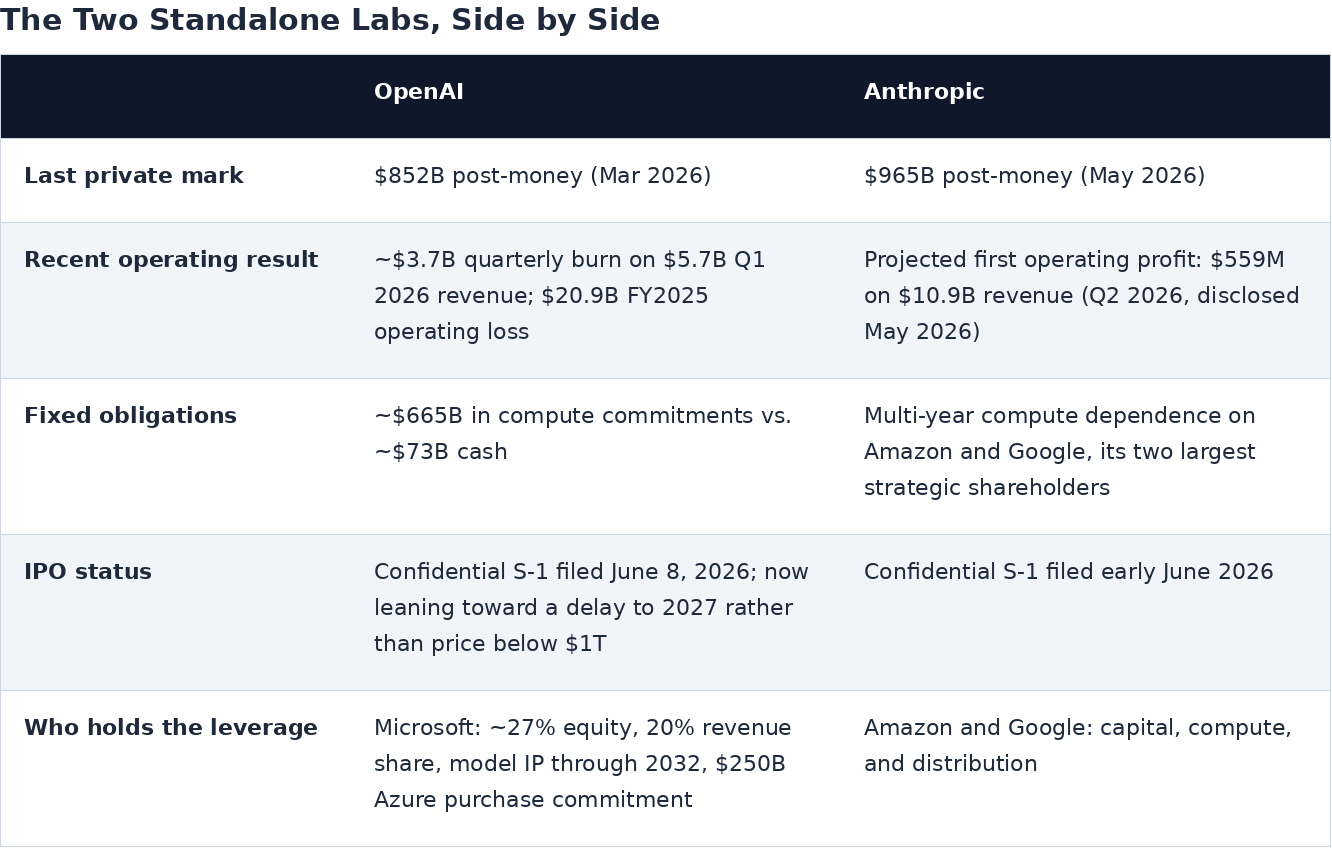
Positions as disclosed through August 2026.
The structural problem is not the size of the losses. It is their direction relative to price. Every dollar of revenue these companies book is a dollar earned at a price point that open-source and integrated competitors are actively driving lower. Growth in volume cannot outrun deflation in price when the marginal competitor's required margin is zero.
The Integrated Players Own the Negotiation
Amazon, Google, Meta, Microsoft, and Apple do not need to make money on models. They monetize intelligence through cloud consumption, advertising, devices, and commerce. The model itself can be free, and for several of them it strategically should be free. Together the hyperscalers will spend roughly $700 billion on AI infrastructure in 2026 alone, with Goldman Sachs projecting $5.3 trillion in cumulative data-center spend through 2030. Nvidia is paid regardless of which model wins. The integrated players own the compute, the distribution, and the balance sheets, and the standalone labs rent all three from them.
Elon Musk read this board earlier than most. In February 2026 he merged xAI into SpaceX at a combined $1.25 trillion valuation, attaching his model company to launch monopoly, Starlink distribution, and, through Tesla, an energy and robotics complex, rather than leave it standing alone against the curve. The one frontier lab whose founder could raise unlimited capital chose integration over independence. That is the tell.
Microsoft's position deserves its own paragraph
Microsoft holds roughly 27 percent of OpenAI's equity on about $13 billion of cumulative investment, collects a 20 percent share of OpenAI's revenue through 2030, retains license rights to OpenAI's models and products through 2032, and is owed $250 billion of contracted Azure purchases by OpenAI itself. Microsoft is paid on the revenue line, the compute line, and the IP line simultaneously, before public shareholders see anything. An investor buying OpenAI stock at the IPO is buying the residual claim left over after the most sophisticated counterparty in the industry has already carved out the protected pieces. Microsoft does not need OpenAI's equity to work. It has already won either way.
The Capital Window Closed Behind SpaceX
For a decade, the standalone labs' true product was not intelligence. It was story, sold to capital. That market has now cleared. SpaceX's June 2026 IPO absorbed the entire pool of low-cost, story-driven public capital: $250 billion of demand for $75 billion of stock, more than $100 billion of it retail, and a 19 percent first-day pop, followed by a round trip from a $225 peak back to roughly $153 within two weeks. Retail bought the one company with monopoly launch economics and real Starlink revenue, and still lost money in fourteen days. Nobody bought SpaceX for AI, and no one who round-tripped SpaceX is standing in line to fund a 65 percent burn ratio at a trillion-dollar mark.
OpenAI's own advisers have conceded the point. Goldman Sachs and Morgan Stanley, the banks paid to be optimistic, warned that public enthusiasm may not support the number, and offered management a choice: price below $1 trillion now, or wait until 2027. Sam Altman called any cut a nonstarter, and the company is now leaning toward delay. A company that postpones its IPO because the market will not pay its price has already received the market's verdict. It simply has not accepted it. Bridgewater's co-CIO put the thesis in one line to clients: the valuation is priced for a monopoly outcome that does not exist.
The last private marks were not price discovery
The $852 billion and $965 billion marks were set largely by conflicted capital. Of OpenAI's $122 billion round, one analysis found only about $37 billion was clean, immediate, unconflicted cash. Amazon's $50 billion included $35 billion contingent on an IPO or an AGI declaration, Nvidia's $30 billion arrived substantially as compute capacity, and SoftBank's $30 billion was tranched against milestones. The vendors financed their own customer and called it a valuation.
The stress is already visible at the weakest link. SoftBank, holding roughly 13 percent of OpenAI against a $40 billion bridge loan due March 2027, fell more than 12 percent in a single session on the mere report of an IPO delay, and a $6 billion margin loan against its OpenAI stake stalled because lenders could not establish a loan-to-value without a public reference price. When lenders will not lend against the mark, the mark is already gone.
The market has passed them by. The question is no longer whether the last-round valuations hold. It is which of the three exits each company takes, and how much optionality remains when they take it.
The Clock: Nineteen Months, Not a Decade
This resolution will not wait for the end of the decade, because every forcing event is already on the calendar, and the last of them lands in early 2028.
In March 2027, SoftBank's $40 billion bridge loan matures. The loan was taken to fund its OpenAI commitment, repayment was premised on a public listing, and lenders have already refused to establish a loan-to-value against the private mark. A holder of roughly 13 percent of the company becomes a forced seller, or forces a repricing, on a fixed date.
During 2027, the delayed IPO must price or fail. Having refused to list below $1 trillion in 2026, OpenAI has staked everything on a 2027 debut. A second delay is indistinguishable from a failed auction, and Amazon's $35 billion of contingent capital, conditioned on a listing, hangs on the same event.
Across the same window, the burn meets the commitments. Roughly $73 billion of cash against a $3.7 billion quarterly burn and escalating contracted compute payments means the gap must be refinanced in 2027, in a market that has already refused the mark once.
And through all of it, the price curve compounds quarterly. Six Chinese price cuts arrived in the first six months of 2026 alone. Every quarter of delay reprices the product lower while the obligations stay fixed. Time does not heal this structure. It is the disease.
Stack the dates. The mark must refinance in 2027, the leveraged holders need liquidity in 2027, the IPO must clear in 2027, and the price deflation compounds through all of it. The choice among the three endings gets made, voluntarily or otherwise, no later than the first quarter of 2028. Nineteen months from today.
Ending One: Bankruptcy or Restructuring
This is the default path, the one that requires no decision at all. The mechanism is mechanical: fixed, contracted compute obligations on one side, deflating unit prices and decelerating growth on the other. The funding flywheel that papered over the gap, each round priced off the last and each vendor financing its own demand, runs in reverse the moment marks stop rising. Compute commitments approaching $665 billion do not renegotiate themselves, and a company burning 65 percent of revenue cannot service story-priced obligations with commodity-priced products.
Restructuring in this scenario does not mean disappearance. It means the equity is repriced to approximately zero while creditors and compute counterparties, chiefly the hyperscalers, convert their claims into control. Which is simply Ending Two, arriving through the courthouse instead of the boardroom.
Ending Two: Absorption by Apple, Amazon, Microsoft, or Google
The cleaner version of the same outcome. The integrated players already hold the pre-positioned claims. Microsoft owns 27 percent of OpenAI plus the revenue share, the IP license, and the Azure receivable. Amazon and Google are simultaneously Anthropic's largest strategic investors, its compute landlords, and its distribution channels. Apple is the one integrated player still missing a frontier model, and the one with the balance sheet and device distribution to justify acquiring one outright.
Absorption will not happen at $852 billion or $965 billion. It happens after the repricing, at a number that reflects the burn rather than the story, when leveraged holders like SoftBank need liquidity and founders need an exit that preserves the mission language. The acquirers can wait. Time is their ally and the sellers' enemy, because every quarter that passes, the price of the asset falls and the price of waiting does not.
Ending Three: The Coupon Token, Monetize Velocity Rather Than Price
There is exactly one path that preserves independence, and it requires abandoning the business model rather than the business. If the price of intelligence is heading to zero, then intelligence cannot be the thing you sell. What a frontier lab still owns, and what open source cannot commoditize, is flow: hundreds of millions of users, billions of daily interactions, and a community that transacts through the platform. The coupon-token architecture converts that flow into recurring, self-replenishing revenue at zero marginal cost, without charging a price for the model at all. BCII Enterprises' Super Coupon Token is the operating template.
The mechanics compress into four moves. The platform mints a fixed token supply at no cash cost, which in the BCII reference design is 300 million tokens: 60 million as the technology-provider fee, 50 million to market makers each capped at 10 percent of average daily volume over five years, and 190 million into the company's working treasury. The company then sells from treasury into market demand, up to 25 percent of average daily volume, exactly like any other holder, and this is by far the largest line. Every token comes home, because all tokens including those sold revert to the company after an 11-month cycle of ten months trading and one month redemption, so the treasury is never depleted and the same asset is rented back out cycle after cycle. And every trade carries a 3 percent in-kind tax on the buyer and 3 percent on the seller, of which 1 percent per side goes to the technology provider, 0.3 percent per side to BCII, and 1.7 percent per side to the company less platform administration costs. Tax coupons earned are forever tokens until sold, at which point they become 11-month tokens in the buyer's hands.
Run that architecture on an OpenAI-scale or Anthropic-scale user base and the strategic inversion is total. Revenue no longer depends on the price per million tokens of inference, the number collapsing toward zero, but on the velocity of activity across the platform, a number that grows as models get cheaper. Price deflation stops being the enemy and becomes the fuel. The cheaper intelligence gets, the more of it flows, and the more the treasury cycle and the trading tax earn. The model can be given away at cost, or below it, precisely because the model is no longer the product. Accounting treatment for such instruments has already been squared, with a favorable independent accounting opinion under FASB ASU 2023-08 treating the tokens as near-cash assets marked to market.
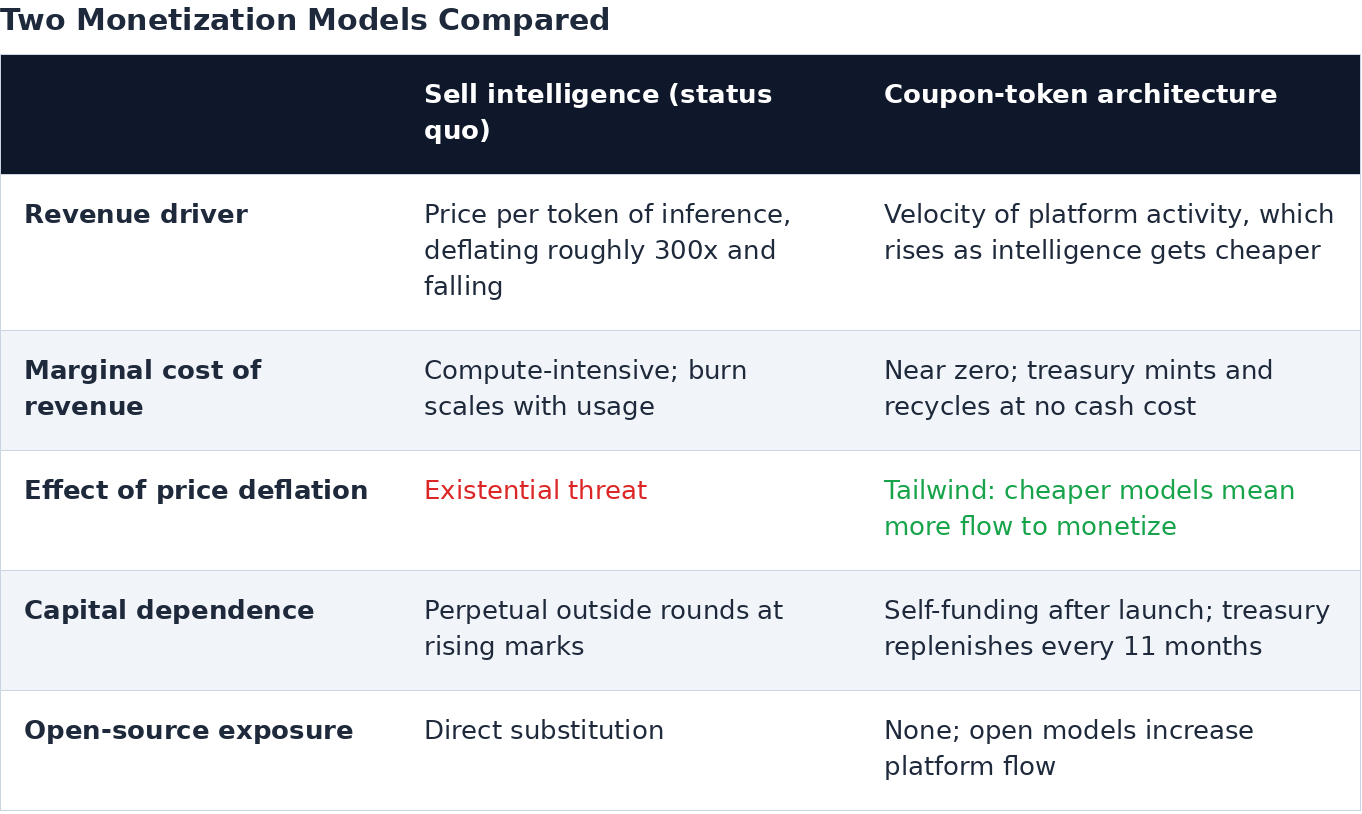
The same user base, two revenue engines.
The Scoreboard
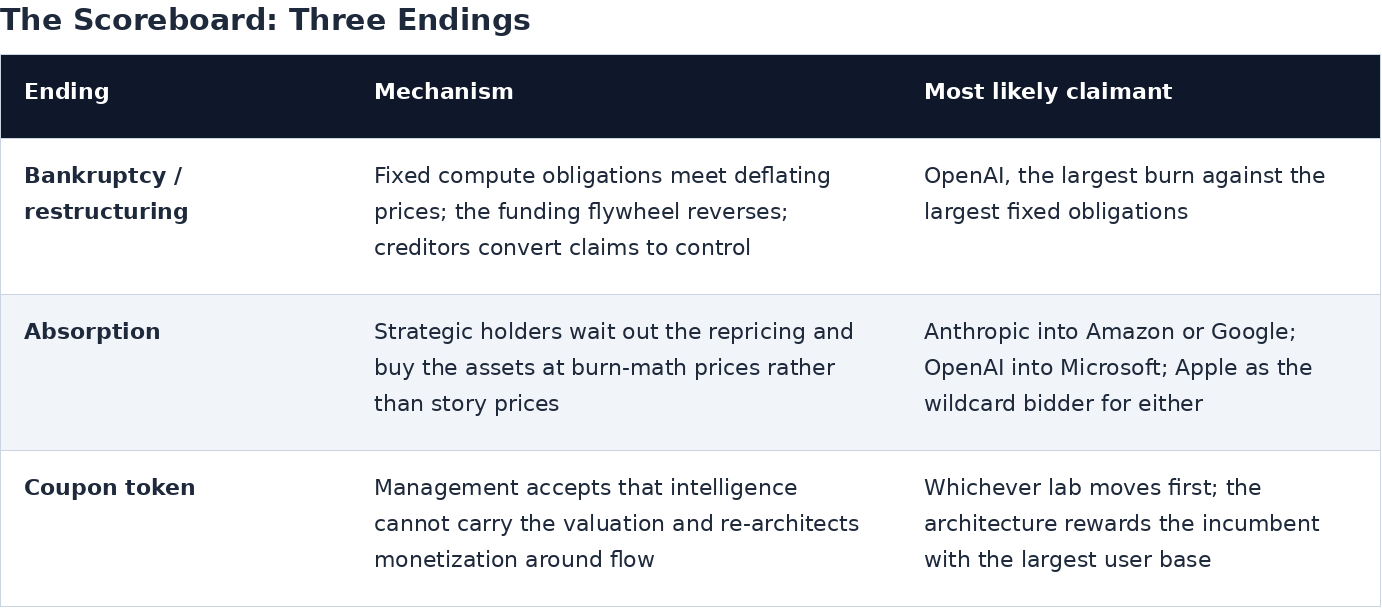
Three endings, three mechanisms, three claimants.
These endings are not mutually exclusive in sequence, and Ending One is frequently the doorway to Ending Two. But Ending Three is the only one a management team can choose while it still holds leverage. It cannot be chosen from a bankruptcy auction, and it will not be chosen by an acquirer who already monetizes flow through ads and cloud. The window for the coupon-token answer is the same window in which the companies still command independent user relationships at scale. That window is open now. It will not reopen.
The Accelerant: If Open Source Adopts First
Now run the scenario forward. Suppose several of the US open-weight companies, a Reflection AI, Nous Research, Together AI, Arcee, or Liquid AI, adopt the coupon-token architecture, and one or more replicates Gemma-4-scale adoption of twenty million downloads or more in the first month. Within six months, their monetization, meaning daily treasury sales plus the trading tax, exceeds their inference bill. Compute is now effectively free at the point of use, and the coupon carrier gives merchants for nothing the advertising distribution OpenAI is trying to sell. Four things happen, in order.
First, the consumer price of intelligence goes below zero. The token-adopting platforms do not merely charge nothing. They pay users to engage, in an appreciating instrument with an advertiser-funded coupon book inside. No subscription at $20 to $200 a month survives contact with a competitor that pays its users, and the ad business OpenAI is building gets undercut by coupon distribution that costs merchants nothing.
Second, the funding inversion. A token reaching even $100 million of average daily volume yields roughly $25 million a day in recyclable treasury sales plus 3.4 percent of volume in trading tax, less admin, at near-zero marginal cost. The open companies stop needing venture capital at the exact moment the closed labs still need $30 billion a year of vendor money. The last structural advantage of the closed labs, access to giant private rounds, reverses.
Third, the clock collapses. Subscription churn and decelerating weekly actives deteriorate inside the S-1 window, in public. No banker can price a growth story whose growth is visibly migrating to competitors that monetize without price. Nineteen months compresses toward nine to twelve.
Fourth, Ending Three expires. The token architecture compounds to whoever builds the holder base first. Six months after rivals have live tokens, liquid volume, and holders with five-year reasons to stay, a distressed incumbent launching its own token reads as a desperation financing into a market already captured. The trilemma degenerates into a dilemma: restructure, or be absorbed at burn-math prices minus a distress discount.
The rear-guard action is too thin, because the regulatory path is already settled
The incumbents' only remaining counterattack is legal, a campaign to brand the coupon token an unregistered security. That road is closed, publicly and on the record, at all three levels that matter.
Start with the SEC's own no-action letters. The Division of Corporation Finance publicly cleared consumptive-use tokens in TurnKey Jet in April 2019 and Pocketful of Quarters in July 2019, establishing that tokens sold for platform use rather than profit participation are not securities and may be offered without registration. The coupon token is consumptive by construction. It is a carrier for redeemable merchant coupons, earned and spent in use, not a claim on the efforts of others.
Then the accounting, which is codified and SEC-accepted. FASB ASU 2023-08 put fair-value crypto-asset accounting into US GAAP, effective for fiscal years beginning after December 15, 2024, and flowing directly into SEC filings. BCII already holds a favorable independent accounting opinion under the standard, treating its tokens as near-cash assets marked to market. You cannot simultaneously book an instrument under a codified FASB standard and litigate it as an unregistrable novelty.
And finally the statute and the agency have both moved. The GENIUS Act became federal law in July 2025. The SEC's own Project Crypto redirected the Commission from enforcement-by-default to accommodation of on-chain markets. The CLARITY Act passed the House in July 2025, cleared Senate Banking 15 to 9 with bipartisan support in May 2026, and reached cloture proceedings on the Senate floor in August 2026.
Stack that record: two public no-action letters on point, a codified accounting standard the SEC accepts in filings, a federal digital-asset statute, the Commission's own modernization program, market-structure legislation advancing on bipartisan votes, and the most heavily funded lobby in modern Washington defending all of it. A campaign arguing that coupon tokens are securities, waged by a cash-burning incumbent against that wall, is not a legal strategy. It is a rear-guard action against a path that was settled while the incumbent was still raising private rounds. It buys headlines, not time.
Conclusion
OpenAI and Anthropic were built to win a pricing war that their own suppliers, their open-source competitors, and the laws of commodity economics have already decided against them. The compute curve points to zero. The integrated platforms own the negotiation. Microsoft has contractually pre-harvested OpenAI's safest cash flows. And the SpaceX round trip closed the public market's one window for story-priced mega-listings, a verdict OpenAI's own bankers have delivered and its leadership has so far refused to hear.
What remains is arithmetic and a choice: restructure by force, sell to the platforms at the clearing price, or stop selling the thing whose price is going to zero and start monetizing the thing that grows when it does.
Bankrupt, absorbed, or the coupon token. There is no fourth ending, and on the calendar the market has already set, the choice arrives within nineteen months.
This whitepaper is a market thesis and opinion of BCII Enterprises Inc. It is provided for informational purposes only and does not constitute investment advice, a research report, an offer to sell, or a solicitation of an offer to buy any security or digital asset. Statements regarding the future condition, valuation, financing, or corporate outcomes of OpenAI, Anthropic, or any other company are forward-looking opinions subject to substantial uncertainty and may prove incorrect. Financial figures are drawn from public reporting believed reliable but not independently verified. BCII Enterprises Inc. is the developer of the Super Coupon Token architecture described herein and has a direct commercial interest in its adoption. Readers should conduct their own diligence and consult their own advisors. The authors hold positions in securities mentioned and reserve the right to buy or sell shares at any time without notice.