
Bitcoin’s Path to $20,000

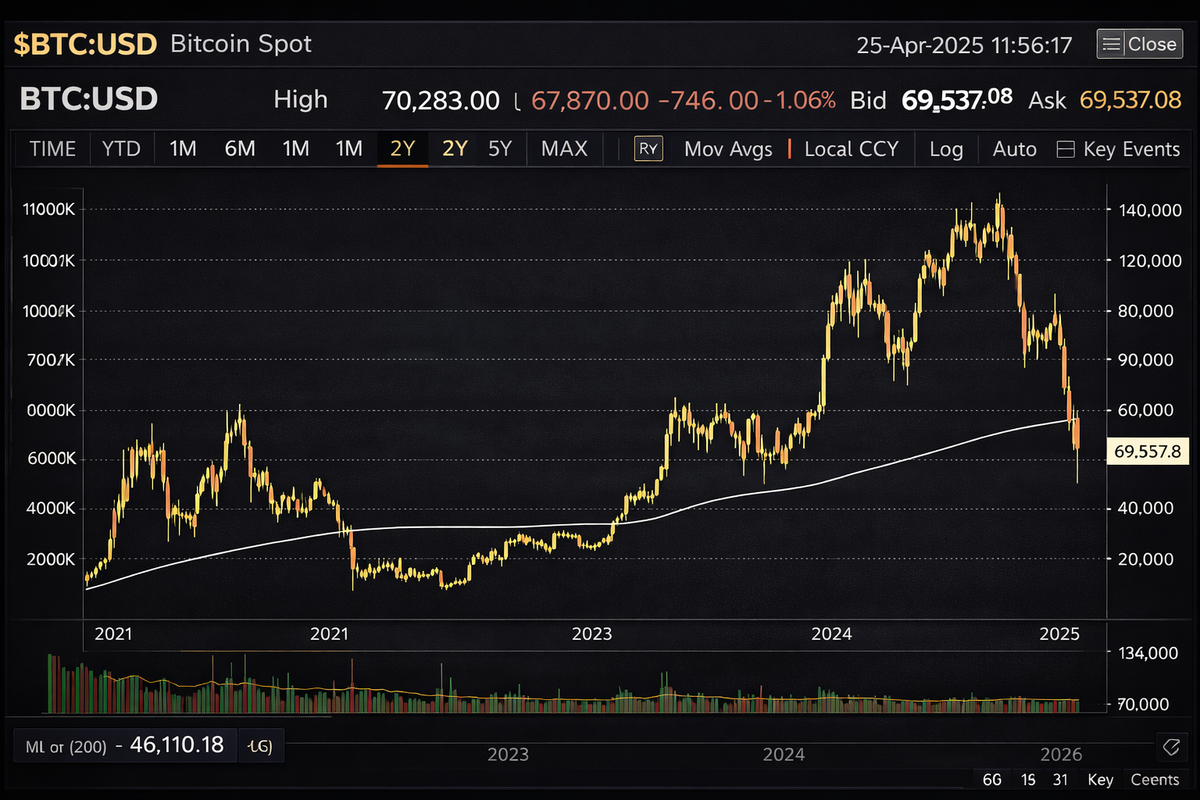
Bitcoin’s long-term narrative has always leaned on scarcity, adoption, and institutional legitimacy. But markets do not clear on narratives alone. They clear on ownership structure, liquidity, and marginal flows.
When those factors are examined together, a coherent scenario emerges in which Bitcoin could plausibly fall back into the $20,000–$25,000 range over the coming years. This outcome does not require fraud, prohibition, or technological failure. It requires only sustained structural selling that overwhelms available demand.
Effective Supply Is Smaller and More Fragile Than It Appears
Bitcoin’s theoretical cap of 21 million coins overstates the amount that actually trades. Roughly three million coins remain unmined, and serious estimates suggest another three million are likely lost. That leaves approximately fifteen million coins as a practical, usable supply.
What matters is not just the size of that supply, but who holds it. A large share of usable Bitcoin is concentrated in three groups: public companies that adopted Bitcoin as a treasury asset, ETFs and ETPs that accumulated coins during the last bull cycle, and users in high-inflation or capital-controlled economies who historically used Bitcoin as an escape valve.
Together, these cohorts plausibly control half or more of usable supply. That concentration is not dangerous when they are net buyers. It becomes dangerous when incentives shift.
Institutional Coins Were Accumulated Late in the Cycle
Public companies and ETFs together hold roughly 2.4–2.5 million BTC, which represents about 16–17% of the estimated usable supply.
A crucial detail is cost basis. A large portion of these holdings was accumulated during the 2024–2025 bull phase, often at prices between $80,000 and $90,000, with some purchases occurring even higher. MicroStrategy’s blended cost of roughly $76,000 per coin across hundreds of thousands of BTC is emblematic of the broader pattern.
When price trades meaningfully below these levels for extended periods, the framing shifts. What was once described as a visionary treasury strategy can become an earnings drag and a governance concern. At that point, prior support zones risk turning into areas of supply rather than demand.
High-Inflation Economy Holders Are the Largest Swing Factor
While institutions receive the most attention, users in financially fragile economies likely represent an even larger block of Bitcoin ownership. Adoption data suggests they may account for roughly 30–40% of meaningful holdings, implying somewhere between 4.5 and 6.0 million BTC.
These holders are often portrayed as ideologically committed, but in reality they tend to be pragmatic. Bitcoin was attractive because it solved multiple problems at once: transactions, currency escape, and long-term appreciation. As alternative tools emerge, particularly stablecoins and tokenized assets, their incentives change.
A fifty percent reduction in exposure by this cohort over a multi-year period would not be irrational. It would be portfolio rebalancing.
The Rotation Math: How 3–3.6 Million Coins Reach the Market
If high-inflation-economy users reduce their Bitcoin holdings by half, net selling would range from approximately 2.25 to 3.0 million BTC.
If public companies reduce their holdings by a quarter, reflecting earnings pressure, audit scrutiny, and political optics, that adds another 0.6–0.625 million BTC of supply.
Combined, this produces a total of roughly 2.85 to 3.63 million BTC sold over a two-year period. Relative to the estimated fifteen-million-coin usable supply, that represents about 19–24%.
Spread across roughly 730 days, this equates to approximately 3,900–5,000 BTC of incremental net selling per day layered on top of normal market activity.
Why Liquidity May Not Absorb This Supply
Bitcoin’s market capitalization can exceed a trillion dollars near cycle peaks, but actual order-book depth is far thinner. On-chain data consistently shows that a large majority of coins rarely move, meaning the actively traded float is small.
In such a structure, persistent daily selling measured in thousands of coins does not need to trigger panic to drive price materially lower. It only needs to meet insufficient new demand.
Once prices fall below institutional cost bases, reflexivity can accelerate the move. ETF redemptions increase, corporate exposure is reduced, and risk-sensitive capital steps aside. Each of these actions feeds back into price, creating a negative loop.
Why $20,000–$25,000 Is Not Extreme
Bitcoin has repeatedly experienced drawdowns of 70–80% from peak to trough.
From a peak region near $100,000, a seventy-five percent decline implies prices around $25,000, while an eighty percent decline implies roughly $20,000.
Given the magnitude of potential structural selling outlined above, a move into this range would be consistent with both Bitcoin’s historical volatility profile and the proposed flow dynamics.
Final Perspective
This scenario does not argue that Bitcoin must fail. It argues that Bitcoin’s demand structure is evolving at the same time ownership has become more concentrated and cost bases have risen.
Scarcity alone does not support price. Scarcity combined with persistent, price-insensitive demand does.
If a meaningful share of Bitcoin’s largest holders transition from accumulation to gradual liquidation, prices will adjust until a new equilibrium is found. The $20,000–$25,000 range is not a prediction. It is a mathematically consistent outcome given the flows outlined.
Markets do not need to break for prices to fall sharply. They only need imbalance.