
The Industrialization of AI: Why the Profits are Shifting Away From Compute

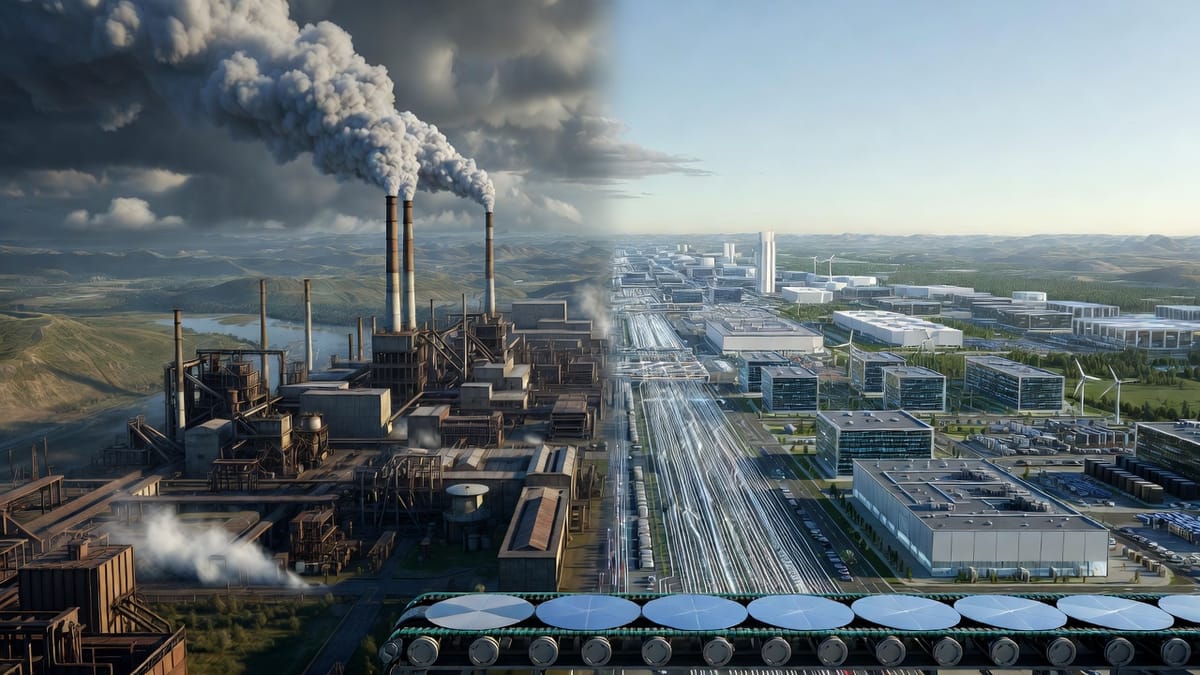
The comparison between plastics and AI compute is no longer merely conceptual. What once read like a structural analogy is beginning to appear in market behavior itself.
In the 1960s, plastics were treated as a miracle material—scarce, differentiated, and priced accordingly. Over time, scale and process innovation transformed them into a mass industrial utility. Margins compressed, capacity expanded, and the profit pool migrated downstream to the companies that applied the material rather than produced it. We first shared this idea here.
AI compute is now tracing a remarkably similar path.
The key insight is not that compute demand will slow, it likely will not, but that the economics of supplying compute may increasingly resemble those of a capital intensive industrial cycle rather than a perpetual scarcity premium.
From Skimming to Penetration
During the early AI buildout, high-end accelerators and GPU clusters operated in what industrial economists would recognize as a skimming phase: limited supply, urgent demand, and pricing power supported by performance gaps and few credible alternatives. But that structure is now evolving.
Several forces are pushing the industry toward penetration pricing and commodity behavior:
- Rapid technology cadence is devaluing prior-generation hardware faster than expected.
- Hyperscalers are designing custom silicon to reduce reliance on merchant GPUs.
- The U.S. and Europe are building data centers aggressively while Gulf states position themselves as low-cost AI hubs.
This combination mirrors a classic industrial setup: capacity races plus falling unit costs.
Importantly, history shows that the margin turning point often arrives while demand is still booming, a dynamic once described in plastics as “profitless prosperity,” where volumes rise but returns stagnate.
The Market Is Beginning to Price the Shift
A full overcapacity event is unlikely in 2026. But equity markets tend to anticipate these transitions well before physical gluts emerge.
Recent behavior fits that pattern.
Broadcom’s late-2025 selloff centered not on demand weakness but on fears that AI system mix would pressure margins, a textbook penetration-phase signal.
AMD’s roughly 17% single-day drop after earnings reflected similar dynamics: strong demand commentary was overshadowed by investor sensitivity to pricing, mix, and cycle risk.
Even Nvidia trading below prior highs suggests a subtle shift away from the “scarcity forever” narrative toward recognition that cycle risk exists.
At the index level, a wider Nasdaq decline relative to the S&P 500 has signaled a rising risk premium for long-duration technology assets, which is another hallmark of sectors transitioning toward industrial economics.
None of this implies structural weakness, but it imply maturation.
Why the Profit Pool Moves Downstream
When foundational inputs become abundant, economic power typically migrates toward firms that control workflows, distribution, and customer relationships.
The plastics era rewarded specialty chemical firms and downstream manufacturers that used cheaper inputs to redesign products and improve margins.
Compute appears poised to follow the same channel logic.
The emerging winners are likely to be companies that buy compute rather than sell it, embedding intelligence into networks, physical operations, and software platforms.
Translating the Framework Into Positioning
If the plastics-to-compute analogy holds, the investment implication is straightforward: durable value should accrue less to the producers of raw compute and more to the companies that embed intelligence into defensible business systems.
During the petrochemical era, the largest wealth creation did not occur at the ethylene crackers. It accrued to specialty chemical firms and downstream manufacturers that transformed cheap inputs into differentiated products, brands, and workflows. Compute appears poised to follow the same economic path.
The emerging “buy-type” cohort is therefore composed primarily of workflow owners, network operators, and platform companies whose competitive advantages strengthen as intelligence becomes cheaper.
Apple sits at the center of this structure. By controlling the consumer interface, device, identity layer, operating system, and services ecosystem Apple can incorporate increasingly powerful agentic capabilities without needing to win the capital-intensive compute race itself. Falling inference costs effectively expand the value of the installed base while reinforcing switching costs.
Uber represents a parallel dynamic in the physical economy. As autonomy improves and dispatch intelligence becomes less expensive, the economic gravity shifts toward the orchestration layer rather than the hardware stack. Uber’s regulatory integration, routing engine, liquidity of supply and demand, and multi-modal network create a moat that deepens as compute costs decline.
Microsoft belongs in the same category, though from an enterprise vantage point. Even if cloud infrastructure ultimately faces margin normalization, the company’s true leverage resides in workflow embed across Office, Dynamics, and enterprise software. Copilots layered directly into mission-critical processes behave much more like specialty applications than commodity infrastructure.
Amazon and Alphabet reflect similar downstream strength at global scale. While each participates in the supplier layer through cloud services, their most defensible economics sit closer to the customer — retail logistics, advertising systems, search, video distribution, and data integration. AI enhances pricing, personalization, inventory optimization, and monetization, turning compute into an operating lever rather than the core profit engine.
The same logic extends into enterprise backbone providers such as SAP, whose ERP stack sits directly inside financial, HR, and supply-chain processes. Agents that automate reconciliation, planning, and procurement attach themselves to deeply embedded data structures, raising productivity while increasing platform dependence.
Industrial leaders like Siemens illustrate how this transition reaches beyond software. When intelligence is applied to digital twins, predictive maintenance, and factory automation, compute becomes a force multiplier on long-lived industrial moats rather than a standalone product.
ServiceNow and Salesforce similarly benefit from owning the workflow layer in IT and customer operations. As agents absorb repetitive tasks — ticket resolution, prospecting, drafting, forecasting the platforms monetize outcome improvements rather than raw processing power.
Even traditional infrastructure networks such as major railroads and integrated logistics operators fit the downstream winner template. These businesses already possess irreplaceable physical assets and network effects; AI simply improves dispatch, maintenance, capacity utilization, and yield on infrastructure that competitors cannot easily replicate.
Taken together, these firms resemble the specialty chemical and downstream manufacturing winners of the plastics cycle: they purchase a newly abundant input and convert it into higher margin outcomes.
The Structurally Vulnerable Layer
The inverse group consists of companies whose economics are tightly linked to producing compute itself or financing the capacity required to deliver it.
None of these businesses are weak. Many are extraordinary operators. The issue is structural: capital intensity plus rising competition historically compresses returns once an input industrializes.
Nvidia remains the dominant merchant GPU provider, but dominance does not immunize a company from the mathematics of supply expansion and customer verticalization. As hyperscalers design custom silicon, pricing power becomes more contested and expectations become harder to sustain.
AMD’s sharp repricing after earnings already suggests the market is beginning to treat advanced semiconductors less like perpetual scarcity assets and more like cyclical industrial exposures.
Broadcom’s experience underscores the same point. Even with strong AI revenue growth, investor concern has shifted toward margin durability as custom systems dilute mix — a classic penetration-phase signal.
Equipment suppliers such as ASML occupy a critical position in the ecosystem yet remain tethered to the volatility of fab capital expenditures. When customers moderate expansion, orders can swing abruptly regardless of long-term technological necessity.
The capacity landlords, including large data center REITs, face a different version of the same risk. High fixed costs, tenant concentration, power economics, and the possibility of regional overbuild create sensitivity to utilization rates and pricing pressure.
Component suppliers like Marvell and memory producers such as Micron are even more exposed to commodity dynamics. History has been unambiguous on this point: memory behaves like memory, regardless of how transformative the end market appears at the time.
Auto-oriented semiconductor firms may benefit from rising chip content per vehicle, but they remain component providers subject to OEM bargaining power and cyclical demand.
Smaller or regional data center operators are arguably the most fragile participants in such an environment. Without scale advantages or interconnection moats, they risk becoming price takers if capacity expands faster than demand.
What emerges is not a simple bullish-versus-bearish distinction but a structural divide within the AI economy.
On one side sit the orchestrators, companies that own customers, workflows, distribution, or irreplaceable networks. For them, cheaper compute expands margins and opportunity.
On the other side sit the producers, firms required to spend enormous capital simply to remain competitive, often in markets where the marginal supplier ultimately sets the price.
This is precisely the economic transition that reshaped petrochemicals decades ago. The miracle material did not disappear; it became ubiquitous. And ubiquity redirected the profit pool.
Compute now appears to be entering the same channel.
The Industrialization of Intelligence
If the analogy continues to hold, the next phase should resemble the moment in petrochemicals when the market quietly recognized that a “miracle” industry was becoming an industrial one.
Over the next several years, supplier economics may increasingly feature:
- pricing pressure and margin volatility
- periodic overbuild followed by digestion
- stronger cyclicality in earnings and multiples
Meanwhile, compute buyers should benefit from declining input costs and operating leverage as automation penetrates workflows.
The transition is less about technological limits than about channel mathematics.
The Confirm-or-Fail Checklist
For investors trying to determine whether this shift is real, several indicators will matter over the next 18–36 months:
- hyperscaler capex discipline
- visible price compression in training and inference
- collapse in used GPU pricing
- rental pressure in high-cost data-center markets
- operating leverage emerging at compute buyers
The early signals—margin anxiety, violent earnings reactions, and infrastructure skepticism suggest the first stage may already be underway. This is not the end of the AI cycle, but it may be the beginning of its industrial phase.
The Channel Rule That Keeps Repeating
When a foundational input becomes abundant, the enduring winners are rarely the firms that manufacture it. The durable winners are those that own the customer and apply the input to create differentiated outcomes.
Plastics taught that lesson over decades.
Compute appears ready to teach it again, only faster.