
Housing Affordability Crisis Solved! How Tokenization and Smart Tax Design Can Fund a National Homeownership Boom

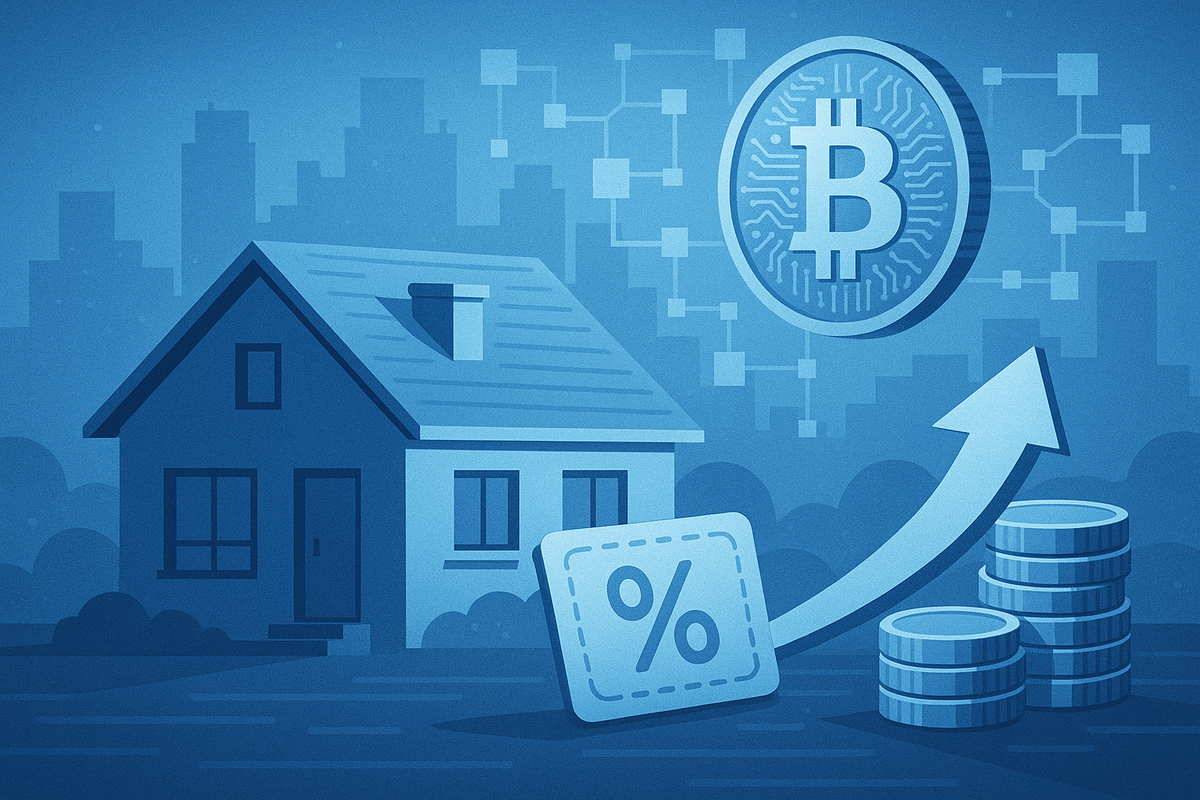
For years, the United States has struggled with a structural housing affordability crisis. Prices remain high, mortgage rates remain elevated, and tens of millions of renters remain locked out of homeownership despite being willing, able, and economically essential to the future of the housing market. Traditional policy tools have failed to break this deadlock. A new approach is needed, one that matches the scale of the problem and realigns the incentives of everyone who participates in the American housing economy.
The Federal First-Time Homebuyer Coupon Token Program achieves exactly that. This is not just a down-payment assistance initiative or a mortgage subsidy. It is a comprehensive, digitally powered national policy designed to bring 46 million renters into the homeownership ecosystem, while simultaneously building a funding mechanism that pays for itself. Its core innovation is symmetry: every group that benefits from a functioning housing system, sellers, borrowers, traders, and homeowners contributes proportionally to its cost. This allows the government to deliver extraordinary economic and social gains at minimal expense to the general taxpayer.
At the center of this architecture is BCII Enterprises (BCII), whose blockchain-based coupon token infrastructure makes universal distribution, secure ownership, real-time trading, and perpetual federal tracking possible at national scale. BCII’s system turns a policy concept into an operational reality, creating the first fully digital, fraud-proof, and market-integrated homeownership assistance platform in American history.
A Universal Homeownership System Delivered Through Blockchain
The program starts with a simple premise. Every U.S. citizen renter, 46 million households, receives a homebuyer coupon token through the IRS and BCII’s blockchain distribution system. Rental invoices and tax filings verify eligibility, ensuring a precise and easily administered population.
Each coupon provides a permanent 2% reduction in a 30-year mortgage rate. Separately, the federal government offers an 8% down-payment grant (equal to 40% of the required 20% down payment) only for homes priced at or below $300,000.
A buyer of a $300,000 home who uses a coupon receives the 2% interest-rate discount, and, because the property qualifies, the 8% down-payment grant as well. But the grant does not attach to purchases above the $300,000 threshold or to people who don’t have a coupon.
The home buyer must have a coupon, the grant, and be buying a home for $300,000 or less. Furthermore, there are explicitly 46 million tokens, a limited supply and if used, it is burned and self-liquidates. This isn't a perpetual motion machine, these tokens are a scarce product.
Renters can either use their coupon to buy a home or sell it in the secondary market. BCII’s marketplace and centralized exchanges like Coinbase support fully transferable digital coupons, with realistic prices ranging from roughly $37,000 to $75,000 depending on market conditions. Once a coupon is distributed, it can be bought and used by anyone, renter or homeowner, first-time buyer or not. The only limitation is that the 8% down-payment grant applies solely to homes at or below $300,000.
For the first time, homeownership assistance becomes both universal and flexible, an intervention that uplifts every renter while creating a liquid financial instrument that can circulate throughout the economy.
A Funding Architecture Built on Symmetry
What distinguishes this program from every previous federal housing initiative is the structure of its funding. Instead of relying on broad-based taxation or deficit spending, the program raises most of its financing from within the very housing ecosystem it stimulates.
The first source is a reform to the capital gains exclusion on home sales. Lowering the exclusion for married filers from $500,000 to $300,000 affects only high-appreciation properties and leaves roughly 60% of homeowners untouched. This generates $600 billion over ten years while aligning costs with those who have benefited most from long-term property appreciation.
The second and largest source is a 3% mortgage origination fee applied to all mortgage purchases, refinances, and cash-outs. Because borrowers can roll the fee into their loan, the typical impact is a modest $35 per month on an average $240,000 mortgage. With an expected 16.2 million annual originations during the program period, this generates $1.166 trillion over a decade.
The third source is a tax on coupon-token trading. Every trade carries a 2.5% charge on the buyer and seller, of which 10% flows to the federal government. With a conservative estimate of $100 billion in annual coupon-token trading volume, this produces $5 billion over ten years, one of the first instances of federal revenue generated directly from blockchain-based financial activity.
Together, these three offsets fund nearly three-quarters of the total program cost.
Built-In Federal Equity Recovery
Beyond these offsets, the program includes an additional repayment mechanism. Every home purchased with a coupon includes a 10% federal profit participation interest recorded as a junior lien. When the homeowner eventually sells, typically within seven to eight years, the government recovers its share of the appreciation. On a qualifying $300,000 home with typical appreciation, the recovered amount exceeds $7,000. Across all coupon-assisted purchases, federal equity recovery adds $283.9 billion back into the system, making the program partially self-liquidating.
A High-Return Investment for the Entire Economy
After subtracting the equity recovery and all revenue offsets, the net cost of the program is about $688 billion over ten years—roughly $69 billion per year.
For a federal budget of $6 trillion, the net cost is minimal. The return, however, is extraordinary. Over a decade, the program generates $14.87 trillion in GDP, driven by construction activity, home improvements, increased consumption from interest savings and coupon sales, and a cascading multiplier effect across related industries. It produces 58.9 million construction job-years, $1.52 trillion in new property tax revenue for state and local governments, and $589 billion in additional federal income tax revenue.
On average, a coupon-assisted homeowner builds more than $100,000 in home equity within ten years, contributing to a total of $4.75 trillion in household wealth. This becomes the largest working-class wealth creation initiative in American history. For every $1 the federal government invests, it receives more than $21 in economic output, far exceeding the returns associated with infrastructure spending, tax cuts, or traditional stimulus programs.
Transforming the Housing Market
The program’s impact extends far beyond individual buyers. It breaks the paralysis caused by the mortgage rate lock-in problem, where more than 80% of homeowners currently hold mortgages below 6% and are reluctant to sell. By generating millions of newly qualified buyers with discounted rates, the program restores mobility to the housing market.
It also stabilizes the rental market. As millions move from renting to owning, rental demand eases, exerting downward pressure on rents and improving affordability for those who remain renters.
Most importantly, the program triggers a sustained construction boom. Over ten years, it drives the construction of 18.4 million new homes, an output unmatched in modern American history and a direct, scalable response to the nation’s chronic undersupply. The economic ripple effects reach lumber, concrete, steel, appliances, real estate services, transportation, legal industries, and local tax bases.
A New Blueprint for American Economic Policy
The First-Time Homebuyer Coupon Token Program represents a fundamental rethinking of how federal policy can function in the digital era. It merges blockchain distribution with traditional lending, uses market activity to generate public revenue, and structures incentives so that those who benefit from the system contribute proportionally to its cost.
It strengthens working families, reduces the racial wealth gap, expands tax bases, stimulates local economies, and helps rebuild the middle class. At a net cost of just 1.1% of the federal budget, the United States gains $1.49 trillion in annual GDP stimulus, millions of jobs, and a more fluid, stable, and equitable housing system.
This is a comprehensive economic engine, built on symmetry, powered by digital finance, and designed to reshape the structure of American opportunity for generations.