
Boisterous Trump and Silent Coolidge Politically Rhyming 100 Years Later

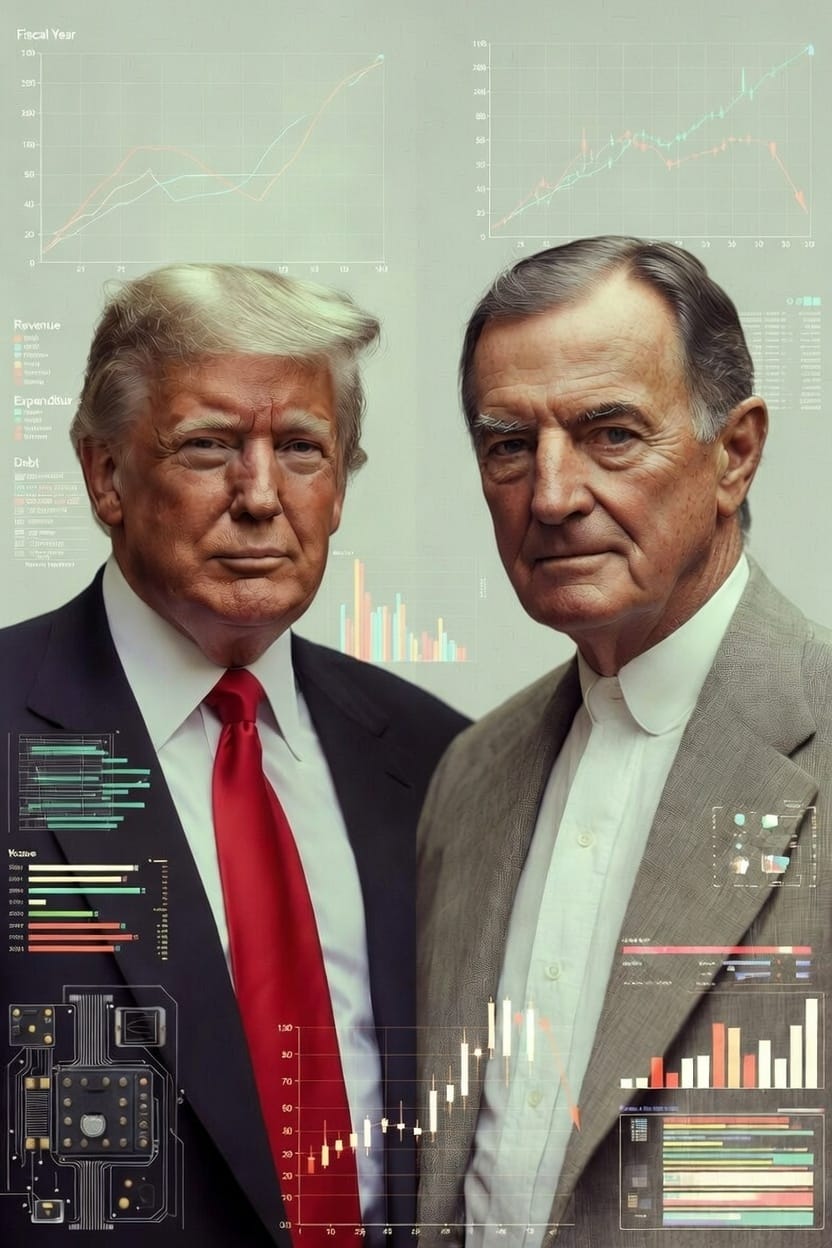
It is a mistake to evaluate President Trump’s second term through the lens of his first. The economic, fiscal, and geopolitical environment of Trump’s initial presidency was shaped by conditions that no longer apply, such as pandemic-era distortions, emergency fiscal expansion, and a global system temporarily suspended by crisis. Those circumstances obscure rather than clarify the strategic architecture now taking shape.
When Trump’s second term is examined on its own terms, a clearer historical parallel emerges. The closest analogue is not Reagan, Nixon, or any postwar president, but Calvin Coolidge in the mid-1920s. This comparison is not rhetorical or ideological. It rests on converging fiscal metrics, shared responses to rising nationalist powers, similar approaches to tariffs and spending discipline, and a common willingness to retrench strategically where American resources no longer generate sufficient return.
The Proper Fiscal Framework: Debt Relative to Wealth
The standard debt-to-GDP metric presents a misleading picture of fiscal sustainability during periods of rapid private wealth creation. By that measure, US federal debt appears historically elevated. But GDP captures annual output, not balance-sheet capacity. What ultimately matters is whether the nation’s accumulated wealth can service its obligations.
Measured properly, the picture changes. Excluding Federal Reserve holdings and intragovernmental IOUs, federal debt held by the public stands near $27 trillion. Total US household wealth exceeds $180 trillion. The resulting debt-to-wealth ratio is approximately 15 percent, or nearly identical to the level prevailing during Coolidge’s presidency in 1926–27.
This convergence is not coincidental. Both periods follow major disruptions, including World War I and the Spanish flu in the 1920s, COVID in the 2020s and both are defined by technology-driven asset booms. In the 1920s, electrification and mass production transformed productivity and asset values. In the 2020s, artificial intelligence, digital platforms, and financial asset inflation have driven similarly rapid wealth accumulation.
The implication is critical: when national wealth expands faster than federal debt, the real burden of debt declines even if nominal borrowing continues. This dynamic allowed Coolidge to reduce debt sustainably without austerity. It is now operating again.
Technology-Led Wealth Growth as the Hidden Stabilizer
In both eras, asset appreciation, not wage growth alone, underpins fiscal resilience. Equity markets, real estate, and business valuations have expanded rapidly, disproportionately benefiting the top deciles of the wealth distribution. This concentration mirrors the 1920s, when private speculation flourished atop sound public finances.
Recent quarterly data show household wealth growing at annualized rates well above federal borrowing. If sustained, this trajectory naturally lowers debt-to-wealth ratios without requiring sharp fiscal contraction. Coolidge relied on this mechanism implicitly; Trump’s second-term framework does so explicitly.
Spending Discipline Through State Retrenchment
Coolidge’s defining fiscal achievement was not tax policy but spending restraint. Federal expenditures were cut by roughly half between 1920 and 1922 and remained tightly controlled throughout the decade. Coolidge left office with a smaller federal budget than when he entered, even as the economy expanded.
Trump’s second term exhibits a structurally similar approach. Large-scale reductions in the federal workforce, exceeding 250,000 positions, represent the most aggressive peacetime contraction of the administrative state in modern history. While near-term savings are limited by deferred resignation programs, the long-term fiscal impact compounds as salaries, benefits, and pension obligations permanently roll off.
The strategy mirrors Coolidge’s philosophy: government should perform core functions efficiently or not at all. Rather than marginal trims, entire offices and agencies are eliminated or consolidated. The objective is not cosmetic deficit reduction but a lasting reduction in the government’s claim on national resources.
Tariffs as Revenue and Leverage
Tariffs form the second pillar of the fiscal architecture. At peak rates, tariff collections have reached an annualized range of $250–500 billion, providing a meaningful, though not standalone, revenue stream. Historically, this approach aligns squarely with Republican economic orthodoxy prior to 1932. The Fordney–McCumber Tariff of 1922 played a similar role under Coolidge, funding tax reductions while preserving budget surpluses.
Trump’s innovation lies in the tactical use of tariffs. Rather than maintaining static protection, tariffs are deployed as leverage—escalated, negotiated, reduced, and reimposed as circumstances require. This flexibility introduces uncertainty, but it also converts market access into a bargaining instrument. Revenue generation, industrial policy, and diplomatic pressure are unified in a single tool.
Politically, tariffs substitute for domestic taxation. Duties are collected at the border from foreign-linked firms, creating fiscal space without direct tax increases. Economically, they shift part of the surplus generated by the US market back to the sovereign that anchors global demand.
Fraud Reduction and Institutional Skepticism
Beyond workforce reductions, the administration’s emphasis on fraud detection and program elimination reflects a deeper institutional skepticism. Offices deemed redundant or misaligned with core state functions are dismantled entirely. This approach echoes Coolidge’s embrace of zero-based budgeting, which required agencies to justify their existence annually rather than rely on precedent.
Whether every cut represents genuine efficiency is debated. What matters structurally is the willingness to remove entire layers of administration rather than manage decline incrementally. That willingness defined Coolidge’s tenure and now defines Trump’s second term.
Capital Inflows: An Advantage Coolidge Did Not Have
One critical difference between the two eras strengthens, rather than weakens, the comparison. Coolidge presided over a period when American capital flowed outward to stabilize Europe through private lending. Trump’s second term has reversed that direction. Over $2 trillion in sovereign wealth commitments from Middle Eastern states are directed toward US energy, infrastructure, and technology investments.
These inflows finance domestic growth without adding to federal debt. They represent a structural advantage unavailable in the 1920s and materially improve the sustainability of the current fiscal model. Foreign capital now bears risk that American taxpayers once carried.
Hemispheric Assertiveness: Nicaragua and Venezuela
Coolidge’s intervention in Nicaragua and Trump’s intervention in Venezuela follow strikingly similar strategic logic. In both cases, drug trafficking and external influence served as justifications. In both, regime change was followed by extended oversight. And in both, the Monroe Doctrine provided the underlying framework for excluding extra-hemispheric powers.
The common interpretation that Coolidge retreated from interventionism rests on a misreading of the Clark Memorandum, which he never published. His actions, maintaining Marine deployments and enforcing hemispheric dominance, tell a different story. Trump’s so-called “Trump Corollary” simply makes explicit what Coolidge practiced implicitly.
China as the Unique Shared Challenge
No president between Coolidge and Trump faced a rising, economically integrated, nationalist China. In the 1920s, Chinese nationalism challenged Western privileges and demanded tariff autonomy. Coolidge balanced deterrence with accommodation, granting tariff sovereignty while protecting American lives and property.
Today’s China presents a broader challenge—economic, technological, military, and ideological, but the structure is similar. Full containment is impossible without self-harm. Trump’s escalation–negotiation–truce model mirrors Coolidge’s balance between pressure and accommodation. No Cold War or post–Cold War analogy fits as closely.
Europe and Strategic Retrenchment
Coolidge supported European recovery because Europe remained central to global stability. Trump’s second term assumes the opposite: Europe is wealthy enough to defend itself but strategically declining relative to Asia. Resources are therefore reallocated toward the Indo-Pacific.
This difference reflects changed global power distributions, not altered philosophy. Both presidents practiced retrenchment, Coolidge by avoiding binding commitments, Trump by forcing burden-sharing and leveraging access. The Greenland episode underscores this approach: leverage replaces subsidy.
Economic Nationalism Restored
Trump’s second-term policies revive a Republican tradition dormant since 1932. Protective tariffs, immigration control, and prioritization of domestic labor markets were once core party tenets. Coolidge articulated them explicitly. Trump operationalizes them under modern conditions.
The break was not Trump from history, but the postwar consensus from earlier Republican orthodoxy.
A Real Historical Rhyme
When measured correctly, excluding Trump’s first term, using debt-to-wealth rather than debt-to-GDP, and recognizing the unique China challenge, the Trump–Coolidge parallel holds. Both pursued spending discipline, leveraged tariffs for revenue and policy flexibility, enforced hemispheric dominance, retrenched strategically in Europe, and governed during technology-driven wealth expansions.
History does not repeat. But in this case, it rhymes closely enough to matter. Coolidge’s framework produced sustained prosperity and manageable debt. The same outcome is not guaranteed, but the structure now in place makes it plausible again.